

Introduction
Picture this: you and your spouse own a 3-bedroom OCR condo bought in 2018 for S$1.3M, now valued around S$1.6M. An agent’s glossy Instagram ad lands in your feed – “Sell 1, buy 2, build wealth faster!” – and suddenly you’re wondering if the math actually works. The promise of going from one home to two properties is one of the most seductive pitches in Singapore real estate marketing, but separating buy two 1 to 2 real estate expansion fact vs marketing myth requires looking past the headlines and into the regulatory, financial, and personal realities that govern every property transaction on this island.
The direct answer: Yes, some couples can realistically expand from 1 to 2 properties – but only if they clear specific financial and regulatory hurdles involving ABSD, TDSR, LTV limits, and CPF refund obligations. Glossy marketing frequently hides the stress-test reality, and for many households, the move creates more risk than reward.
This article focuses on Singapore Citizen couples currently owning one private condo who are exploring whether they can safely split into two properties – whether that means two condos, one condo plus one investment unit, or one home plus one industrial/commercial space. It is not aimed at first-time buyers or overseas markets.
Who should read this: Mid-30s to mid-50s working couples, small business owners, and people considering decoupling or “sell 1, buy 2” strategies – especially those feeling the tension between cash flow constraints, children’s schooling needs, aging parents, and business space requirements.
By the end of this article, you will:
-
Understand the difference between marketing “buy two” pitches and MAS/IRAS/HDB realities
-
Be able to run a simple but robust financial stress test on your current condo and income situation
-
See worked examples with real numbers (e.g. dual-income couple earning S$8k + S$9k, current condo at S$1.6M)
-
Recognize key risks: ABSD, TDSR, interest-rate shocks, vacancy risk, and family-life trade-offs
-
Know when to seek professional advisory for personalised planning
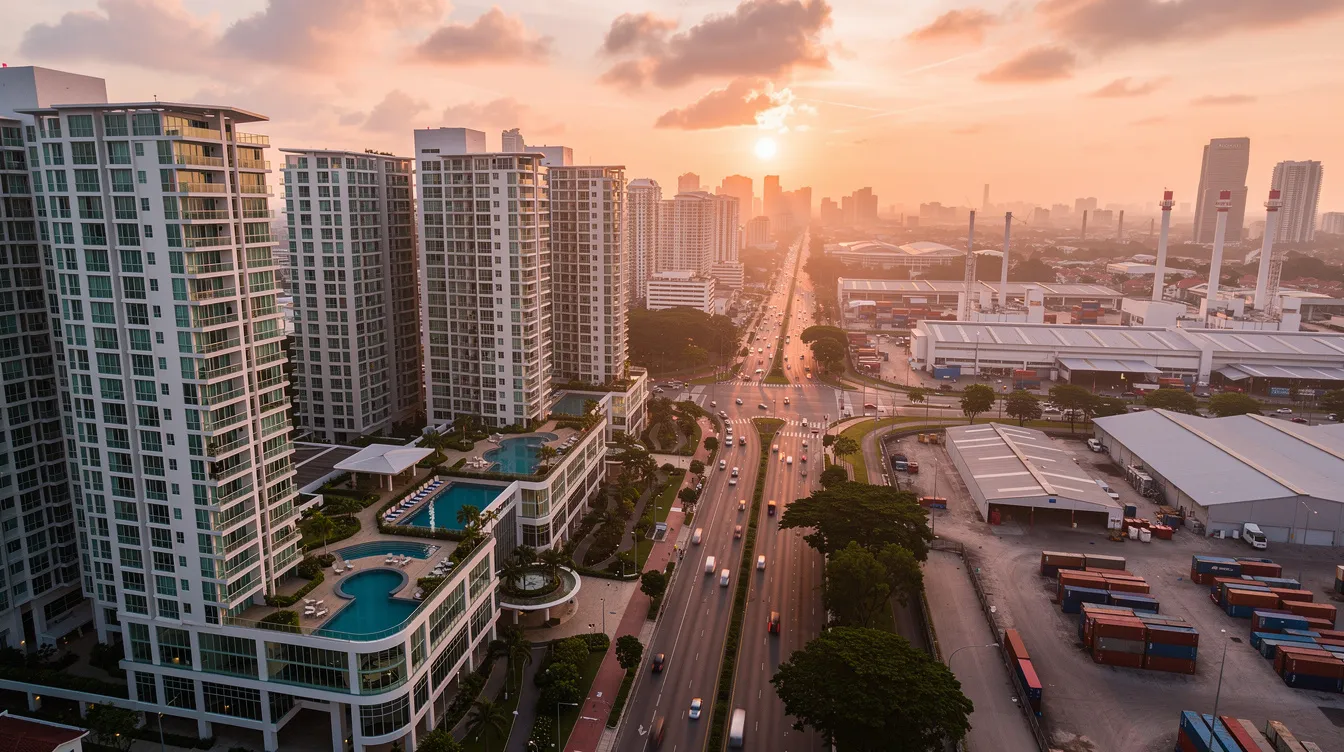
Understanding the “Buy Two from One” Expansion Strategy
In Singapore’s property market, the phrase “buy two from one” typically describes a strategy where a couple leverages their existing single property – through sale proceeds, decoupling, or equity extraction – to end up holding two properties. It sounds elegant in a marketing pitch. The truth is more layered.
What “Buy Two from One” Usually Looks Like in Practice
There are three common structures that agents and property seminars promote:
-
Sell existing condo, buy two smaller units. The couple sells their current home, pockets the equity after loan repayment and CPF refunds, and uses the proceeds plus new loans to purchase two separate condos – often smaller or in more affordable locations.
-
Decouple ownership. Spouse A sells their share to Spouse B at market value. Spouse A, now technically owning zero properties, purchases a second property “as a first-time buyer.” The couple ends up with two properties across two names.
-
Cash-out refinance and buy. The couple refinances their existing condo to extract equity, then uses that cash toward a deposit and stamp duties on a second property – without selling the first.
The objectives behind these moves vary: some couples need separate homes after a separation; others want one owner-occupied home plus one rental for passive income; some are positioning for children’s future schooling locations; and business owners may want to shift from renting a warehouse to owning a B1/B2 industrial unit.
This is where seductive marketing narratives begin – and where the hard facts about what Singapore’s regulatory framework actually allows need to be layered in. Real estate is not always a guaranteed investment, and the structures above each carry distinct costs, risks, and eligibility constraints.
Key Rules that Shape What’s Possible in Singapore
Every “1-to-2” strategy in Singapore runs through a gauntlet of regulatory pillars:
-
ABSD (Additional Buyer’s Stamp Duty): As of the April 2023 revision, Singapore Citizens pay 20% ABSD on their second residential property and 30% on their third. Permanent Residents face 5% on a first property, 30% on the second, and 35% on the third. Foreigners pay a flat 60% on any residential purchase, and entities/trusts pay 65%. Additional buyer stamp duties or higher property tax tiers penalize multiple-property portfolios – this is not a rounding error, it is a structural cost that fundamentally changes the math.
-
TDSR (Total Debt Servicing Ratio): Under MAS guidelines, all monthly debt obligations – housing loans, car loans, credit cards, personally guaranteed business loans – must not exceed 55% of gross monthly income. Every new mortgage must fit within this cap. Banks also stress-test at a qualifying interest rate floor (often 4% or higher), regardless of the actual loan rate.
-
Loan-to-Value (LTV) limits: With no existing housing loan, you can borrow up to 75% LTV. If you already carry a housing loan, the LTV drops significantly – sometimes to 40–50% or lower – dramatically increasing your cash down payment requirement. Stricter lending criteria and higher down payment requirements apply when acquiring a second property.
-
CPF usage and refunds: If the existing condo was purchased using CPF, selling it requires the principal plus accrued interest to be refunded to your CPF Ordinary Account. This reduces the usable equity you walk away with.
These rules interact in ways that can make or break a “buy two” plan. Understanding them at a high level is important, but the next step is separating the most common marketing myths from hard facts before running any numbers.

Marketing Myths vs Hard Facts About Expanding from 1 to 2 Properties
You have likely seen the ads: “Upgrade with no cash!”, “Own 2 condos on the same salary!”, or social media posts from agents pushing aggressive decoupling strategies. Let’s examine the three most common myths and hold them against reality.
Myth 1: “Any Dual-Income Couple Can Comfortably Own Two Properties”
The myth: As long as both spouses work and earn decent salaries, banks will “surely approve” two home loans. The marketing line implies that dual income automatically equals dual property.
The fact: TDSR applies across both spouses’ total debt obligations, not just housing. Consider a couple with a combined gross monthly income of S$17,000. Their maximum allowed monthly debt service under TDSR is S$17,000 × 55% = S$9,350. Now subtract their existing obligations:
-
Current condo mortgage: S$3,500/month
-
Car loan: S$900/month
-
Credit card minimum payments: S$400/month
That leaves only S$4,550 for a second mortgage – and that must be stress-tested at the bank’s qualifying rate (typically 4% or higher), not the promotional rate in the brochure. At a 4% qualifying rate over 25 years, S$4,550/month supports a loan of roughly S$860,000. For a S$1.2M second condo, that means coming up with over S$340,000 in cash for the down payment alone – before ABSD.
Age matters too. If one spouse is 45, maximum loan tenure may be capped at 20 years (to align with the retirement age threshold), pushing monthly instalments higher and reducing the maximum borrowable amount further. All real estate agents are not the same – the ones who gloss over these calculations are doing you a disservice.
Myth 2: “Decoupling Always Saves ABSD and Makes Buying Two a No-Brainer”
The myth: “Sell half your condo to your spouse, free one name, buy another property under the freed name – save hundreds of thousands in ABSD!”
The fact: Decoupling involves one spouse transferring their ownership share to the other at fair market value. This triggers:
-
Buyer’s Stamp Duty (BSD) on the transferred share, calculated on market value
-
Legal fees and valuation costs (typically S$3,000–S$8,000 combined)
-
The receiving spouse must prove they can service the full loan independently under TDSR
-
Cash or CPF to fund the “purchase” of the other spouse’s share
Headline savings vs hidden costs: A couple decoupling a S$1.6M condo may save S$320,000 in ABSD on the second purchase – but the BSD on transferring a 50% share (S$800,000 market value) is approximately S$18,600, plus legal and valuation fees. More critically, the receiving spouse must have sufficient income and cash to accept full ownership, and the “freed” spouse still needs to fund a full down payment for property number two. You do not need a 20% down payment to buy a home in every scenario, but for a second property with existing leverage, banks will often demand 25–45% down.
Important nuance: decoupling is not allowed for HDB flats. For Executive Condos (ECs), it is only possible after the Minimum Occupation Period (MOP) has been satisfied and the unit has been privatised. These restrictions are frequently glossed over in marketing.
Myth 3: “Rental Income from the Second Property Will Cover the Mortgage Easily”
The myth: Buy one more unit, rent it out, and the tenant “pays for your retirement property.” The marketing slides show gross rental yield covering monthly instalments with money to spare.
The fact: Gross rental yields for private residential condos in 2025 averaged roughly 3.29% islandwide, with OCR suburban condos delivering around 3.5–4.5%, RCR city-fringe at 3.0–4.0%, and CCR prime at 2.5–3.0%. But a comprehensive financial analysis should include all expenses beyond just mortgage payments.
For a S$1.2M OCR condo generating 3.8% gross yield, that is approximately S$3,800/month in rent. Now deduct:
-
Property tax (non-owner-occupied rates): ~S$3,600/year or S$300/month
-
MCST maintenance fees: ~S$350/month
-
Vacancy (conservatively 1 month/year): reduces effective annual rent by ~8%
-
Agent commission on new lease: ~1 month’s rent every 2 years
-
Repairs and maintenance: ~S$1,200/year
Net rental income often drops to around 2.0–2.8% of property value. On a S$1.2M unit, that is roughly S$2,000–S$2,800/month. If the mortgage payment at current rates (say 3.5–4.0%) on an S$800,000 loan is approximately S$3,700–S$4,000/month, the buyer faces a monthly cash top-up of S$1,000–S$2,000 – not the self-funding dream the marketing promised.
Buying is not always cheaper than renting, and a rental property is not always cash-flow positive. Leverage can amplify both gains and losses in real estate investments – and when interest rates rise even 1–2%, the gap between rental income and mortgage obligations widens sharply. Cash flow should account for recurring costs like maintenance and property taxes.
The reason you must run a tailored stress test – not rely on generic rental claims – is the bridge to our next section.

How to Run a Realistic 1-to-2 Home Money and Financial Stress Test
This is the core toolkit section. Instead of accepting marketing projections at face value, map your actual numbers to find out whether expanding to two homes is viable or dangerously tight.
Step 1: Establish Your Current Position (Home Value, Loan, Equity)
Before exploring any options, get your baseline right:
-
Estimate current market value of your existing condo using recent comparable transactions from the URA REALIS portal or by requesting an indicative bank valuation
-
Determine outstanding loan amount, current interest rate, and remaining tenure from your latest bank statement
-
Calculate CPF refund obligation: total CPF principal used for the purchase + accrued interest at 2.5% p.a. – this amount returns to your CPF OA upon sale and is not available as cash
-
Compute usable equity: estimated sale price – outstanding loan – CPF refunds – selling costs (agent commission ~2%, legal fees ~S$3,000, potential SSD if within holding period)
Example: For a condo currently worth S$1.6M with an S$800,000 outstanding loan, S$180,000 CPF refund obligation, and ~S$40,000 in selling costs, usable equity is approximately S$580,000. This is the real number – not the S$800,000 “paper gain” that marketing presentations love to show.
Step 2: Define the Two-Home Scenario You Are Actually Considering
Choose a concrete target rather than an abstract goal. The three most common configurations:
-
Scenario A: Two smaller condos (e.g. S$1.0M + S$1.0M) – common in amicable separations where both spouses need independent housing
-
Scenario B: One family home (S$1.5M–S$1.8M) + one compact investment condo or industrial unit (S$800k–S$1.2M) – for couples wanting own-stay plus income or business premises
-
Scenario C: Downsize the owner-occupied home to a cheaper unit and free capacity to buy a higher-yield asset
For each scenario, specify:
-
Target price range and location for each property
-
Whether each property will be owner-occupied or rented out (affects property tax rates and ABSD)
-
Down payment sources (cash, CPF, sale proceeds)
Don’t forget non-financial constraints. Location significantly impacts property value in real estate, but it also determines school distances for children, proximity to elderly parents, and commute times. Property size directly correlates with its market value, but also with your family’s daily quality of life. These are not afterthoughts – they are core decision inputs.
Step 3: Apply TDSR and LTV to Your Future Loans
This is where many “buy two” plans fail the reality check. Work through this systematically:
-
List all monthly debt obligations: existing mortgage, car loans, credit card minimum payments, personal loans, any business loans you have personally guaranteed
-
Calculate TDSR headroom: multiply gross monthly income by 0.55, then subtract all non-housing debt payments – the remainder is the maximum available for housing loan payments
-
Apply the stress-test rate: banks assess affordability at qualifying rates of approximately 4.0–4.5%, not the promotional rate. Use this higher rate for your calculations
-
Determine LTV: if you clear your existing housing loan before the second purchase, you may qualify for up to 75% LTV. If you hold overlapping loans, LTV drops to 40–50% or lower, requiring substantially more cash upfront
|
Factor |
No Existing Loan |
One Existing Loan |
|---|---|---|
|
Maximum LTV |
75% |
40–50% |
|
Minimum cash down payment |
5% (of purchase price) |
25%+ |
|
TDSR impact |
Full headroom available |
Reduced by existing mortgage |
|
Stress-test rate |
~4.0% floor |
~4.0% floor |
Note for business owners: Banks may conservatively discount variable, commission-based, or self-employed income by 20–30% when assessing TDSR. If your declared taxable income fluctuates, expect the bank to use a lower figure than your best year. This is a common reason agents’ quick calculations fall apart when the actual loan application lands.
Step 4: Stress-Test for Interest Rate Shocks and Income Drops
Numbers that work today may not work in 18 months. Test your plan against adversity:
-
Interest rate shock: Model monthly instalments at rates 1–2% higher than current. If your loan is at 3.5% today, calculate payments at 4.5% and 5.5%. A S$900,000 loan over 25 years goes from ~S$4,500/month at 3.5% to ~S$5,400/month at 5.5% – an extra S$900/month that must come from somewhere
-
Income disruption: Model a scenario where one spouse loses income for 3–6 months, or a self-employed borrower sees a 20–30% revenue decline for a full year
-
Emergency buffer: Determine whether you hold at least 6–12 months of combined mortgage payments plus core living expenses in accessible cash or near-cash – not locked in CPF, not in illiquid assets
A 10% decline in property value can significantly reduce equity due to leverage effects. If both properties are purchased with high leverage and prices soften, you could find yourself in negative equity on one or both units while still servicing two large monthly payments.
Couples should only proceed if they can survive these adverse scenarios without a forced sale. Patience in stress-testing now saves enormous pain later.
Structuring the Move from One to Two Homes: Options and Trade-Offs
Numbers alone are not enough – the structure and timing of the move matter as much as the financial capacity. Here are the three primary paths, with honest trade-offs.
Option 1: Sell First, Then Buy Two Properties
This path suits couples with limited cash reserves who need the sale proceeds from their existing condo to fund both down payments. It is also the cleanest way to minimise ABSD exposure, since you can time each purchase to occur when you own zero or one property.
Pros:
-
Cleaner balance sheet; easier to keep TDSR under control
-
Potentially higher loan eligibility for each individual purchase
-
No double-mortgage period (reduces cash flow strain)
Cons:
-
Temporary renting between the sale and purchases – added cost and inconvenience of moving twice
-
Market risk: property prices may rise while you are “out” of the market
-
Time pressure to find and secure two suitable properties while managing sale completion
This is the most conservative path and often the most practical for salaried couples with moderate savings. You can negotiate the price of a home more effectively when you are not under pressure from an overlapping sale-and-purchase timeline.
Option 2: Decouple and Retain Existing Condo While Buying a Second
In this structure, one spouse sells their share to the other at market value. The selling spouse, now owning zero properties, purchases a second property as a “first-time buyer” – potentially sidestepping ABSD if they are a Singapore Citizen.
This approach preserves your existing home but creates higher leverage and a more complex loan structure. Both spouses are now individually carrying significant mortgage obligations, and concentration risk increases if both properties are in similar segments or locations. Diversification doesn’t occur automatically with multiple properties in the same region – you need to intentionally choose different asset types or geographies.
Common decoupling pitfalls to watch for:
-
The receiving spouse may not qualify to take over the full loan independently under TDSR
-
BSD on the transfer is a real cost, not a rounding error
-
If the “freed” spouse’s income is variable or lower, their borrowing capacity for the second property may be disappointing
-
Loan tenures must be matched to retirement horizon and children’s life stages – a 20-year loan starting at age 47 extends to 67
It is important to match this strategy with realistic income projections and to accept that you are increasing total household leverage substantially.
Option 3: Reposition into One Home + One Business/Industrial Property
For business owners – particularly those running logistics, e-commerce, fabrication, or creative studios – there is a compelling way to go from renting commercial space to owning it. This means using equity in the existing condo to acquire a B1 or B2 industrial unit that doubles as business premises and a long-term investment.
Unique considerations:
-
Industrial/commercial property loans typically carry higher interest rates (floating SORA + 0.7–0.9% or more), shorter tenures, and different LTV limits compared to residential. Some banks like OCBC offer up to 80% LTV for owner-occupied commercial property, but underwriting is stricter
-
CPF cannot be used for industrial or commercial unit purchases – the entire down payment must come from cash
-
Property tax rates, GST treatment, and zoning/usage controls differ significantly from residential
-
Higher potential yields (4–6% gross for some industrial segments) but also higher volatility and lower liquidity on resale
-
Owners must hire professional property management earlier than expected if the unit is leased to third-party tenants
Vignette: Consider an SME owner currently paying S$4,500/month to rent a B1 unit. Purchasing a S$900,000 unit with a 70% LTV business property loan at 4.5% over 20 years means monthly instalments of approximately S$3,990. The money previously spent on rent now builds equity – though maintenance, property tax, and compliance costs must be factored in. Property condition affects its valuation significantly, particularly for industrial assets where wear and tear is higher.
Comparison Overview: Which Path Fits Which Buyer or Couple?
|
Criterion |
Sell-Then-Buy-Two |
Decouple + Buy 1 More |
Home + Industrial/Commercial |
|---|---|---|---|
|
Upfront cash/CPF needed |
Moderate (from sale proceeds) |
High (BSD, legal, down payment for second) |
High (no CPF for industrial; cash only) |
|
ABSD exposure |
Manageable if timed correctly |
Potentially avoided for SC “first-time” buyer |
Lower (ABSD does not apply to industrial) |
|
Risk level |
Low–Medium |
Medium–High (dual leverage) |
Medium–High (business income variability) |
|
Best suited for |
Conservative salaried couples |
High-income dual-earner couples |
SME owners wanting to own business premises |
|
Nearby amenities impact |
Relevant for both units |
Relevant for residential; less for investment |
Less relevant for industrial; critical for home |
If you see yourself in one of these profiles, the next section provides concrete, number-based case studies to learn from.
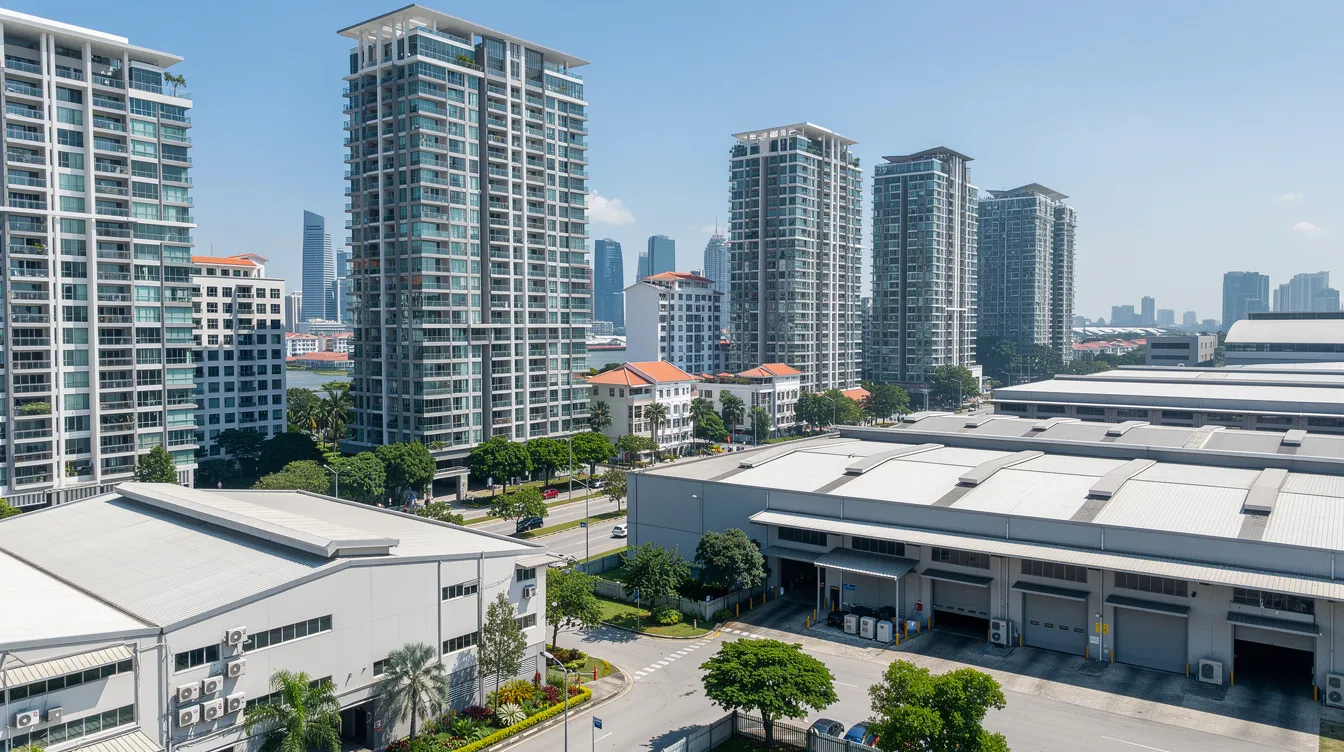
Realistic Case Studies: From One Central Condo to Two Homes
These examples use 2025–2026 market conditions to show where the numbers work, where they strain, and where they break.
Case Study 1: Amicable Split – Turning One OCR Condo into Two Smaller Homes
Profile: Married Singapore Citizen couple, both 40, combined income S$17,000/month (S$8,000 + S$9,000). Two children. Own a 3-bedroom OCR condo bought in 2018 for S$1.3M, now worth S$1.6M, with S$800,000 loan outstanding. CPF refund obligation: ~S$150,000.
The scenario: They agree to separate and each needs an independent home. They sell the current unit.
-
Net sale proceeds: S$1,600,000 – S$800,000 (loan) – S$150,000 (CPF refund) – S$40,000 (agent, legal, misc) = S$610,000
-
Split between spouses: ~S$305,000 each
-
Each targets a S$1.0M OCR condo
Spouse A (earns S$8,000/month):
-
Maximum TDSR: S$8,000 × 55% = S$4,400/month for all debt
-
No car loan → full S$4,400 available for mortgage
-
At 4% stress-test rate over 25 years: maximum loan ~S$830,000
-
Down payment needed for S$1.0M unit: S$170,000 minimum (assuming no existing loan, 75% LTV, plus BSD ~S$24,600)
-
Total cash needed: ~S$195,000 – achievable from S$305,000 share
-
Monthly instalment at 3.8% actual rate: ~S$4,300 – this consumes nearly all TDSR headroom
Verdict: Technically feasible, but extremely tight. Spouse A has almost zero margin for car payments, credit card debt, or any income disruption. A brand new expense like childcare or school fees could tip the balance. Buying two properties can magnify financing and vacancy risks – here, the risk is purely on the financing side, with no rental income cushion.
Case Study 2: One Home + One Rental Investment (Minimal Stress) – When It Actually Works
Profile: Singapore Citizen couple, 38 and 36, combined income S$25,000/month. No car loans, strong cash buffer of S$350,000. Own a fully paid-up 2-bedroom RCR condo worth S$1.4M.
The scenario: Keep current unit as own-stay. Buy a S$1.2M OCR investment condo.
-
ABSD on second property: S$1.2M × 20% = S$240,000
-
Down payment: 25% of S$1.2M = S$300,000 (given first property still owned, LTV limited)
-
BSD: ~S$31,800
-
Total upfront cash needed: ~S$572,000 – within reach with savings plus partial CPF
-
Loan quantum: S$900,000 at 4% over 25 years = ~S$4,750/month
-
TDSR check: S$25,000 × 55% = S$13,750 headroom; S$4,750 mortgage uses 35% – comfortable
Rental estimate: S$1.2M OCR condo at 3.5% gross yield = S$3,500/month. After property tax, MCST, vacancy, agent fees, and maintenance, net income: ~S$2,500/month. Monthly top-up required: ~S$2,250.
Verdict: This works – but only because the first home is fully paid up, income is strong, and the couple has substantial cash reserves. The S$2,250 monthly top-up is manageable, and they can absorb interest rate increases of 1–2% without distress. This is the exception, not the rule. Market trends influence property valuation over time, and this couple has the patience and buffer to weather short-term fluctuations.
Case Study 3: Home + Industrial Unit for a Business Owner – Balancing Risk and Flexibility
Profile: Singapore Citizen couple, 45 and 42. Spouse A is salaried (S$9,000/month). Spouse B runs a light manufacturing SME (averaging S$12,000/month taxable income over three years). Own a S$1.5M resale condo with S$600,000 remaining loan. Currently renting a small B1 unit for S$4,200/month.
The scenario: Refinance the condo to extract equity, then acquire a S$900,000 B1 industrial unit to own business premises.
-
Condo equity: S$1.5M – S$600,000 = S$900,000 in paper equity. Cash-out refinance at 75% LTV = S$1,125,000 loan; net cash released = S$525,000 (after repaying existing S$600,000 loan)
-
Industrial unit financing: Banks may offer 70–80% LTV for owner-occupied business property. At 70% LTV on S$900,000 = S$630,000 loan; down payment = S$270,000 cash (no CPF allowed for industrial). Interest rate: ~SORA + 0.9%, estimated 4.2–4.5% over 20 years
-
Monthly industrial loan instalment: ~S$3,900/month
-
New residential mortgage (after refinance to S$1,125,000 at 3.8% over 20 years – tenure limited by Spouse A’s age): ~S$6,700/month
-
Combined monthly debt service: ~S$10,600
-
TDSR check: Combined income S$21,000 × 55% = S$11,550. But banks may discount Spouse B’s variable income by 30%, treating it as S$8,400 → adjusted combined income S$17,400 × 55% = S$9,570. The plan may not pass TDSR.
Verdict: This is a realistic view of the challenge business owners face. The offer of “own your premises instead of renting” is compelling, but bank underwriting of self-employed income is conservative. Solutions include increasing Spouse A’s declared income, reducing the industrial loan quantum, or finding a cheaper unit. Geographic and asset concentration often remains high with multiple properties unless intentionally diversified – owning both a residential condo and an industrial unit in the same district creates location-specific risk.
Common Pitfalls and How to Avoid Them in 1-to-2 Expansion
Many failed “buy two” plans did not fail because of the properties themselves, but because of overlooked details and over-optimism. Here are the most relevant pitfalls people encounter.
Pitfall 1: Ignoring Liquidity While Focusing Only on Paper Net Worth
Couples may end up asset-rich but cash-poor – with two large loans, rising maintenance costs, and insufficient buffer to handle a car repair, medical bill, or school fee increase. The exchange of cash for bricks feels like progress, but illiquid wealth cannot pay next month’s mortgage.
Solution: Insist on maintaining a minimum cash reserve of 6–12 months of all mortgage obligations plus core living expenses before committing. If buying the second property would drain reserves below this floor, the timing is wrong – no matter how attractive the deal looks.
Pitfall 2: Over-Relying on Best-Case Rental and Occupancy Assumptions
Marketing projections typically assume 100% occupancy, market-rate rent from day one, and no maintenance surprises. Reality includes units that take 2–3 months to find a tenant, tenants who leave mid-lease, and unexpected repair costs. Nearby amenities can enhance property value, but they don’t guarantee occupancy.
Solution: Use rental projections that are 10–15% below current market rates. Factor in at least 1 month of vacancy per year. Budget for property tax at non-owner-occupied rates and agent commissions of one month’s rent per lease cycle. If the numbers only work under perfect conditions, they don’t actually work.
Pitfall 3: Overlapping Timelines and Double ABSD Traps
Buying before selling can trigger full ABSD upfront – which is only remitted if the sale of the original property completes within a strict timeline (typically 6 months for the old property). Delays due to buyer financing issues, legal complications, or market slowdowns can leave you holding an ABSD bill of hundreds of thousands with no save available.
Solution: Sequence transactions conservatively. Understand IRAS remission timelines precisely. Have a contingency plan – including bridge financing or a price reduction on the existing unit – if the sale falls through or delays. The time pressure of overlapping transactions is one of the most underestimated risks in this strategy.
Pitfall 4: Not Aligning Property Decisions with Life Events
A second property purchase locks up capital and borrowing capacity for years. If children are changing schools in two years, if elderly parents may need to move in, or if one spouse is planning a career switch or business pivot – these life events can make an otherwise sound two-property structure deeply inconvenient or financially dangerous.
Solution: Before committing, map the next 5–10 years of major life events as a couple. Test whether the two-home structure supports or constrains those plans. If you cannot clearly view how both properties serve your life – not just your balance sheet – reconsider.
Conclusion and Next Steps
Moving from one central condo to two homes is sometimes feasible – but it is rarely as simple or painless as marketing makes it appear. The myth that any dual-income couple can comfortably hold two properties crumbles under the weight of ABSD at 20%, TDSR caps at 55%, reduced LTV on second loans, and the reality that rental yields in Singapore rarely cover full mortgage costs after expenses.
The “right” answer depends on income stability, age, loan headroom, the desired property mix (residential vs industrial), and your tolerance for volatility. People who succeed at this strategy typically share a few traits: they have strong cash reserves, low existing debt, clear reasons for the expansion beyond “wealth building,” and the patience to choose the right time rather than the exciting time.
Your concrete next steps:
-
List all current loans and calculate your TDSR headroom using the framework in Step 3 above
-
Define your desired two-property configuration with approximate price ranges and locations – be specific, not aspirational
-
Run at least one “bad year” stress test: higher interest rates (+1.5%), income drop (–20%), plus one month of vacancy
-
Discuss non-financial priorities as a couple: schooling, business plans, proximity to family, and lifestyle preferences
-
Seek professional advisory services for a detailed, customised 1-to-2 property feasibility review, including industrial or commercial options where relevant
Related topics worth exploring next: upgrading vs right-sizing your single property, industrial vs residential yield profiles in current market conditions, and the full legal mechanics of decoupling vs co-ownership structures.
Additional Resources and Tools
To run your own analysis with current data:
-
IRAS Stamp Duty page – latest ABSD and BSD rates for residential, industrial, and commercial properties
-
MoneySense property affordability guide – official explanation of TDSR and LTV guidelines from the Singapore government
-
URA REALIS – transaction and rental data for checking recent condo and industrial property prices
Frequently Asked Questions:
Can we still buy two if one of us is self-employed? Yes, but banks will typically assess self-employed income conservatively – often using a 2–3 year average of taxable income, discounted by 20–30%. This significantly reduces borrowing capacity. Prepare comprehensive tax documentation and work with a mortgage specialist who understands business income structures.
What if we plan to return to a single home later? Selling the second property triggers its own costs (agent fees, potential SSD, capital gains considerations for non-residential). If the “buy two” phase is intended as temporary – say, 3–5 years – model the round-trip transaction costs before deciding. Often, the stamp duties and fees consumed on entry and exit erode much of the financial benefit.
Is an industrial unit a better investment than a second condo? It depends on your profile. Industrial units can offer higher gross yields (4–6%) and are exempt from ABSD, but carry higher interest rates, no CPF usage, shorter lease terms, stricter zoning, and lower resale liquidity. They work best for business owners who will occupy the space and capture the rent savings directly.

