

Introduction
Owning two private properties in Singapore is a significant investment that demands far more than bank approval – it requires meeting a precise set of essential pre-requisites before owning 2 private properties in Singapore. This article provides a numbers-based checklist covering emergency funds, total gearing ratio, holding costs, rental yields, and the regulatory framework that governs every second property purchase in 2026.
This guide is written for Singapore citizens, permanent residents, and foreigners who already own (or are about to own) one private property and are weighing a second. It is especially relevant for investors, business owners holding industrial or commercial assets, and upgraders planning for family needs. The scope is strictly financial readiness and regulatory compliance – not a property search guide or a step-by-step buying walkthrough.
Here is the direct answer: before you buy a second private residential property, you must confirm that you hold a 12–24 month emergency buffer (covering both personal expenses and property cash outflows), that your total gearing ratio sits within a prudent band, that your cash flow remains positive even when stress-tested at 4.0%–4.5% interest rates, that your rental yield assumptions survive a 10–15% rent decline, and that you fully understand the current ABSD, LTV, and TDSR rules.
By working through this article, you will gain:
-
A clear numeric checklist to test whether you are financially ready to own two private properties.
-
A method to calculate your total gearing ratio and assess safe leverage levels in Singapore’s context.
-
A framework to quantify all holding costs – including additional buyer’s stamp duty, interest, property taxes, and maintenance fees – and stress-test them against rate hikes.
-
A sensitivity-testing approach for potential rental yield before committing capital.
-
Guidance on when to engage an advisor like AESTHETIC HAVENS for portfolio-level scenario planning across residential and industrial assets.
Understanding the Core Pre-Requisites for Owning 2 Private Properties
In this context, “pre-requisites” are the specific financial cushions, leverage limits, and regulatory conditions that should be firmly in place before a second private property purchase. They are not aspirational goals – they are non-negotiable checkpoints that separate a calculated investment from a speculative gamble.
Owning two private residential properties is fundamentally different from owning one. The additional buyer’s stamp duty alone can add hundreds of thousands of dollars to your upfront outlay. Loan to value caps tighten, the total debt servicing ratio becomes harder to clear with existing obligations, and your exposure to market corrections and interest-rate movements doubles. A single vacant unit is manageable; two simultaneously vacant units can drain reserves rapidly.
The rest of this article is built on four pillars:
-
Emergency funds and liquidity buffer – your first line of defence against forced sales.
-
Total gearing ratio and loan eligibility – ensuring leverage stays within a sustainable band.
-
Accurate computation of recurring holding costs – every dollar out the door, mapped and stress-tested.
-
Evidence-based rental yield and cash flow projections – grounded in actual 2026 data, not wishful thinking.
Regulatory Framework You Must Clear First
Before evaluating personal financial metrics, you must understand the regulatory landscape governing additional property purchases in Singapore.
ABSD rates (as of 2026): ABSD rates were last adjusted on 27 April 2023. A Singapore Citizen buying a second residential property pays 20% of the higher of purchase price or market value. Singapore permanent residents face 30% for their second property. Foreigners pay 60% on any residential acquisition, while entities and trustees may face rates as high as 65%. ABSD is a tax on residential property purchases in Singapore, and ABSD increases with each additional property purchase – it also applies to both local and overseas property ownership. A potential remission exists for married couples where at least one spouse is a Singapore Citizen: if the first property is sold within six months of buying the second jointly, the ABSD paid can be refunded.
Loan to value (LTV) limits: The maximum loan-to-value ratio for second properties is 45% for loans with tenure up to 30 years where the borrower is under 65. If the loan tenure exceeds 30 years or extends past the borrower’s 65th birthday, the LTV ratio drops to 25%. A second property requires a 25% cash down payment – you need at least 25% of the property’s price in cash or CPF. If a buyer has an outstanding housing loan on their first property, it affects their borrowing capacity for the second property.
Total debt servicing ratio (TDSR): The total debt servicing ratio is capped at 55% of gross monthly income. All existing debt payments – housing loan instalments, car loans, personal loans, credit card minimums – plus the projected new mortgage payment must cumulatively remain at or below this threshold. The regulatory stress-test interest rate floor is 4.00% p.a. for private residential bank loans, meaning affordability is assessed at this rate even if your contracted rate is far lower.
Before proceeding, verify the following from official sources:
-
Your applicable buyer ABSD rates based on residency status and number of existing residential properties (IRAS).
-
LTV and down payment requirements for your second housing loan (MAS).
-
Whether any HDB, executive condominiums, or Minimum Occupation Period (MOP) restrictions apply – HDB owners must fulfill a 5-year Minimum Occupation Period before buying again, and Singapore Permanent Residents must vacate their HDB flat within 6 months of buying a private property.
-
Eligibility criteria for any ABSD remission schemes.
Risk Profile and Investment Objective Alignment
Investors should clarify their objective for buying a property before committing capital. A second private property should serve a clear purpose that aligns with your risk profile:
-
Pure investment – targeting rental income, capital appreciation, or both. The investment horizon typically needs to be 7–10 years minimum to absorb stamp duties and transaction costs.
-
Future own-stay – upgrading, or purchasing for children or parents. This changes the yield equation because the property may not generate rental income.
-
Business-use adjacency – some property owners combine a residential unit with an industrial or commercial asset tied to business operations, diversifying income streams.
Conservative investors may limit gearing below 50% and insist on positive cash flow even under stressed interest rate scenarios. More aggressive buyers may accept temporary negative cash flow in exchange for long-term capital appreciation, but only with a substantially bigger cash buffer. Understanding market conditions can provide a significant investment advantage, and investors should analyze historical price trends for properties in their target segments. Residential property prices in Singapore have shown persistent growth, but past performance does not guarantee future returns – Singapore’s property market requires careful timing for purchases.
AESTHETIC HAVENS typically helps clients frame these objectives within a portfolio context, particularly where industrial, commercial, and residential holdings intersect, ensuring that a second home purchase does not create unintended concentration risk.
Emergency Funds and Liquidity: Your First Line of Defence
Liquidity is the first pre-requisite because property is inherently illiquid. Selling a private property under duress in Singapore often means accepting price discounts, and the transaction itself – from listing to completion – can take months. Your emergency fund is the difference between a strategic hold and a forced sale.
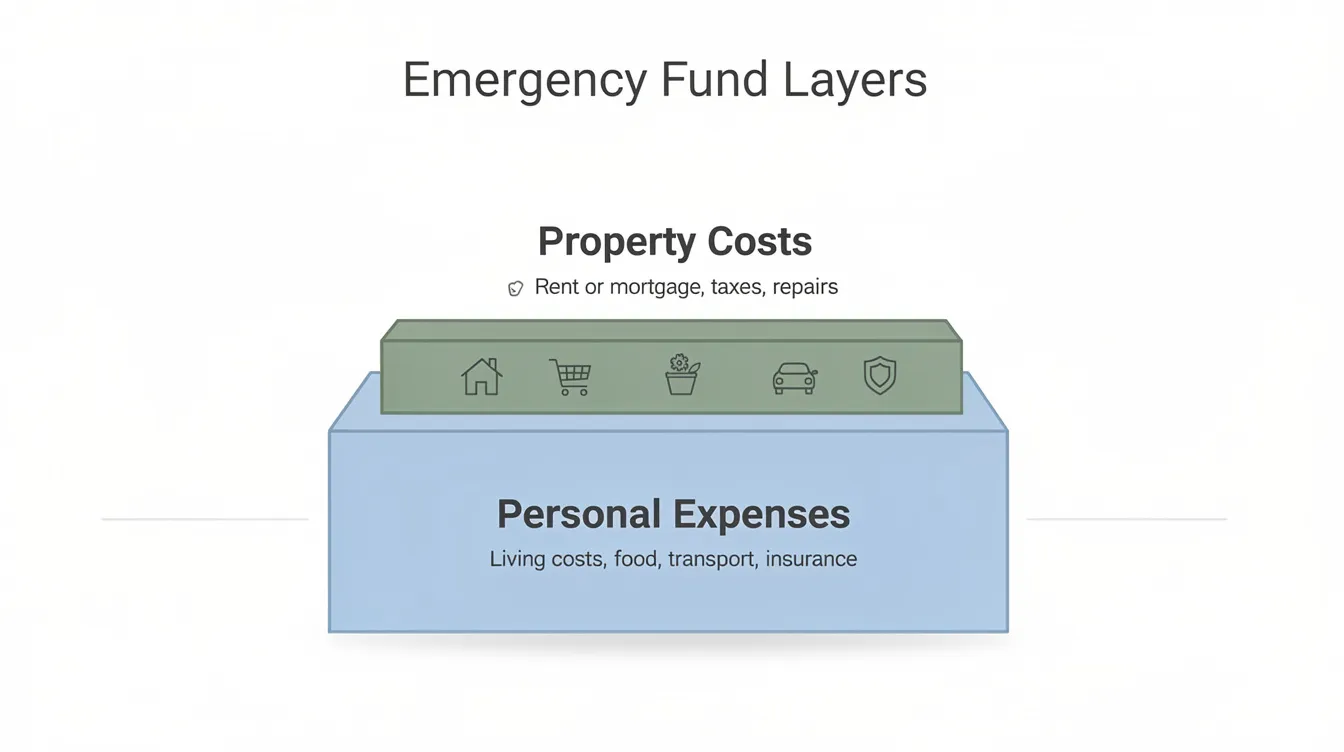
There are two distinct layers to consider:
-
Standard personal emergency fund: 6–12 months of household living expenses unrelated to property.
-
Property-specific emergency buffer: covering both properties’ net cash outflows (mortgage payments minus rental income, plus maintenance, tax, and insurance) for 12–24 months.
Calculating a Proper Emergency Fund for 2 Properties
Here is a clear method to compute your target buffer:
-
Step 1: Add up 12 months of household living expenses (excluding all property-related payments). If your household spends S$5,000/month on food, transport, education, and other essentials, that is S$60,000.
-
Step 2: Calculate the net monthly cash outflow for each property. This is: mortgage payment + maintenance fees + property taxes + insurance − rental income (if any). Sum both properties’ net outflows, then multiply by 18 months (a prudent midpoint in the 12–24 month range).
-
Step 3: Keep the total in liquid or near-liquid instruments – cash deposits, high-liquidity money market funds, or very short-term T-bills. Avoid locking funds in assets that impose penalties or delays on withdrawal.
Concrete example:
-
Household expenses: S$5,000/month
-
Property A net cash outflow (owner-occupied, no rental income): S$1,500/month
-
Property B projected net cash outflow (investment property, rental income partially offsets costs): S$2,000/month
-
Target buffer: (S$5,000 × 12) + (S$3,500 × 18) = S$60,000 + S$63,000 = S$123,000
CPF Ordinary Account savings can be used for certain property-related costs, but strict limits apply for subsequent properties. CPF OA savings are not immediately liquid and should not be counted as primary emergency cash. The withdrawal limit and eligibility requirements tied to the property’s valuation limit further restrict access. Your buffer must be in genuinely accessible form.
Liquidity Traps to Avoid Before Buying a Second Property
Even well-prepared buyers fall into these traps:
-
Draining cash for ABSD and down payment. For a S$2,000,000 property purchase, a Singapore Citizen pays S$400,000 in ABSD alone, plus the 25% down payment. If this consumes nearly all available cash, there is no safety margin.
-
Over-reliance on variable income. Bonuses, commissions, and business distributions fluctuate. Basing monthly mortgage payments on peak-year income is dangerous.
-
Assuming rapid liquidation. Believing you can quickly sell one property if needed ignores listing time, negotiation, the buyer’s own financing timelines, and the potential for sellers to be subject to Seller’s Stamp Duty if they sell a property within three years of purchase.
Safe thresholds to apply:
-
Minimum 6 months of total buffer is risky for leveraged investors; 12–24 months is prudent.
-
If your buffer would fall below target after paying ABSD and down payment, pause the purchase or reduce the property budget.
-
Run a simple internal “liquidity stress test”: assume your income drops 30% and one property sits vacant for three months. Can you still cover all obligations?
Total Gearing Ratio and Loan Eligibility for Two Properties
Once liquidity is confirmed, the next pre-requisite is ensuring your leverage stays within a sustainable band. Singapore’s cooling measures impose regulatory guardrails via TDSR and LTV, but prudent investors go further by tracking their personal total gearing ratio.
Total gearing ratio is straightforward: total property loans outstanding ÷ total net worth, expressed as a percentage. It captures what the regulatory tests do not – your overall vulnerability to a simultaneous drop in property value and income.
How to Compute Your Total Gearing Ratio
Follow this step-by-step method:
-
Step 1: Sum all outstanding property loans – residential, investment property, industrial, and commercial.
-
Step 2: Estimate total net worth = total assets (cash, CPF monies, investment portfolios, properties at conservative valuation) minus total liabilities (all loans, credit lines, outstanding debts).
-
Step 3: Total gearing ratio = (Total property loans ÷ Net worth) × 100%.
Concrete numeric example:
-
Net worth: S$2,000,000
-
Existing mortgage on first property: S$700,000
-
Planned second property mortgage: S$800,000
-
Total property loans: S$1,500,000
-
Gearing ratio: 75% (1.5M ÷ 2.0M)
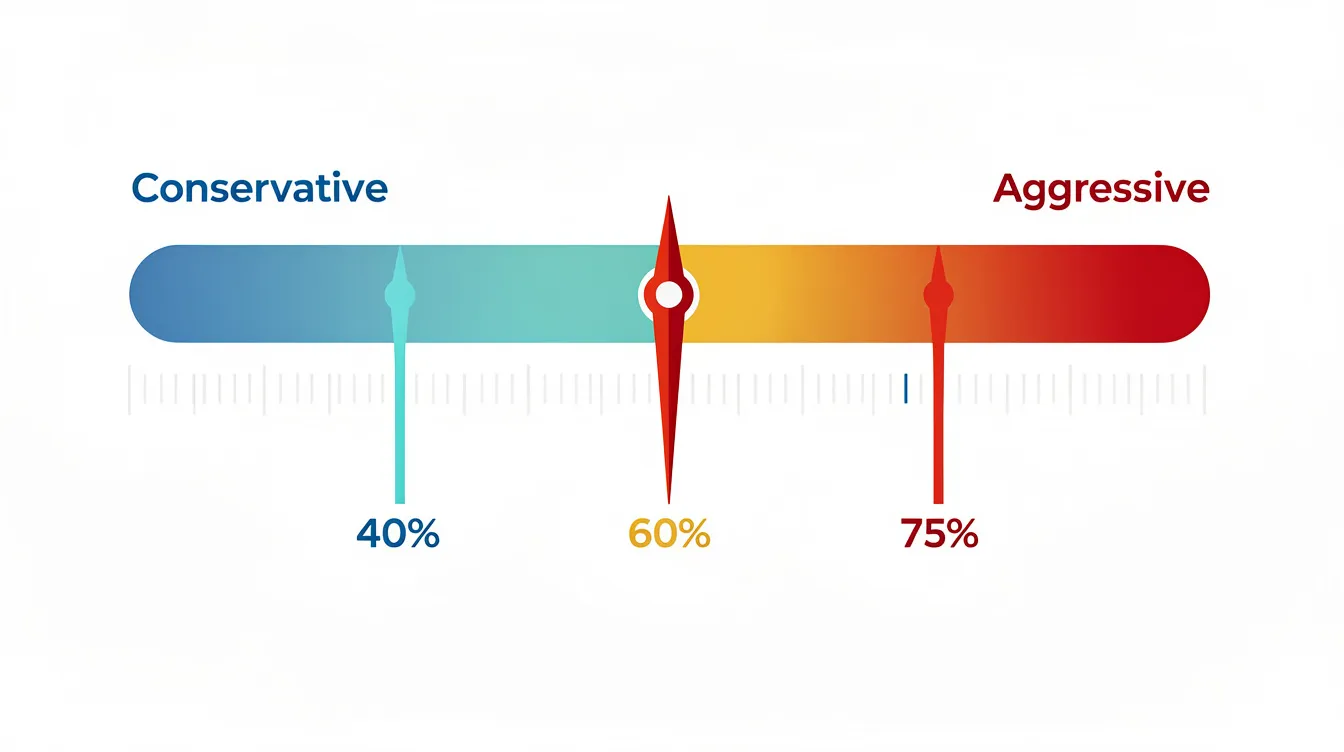
What do the ranges mean?
-
Below 40%: Conservative. Strong cushion against property value drops and income disruption.
-
40–70%: Moderate. Requires stable income and a meaningful cash buffer.
-
Above 70%: Aggressive and vulnerable to shocks. A 20% decline in property prices could push this borrower toward negative equity territory.
Regulatory Tests: TDSR and LTV for a Second Housing Loan
The 2026 rules remain firm. The total debt servicing ratio is capped at 55% of gross monthly income, and the LTV ratio for second property is 45% for 30 years or shorter tenure.
Scenario walkthrough:
-
Household gross monthly income: S$15,000
-
Maximum total monthly debt servicing (55%): S$8,250
-
Existing property instalment: S$3,500
-
Car loans: S$800
-
Remaining capacity for second housing loan: S$8,250 − S$3,500 − S$800 = S$3,950/month
At a stress-test rate of 4.00% with a 30-year loan tenure, S$3,950/month supports a bank loan of approximately S$827,000. With LTV capped at 45%, the maximum property value you could target is roughly S$1,838,000 – before factoring in ABSD and other upfront costs from your cash reserves.
There is a critical distinction between what the bank says you qualify for and what is prudent for your risk profile. Loan eligibility does not equal financial readiness. The bank’s approval is a ceiling, not a recommendation.
Comparison: Conservative vs Aggressive Leverage Profiles
|
Criterion |
Conservative Profile |
Aggressive Profile |
|---|---|---|
|
Target gearing ratio |
Below 40–50% |
60–75% |
|
Cash buffer |
18–24 months |
6–12 months |
|
Reliance on rental income |
Minimal; can service without rent |
Significant; needs rental income to break even |
|
Acceptable negative cash flow |
None |
Up to S$2,000–3,000/month temporarily |
|
Stress-test interest rate |
4.5–5.0% |
3.5–4.0% |
|
Income stability requirement |
Moderate (salaried is sufficient) |
High (must have very stable or multiple income streams) |
Identify which column you are closer to. If you are between the two, default toward the conservative side – property is a long-duration asset, and the costs of over-leverage are asymmetric.
Breaking Down Holding Costs for Two Private Properties
Understanding all-in holding cost is an essential pre-requisite that many buyers underestimate. The purchase price is only the starting line. Every month you own a property in Singapore, recurring costs accumulate – and for two private residential properties, small underestimates compound into meaningful annual shortfalls.
Common recurring and one-off costs specific to Singapore include:
-
Mortgage principal and interest (monthly mortgage payments)
-
Additional buyer’s stamp duty (ABSD) and buyer’s stamp duty (BSD) – mentally amortised over the holding period
-
Property taxes for owner-occupied vs non-owner-occupied units (the property tax rate for non-owner-occupied residential properties can reach progressive rates starting at 12%)
-
Condo maintenance fees, sinking fund contributions, and MCST charges
-
Insurance, repairs, vacancy allowance, and agent leasing fees
-
Legal fees at a conveyancing lawyer’s office, valuation fees, and renovation
Itemising Monthly and Annual Holding Costs
Here is a worked example for one investment property – a mass-market condo purchased at S$1,500,000:
-
Mortgage (S$675,000 loan at ~2.5%, 25-year tenure): ~S$3,030/month
-
Maintenance fees: S$350/month
-
Property taxes (non-owner-occupied): ~S$4,000/year ≈ S$333/month
-
Vacancy and repair allowance: S$250/month
-
Total monthly holding cost: ~S$3,963
Now extend this to two properties. If your owner-occupied first property costs S$3,800/month (mortgage plus maintenance and taxes) and your investment property costs S$3,963/month, combined monthly holding costs reach S$7,763 – before accounting for any vacancies or unexpected repairs.
A S$200 underestimate per property per month adds up to S$4,800/year. Over a 10-year investment horizon, that is nearly S$50,000 of unplanned cash drain.
Stress-Testing Holding Power Under Different Interest Rates
The 2022–2025 interest rate cycle was a sharp reminder that rates can move significantly. In mid-2026, current headline home loan rates have dropped toward 1.40%–1.50% p.a. for many bank loan packages. But the regulatory stress test at 4.00% exists for good reason – and prudent buyers should stress-test even higher.
Impact of rate changes on a S$900,000 loan (30-year tenure):
|
Interest Rate |
Monthly Instalment |
Annual Difference vs Base |
|---|---|---|
|
2.5% (base) |
~S$3,555 |
– |
|
4.0% (stress floor) |
~S$4,295 |
+S$8,880/year |
|
5.0% (severe stress) |
~S$4,831 |
+S$15,312/year |
The jump from 2.5% to 5.0% adds over S$1,275/month per property. For two properties with similar loan sizes, that is an additional S$2,550/month – easily flipping a lightly positive net cash flow into a deeply negative one.
Rule of thumb: only proceed if both properties remain serviceable – with buffer – even at the 4.0% stressed interest rate. If your cash flow turns negative under that scenario, reduce the loan quantum or reconsider timing.
Tax, Legal and Transactional Cost Considerations (Including ABSD)
Key Singapore-specific cost items for your second property purchase:
Buyer’s Stamp Duty (BSD): A progressive tax of up to 6% applied to the purchase price or market value, whichever is higher. Buyer’s stamp duty ABSD is an additional layer charged on top of BSD.
ABSD quantum example: For a Singapore Citizen buying a second residential property at S$2,000,000, ABSD at 20% equals S$400,000. You need S$200,000 ABSD for a S$1 million condo purchase. For a PR buying a second property at the same price, ABSD at 30% equals S$600,000. Buyers may consider strategies like decoupling to optimise additional buyer’s stamp duty liabilities, though these carry their own legal and financial implications.
Legal and transaction costs: Legal fees at your lawyer’s office (S$2,500–S$5,000), valuation fees (S$300–S$600), agent commissions for leasing (typically half to one month’s rent), and renovation (highly variable).
Mental amortisation approach: Spread upfront costs over your expected holding period. For the S$2,000,000 example above – S$400,000 ABSD + ~S$55,000 BSD + S$5,000 legal/valuation = ~S$460,000 upfront. Over a 10-year hold, that translates to S$46,000/year or S$3,833/month in “true annual cost” before even counting the mortgage.
Singapore imposes no capital gains tax on ordinary capital gains from property sales, but trading may trigger taxation. Additionally, sellers may be subject to Seller’s Stamp Duty if they sell a property within three years of purchase – another reason the investment horizon matters.
Rental income generated from properties in Singapore is subject to taxation, with potential deductions available for expenses like mortgage interest, property taxes, and maintenance.
Evaluating Rental Yields and Cash Flow for Two Properties
Now that holding costs are mapped, the next question is whether rental income justifies them. Realistic rental yield assessment is an essential pre-requisite when leveraging into a second property, because a gap between projected and actual yield directly hits your monthly cash flow.
How to Estimate Realistic Rental Yields in Singapore
Two key formulas:
-
Gross rental yield = Annual rent ÷ Purchase price
-
Net rental yield = (Annual rent − Annual costs) ÷ Purchase price
Worked example (2026 market data):
A mass-market private condominium purchased at S$1,500,000, rented at S$4,000/month:
-
Annual rent: S$48,000
-
Gross rental yield: 48,000 ÷ 1,500,000 = 3.2%
-
Annual costs (property tax S$4,000 + maintenance S$4,200 + vacancy 1 month S$4,000 + agent S$2,000 + repairs S$1,500 + insurance S$500) = S$16,200
-
Net rental yield: (48,000 − 16,200) ÷ 1,500,000 = 2.12%
For reference, a median condo in 2026 with S$4,300/month rent and a S$1,790,000 median price yields about 2.88% gross. Gross rental yields for private condominiums generally range between 3.0%–4.0% in suburban OCR locations, while prime CCR areas may yield only 2.5%–3.5%.
Choosing a location with strong rental demand is crucial. Source reliable data from URA transaction records, reputable property portals, and advisors like AESTHETIC HAVENS who maintain marketplace data across residential and industrial sub-markets.
Sensitivity Analysis: What If Rents Fall or Vacancy Rises?
Vacancy rates for private residential properties rose to approximately 6.2% islandwide in Q1 2026, with CCR vacancy reaching 8.3%. This directly increases exposure for second-property owners relying on rental income.
Scenario comparison (same S$1,500,000 unit):
|
Scenario |
Annual Rent |
Annual Costs |
Net Annual Cash Flow |
|---|---|---|---|
|
Base case (100% occupied, market rent S$4,000/mo) |
S$48,000 |
S$52,596 (incl. mortgage S$36,396) |
−S$4,596 |
|
Downside (rent drops 15%, 1.5 months vacancy) |
S$34,680 |
S$52,596 |
−S$17,916 |
In the downside scenario, you are contributing nearly S$1,500/month from personal cash. For two properties, multiply the impact.
Minimum condition: you must be able to sustain at least 12–24 months of the downside scenario without distress, forced sale, or impact on retirement savings, children’s education, or current basic retirement scheme contributions in your Central Provident Fund accounts.
Portfolio View: Balancing Residential and Business/Industrial Assets
Some investors hold a mix of residential units for rent or family use alongside industrial or commercial properties tied to business operations. This can diversify yield volatility – industrial leases tend to be longer and more predictable – but it introduces correlation risk: if business income drops, property loan obligations may become harder to service simultaneously.
AESTHETIC HAVENS helps clients view yields and risks at the portfolio level rather than unit by unit. Before buying a second private home, owners of industrial or commercial property should reassess concentration risk in one sector and the correlation between business income and property debt obligations. Property ownership structures also impact estate planning and asset protection for real estate.
Practical Checklist: Are You Ready to Own 2 Private Properties?
Before proceeding with a second property, tick off every point below. A single unchecked item is a signal to reassess your timeline or budget. Owning two private residential properties in Singapore requires regulatory clearances and financial liquidity – this checklist confirms both.
Financial and Liquidity Checklist
-
☐ Hold at least 12–24 months of combined personal + property cash buffer after paying ABSD, BSD, legal fees, option fee, and renovation costs for the second property.
-
☐ Total gearing ratio stays within your chosen risk band (below 60–70% for most salaried households).
-
☐ Debt servicing ratio TDSR remains comfortably under 55% even with conservative income assumptions – exclude variable bonus, commissions, and irregular business distributions from gross monthly income.
-
☐ Stress-tested monthly mortgage payments at interest rates of 4.0%–4.5% for both properties: both remain serviceable with buffer.
-
☐ CPF monies usage is within the withdrawal limit and does not compromise your current basic retirement scheme balance.
Holding Cost and Yield Checklist
-
☐ Fully itemised all monthly and annual holding costs for both properties – mortgage, property taxes, maintenance fees, vacancy allowance, repairs, insurance.
-
☐ Calculated base case and downside net rental yield; the investment property remains acceptable under a 10–15% rent drop and 1–2 months vacancy.
-
☐ Comfortable funding any negative cash flow for at least 12–24 months without affecting retirement, business operations, or children’s education goals.
-
☐ For business owners: confirmed that property obligations do not depend excessively on volatile business cash flows.
-
☐ Analysed historical price trends and average property price movements in your target district to set realistic capital appreciation expectations.
Regulatory, Legal and Strategic Checklist
-
☐ Confirmed up-to-date ABSD rates, stamp duties, and financing rules from official sources (IRAS, MAS, HDB, SLA). Singapore citizens and Permanent Residents can own multiple private properties simultaneously, but buyer ABSD rates and eligibility requirements differ by residency status.
-
☐ Checked any HDB flat, executive condominiums, or MOP restrictions. HDB owners must fulfill a 5-year Minimum Occupation Period. Singapore Permanent Residents must vacate HDB flats within 6 months of buying a private property. Foreign ownership of landed properties in Singapore requires special approval under the Residential Property Act.
-
☐ Clarified long-term plan: investment horizon (minimum 7–10 years), exit strategies (sell which property first under stress scenarios, sell scheme options), and whether decoupling or other structures are appropriate.
-
☐ Spoken to a licensed mortgage broker or banker to confirm loan eligibility, and where relevant, consulted AESTHETIC HAVENS for holistic portfolio review including industrial/commercial exposure.
-
☐ Engaged a conveyancing lawyer to handle due diligence on the second property’s title, encumbrances, and legal compliance.
Common Pitfalls When Buying a Second Private Property (and How to Avoid Them)
Even with the right pre-requisites in place, these mistakes can erode investment returns or amplify risk. Each pitfall below includes a clear fix.
Pitfall 1: Underestimating ABSD and Upfront Costs
Buyers tend to focus on the purchase price and monthly mortgage payments while treating ABSD as an afterthought. For a S$2,000,000 second property, a Singapore Citizen pays S$400,000 in ABSD alone – on top of BSD, legal fees, and renovation. That is a mid-six-figure cash outlay before the first mortgage instalment is due.
Solution: Always calculate the full cash outlay – ABSD, buyer’s stamp duty, legal fees, valuation, renovation, and your target emergency buffer – before setting a property budget. If paying these costs drains your reserves below the 12–24 month buffer target, reduce the property budget or delay the purchase.
Pitfall 2: Over-Relying on Optimistic Rental and Zero Vacancy
It is tempting to assume continuous tenancy at current peak rents, especially when property prices are rising and the market feels strong. But vacancy rates have climbed – particularly in CCR – and rents do soften.
Solution: Model 1–2 months of vacancy per year plus a 10–15% rent decline. Recalculate net yield under this downside scenario. If your dream home as an investment cannot survive this stress test without causing financial strain, the numbers are telling you to reconsider.
Pitfall 3: Ignoring Correlation Between Business, Job Security and Property Debt
Business owners and commission earners may have volatile income that amplifies leverage risk. When business income drops, rental demand in the same economy may also soften – creating a double hit on cash flow precisely when it is least affordable.
Solution: Require higher cash buffers (18–24 months), lower gearing (under 50%), and consider diversifying into income-producing industrial or commercial assets with longer, more stable leases. AESTHETIC HAVENS can help assess correlation risk across a mixed portfolio before you commit to a second residential purchase.
Conclusion and Next Steps
Owning two private properties in Singapore is achievable, but it must be built on solid numeric pre-requisites – not just bank approval, favourable property prices, or market optimism. The difference between a wealth-building strategy and a financial burden lies in the rigour of your preparation.
The four pillars are non-negotiable:
-
Robust emergency and liquidity buffers – 12–24 months of combined personal and property cash outflows, in liquid form, after all upfront costs are paid.
-
Prudent total gearing and TDSR usage – gearing within your risk band, TDSR comfortably under the 55% cap, and a clear understanding of how each additional loan constricts future flexibility.
-
Clear visibility of all holding costs – itemised, stress-tested at 4.0%+ interest rates, and inclusive of vacancy, tax, and maintenance.
-
Realistic rental yield and cash flow projections – grounded in 2026 market data, sensitivity-tested for rent declines and vacancy, and sustainable over a meaningful investment horizon.
Your next steps:
-
Fill in your own numbers using the emergency fund, gearing ratio, and yield formulas provided in this article.
-
Run at least one downside scenario – rates at 4.5%, rents down 15%, one month of vacancy – and confirm your cash flow remains manageable.
-
Schedule a discussion with AESTHETIC HAVENS if you hold or are considering industrial or commercial properties alongside residential assets. A portfolio-level review can reveal concentration risks or optimisation opportunities that unit-by-unit analysis misses.
Related topics to explore next: structuring ownership for legacy planning and estate protection, and comparing residential versus industrial yields in Singapore for diversified property portfolios.
Additional Resources
The following resources will help you verify current regulations and cross-check yield data:
-
MAS and IRAS official pages for the latest TDSR, LTV, and ABSD rules, including any remission or transitional provisions.
-
URA rental and transaction statistics (REALIS) for cross-checking gross and net yields by district and property type.
-
MoneySense (Gov.sg) for borrower education on loan eligibility, the 55% TDSR cap, and the 4.00% stress-test interest rate floor.
-
AESTHETIC HAVENS’ advisory services for integrated portfolio planning covering residential, industrial, and commercial property investment in Singapore.

