


A dual-key unit is a single strata-titled property split into two self-contained sub-units, each with its own entrance, kitchen, and bathroom. IRAS treats the whole thing as one property when calculating Additional Buyer’s Stamp Duty), which is the detail that make dual-key layouts attractive to multi-generational families and owner-occupiers who want to rent out part of the home.
TL;DR:
- Buying a dual-key unit under one strata title means only paying ABSD once, regardless of owning or holding multiple sub-units.
- The total purchase price impacts ABSD, stamp duty, and legal fees, with costs scaled to the full combined floor area of both sub-units.
- Renting out a sub-unit requires complying with occupancy limits, minimum tenancy periods, and rental regulations, with restrictions differing for HDB flats.
- Dual-key units typically have a narrower resale market and higher maintenance fees, making them more suitable for long-term owner-occupiers or multi-generational families.
- Proper due diligence, including verifying strata boundary plans, MCST by-laws, and rental restrictions, is essential before exercising an option to purchase.
Table of Contents
- What Is a Dual-Key Unit in Singapore?
- Who Actually Benefits From a Dual-Key Layout?
- What Do Dual-Key Units Cost, and How Do You Finance One?
- Can You Legally Rent Out the Sub-Unit?
- Weighing the Pros and Cons Before You Commit
- How Do You Evaluate and Buy a Dual-Key Unit?
- Expert Notes From Aesthetic Havens
- What Legal Documents Do You Need to Buy a Dual-Key Unit?
- How Do You Manage Rentals on a Dual-Key Property?
- What Taxes Apply Beyond ABSD?
- Does a Dual-Key Layout Affect Resale Value?
- Publisher Perspective: When We Recommend Dual-Key vs. Alternatives
- Get a Straight Answer on Your Dual-Key Purchase
- Verify the Rules Yourself
- Sources
- FAQ
What Is a Dual-Key Unit in Singapore?
Walk into a typical dual-key layout and you’ll find one shared main door that opens onto a small foyer, which then splits into two locked doors leading to separate living quarters. Each sub-unit runs independently: its own kitchenette or full kitchen, its own bathroom, sometimes its own tiny living area. Nobody has to walk through someone else’s space to get to their own.
Because the whole configuration sits under a single strata title, you buy it, sell it, and mortgage it as one property. One sale and purchase agreement, one home loan, one Management Corporation Strata Title (MCST) maintenance bill covering both sub-units combined.
This is where confusion creeps in. HDB’s multi-generation (MG) flats, sometimes called 3Gen flats, look similar on paper. Both squeeze two households under one roof. But HDB flats fall under public housing rules with different eligibility criteria, resale conditions, and rental restrictions than private dual-key condos. Treating them as interchangeable is the single most common mistake buyers make when they start comparing dual key apartments in Singapore against public housing options.
Who Actually Benefits From a Dual-Key Layout?
Multi-generational families get the clearest win: aging parents or adult children get a private space with their own kitchen and bathroom, without anyone giving up their independence. That privacy often prevents the friction that comes from sharing a single kitchen or bathroom across three generations.
Owner-occupier investors form the second group. They live in the main unit and rent out the sub-unit, using that rental income to offset part of the mortgage. This only works cleanly under specific conditions:
- You’re a Singapore citizen or permanent resident buying your first or second property, where ABSD math still favors a single strata title over two separate purchases.
- You plan to hold the property for years, not flip it, since dual-key formats carry a narrower resale buyer pool.
- You’ve confirmed the development’s MCST by-laws actually permit sub-unit rentals.
Foreign buyers weighing dual key properties in Singapore against other layouts should think twice. High ABSD rates on any residential purchase erode the “one strata title” savings advantage that makes this format attractive to local buyers. Pure yield-chasers should also pause. Run the numbers in the financing section below before assuming the rental offset beats a plain two-bedroom unit.
What Do Dual-Key Units Cost, and How Do You Finance One?
IRAS treats a dual-key purchase as one property, not two, for ABSD purposes. That single fact drives most of the financial logic behind buying dual key homes in Singapore. Buy a two-unit format under separate titles and you’d potentially trigger ABSD on a second property. Buy a dual-key under one title, and you pay ABSD once, at the rate tied to your buyer profile and property count.
ABSD Snapshot: Under IRAS’s current framework, ABSD is assessed on the entire purchase price according to how many residential properties you already own and your residency status, not on each sub-unit separately.
Financing runs into two hard limits: the Total Debt Servicing Ratio (TDSR) and, for HDB-linked loans, the Mortgage Servicing Ratio (MSR). Dual-key private condos typically carry a price premium over a standard unit of comparable size, and that premium gets tested against your income the same way any other loan does. A TDSR stress test run at a higher assumed interest rate can knock a marginal buyer out of approval even when today’s actual rate looks manageable.
A few costs get underestimated consistently:
- Maintenance fees scale with the unit’s total floor area, and dual-key units run larger than standard layouts, so MCST charges land higher every quarter.
- CPF Ordinary Account funds can cover part of the down payment and monthly installments, but affordability planning should still assume a buffer above the minimum required.
- Stamp duty and legal fees apply to the full purchase price, premium included, not just the “base” unit value.
Can You Legally Rent Out the Sub-Unit?
Private residential rentals in Singapore must run for a minimum of three consecutive months. URA cut this from six months to three, which gives dual-key owners more flexibility than they had before, but short-term or nightly rentals remain off the table.
Occupancy caps matter just as much as tenancy length:
- Private units under 90 square meters are capped at six unrelated occupants.
- Eligible units of at least 90 square meters can register for a temporary relaxation allowing up to eight occupants, a rule currently valid until December 31, 2028.
- HDB flats carry entirely separate restrictions, including Minimum Occupation Period (MOP) rules that block renting out any part of the flat until MOP is satisfied.
Enforcement isn’t theoretical. The Council for Estate Agencies has fined and suspended agents for facilitating rentals that broke HDB rules, and owners who lean on bad advice carry the compliance risk themselves, not just the agent. Rental income also has to be declared to IRAS as part of your annual tax filing, regardless of which sub-unit generates it.
Weighing the Pros and Cons Before You Commit
The single-title ABSD treatment is the headline advantage, and it’s a real one. Buying a dual-key unit instead of two separate properties can save a meaningful chunk in stamp duty for buyers who’d otherwise be hit with second-property ABSD rates. Add the flexibility of housing extended family without sacrificing privacy, plus a rental stream that can chip away at your monthly mortgage, and the case looks strong on paper.
The trade-offs are just as real. Developers price dual-key formats at a premium over comparable standard units, and that premium doesn’t always translate into proportional rental income. The buyer pool is narrower than for conventional layouts, which can mean a longer time on market when you eventually sell. Maintenance fees run higher because the format carries more floor area.
News coverage of a record-setting multi-generation flat sale in Bishan shows demand for large family-friendly layouts can spike in specific pockets of the market, but treat that as an outlier, not a baseline. Before committing, compare the development’s per-square-foot pricing against standard units nearby, and check actual rental listings for sub-units in that specific project rather than assuming citywide averages apply.
How Do You Evaluate and Buy a Dual-Key Unit?
Buying any property is a process. Dual-key units add a few extra checks on top of the usual ones:
- Confirm your ABSD outcome based on your exact buyer profile and property count before you make an offer.
- Run a full affordability check under TDSR (or MSR for HDB-linked loans), stress-tested at a buffer above today’s rate.
- Decide how much of your CPF Ordinary Account you’ll deploy versus keeping in reserve.
- Inspect the physical separation between sub-units: check soundproofing, verify each sub-unit’s usable floor area against the developer’s floor plan, and confirm both kitchens and bathrooms are genuinely independent.
- Request the MCST by-laws in writing and confirm sub-unit rentals are explicitly permitted.
- Pull comparable rental listings and recent resale transactions for that specific development, not the district average.
- Map the timeline: Option to Purchase, exercise, loan approval, then completion, each with its own paperwork and deadlines.
Pro Tip: Ask the developer or seller’s agent to separate the negotiation on net purchase price from any request for furniture packages or upgrade credits. Bundling those into the declared sale price can quietly inflate the base used for your ABSD calculation.
Expert Notes From Aesthetic Havens
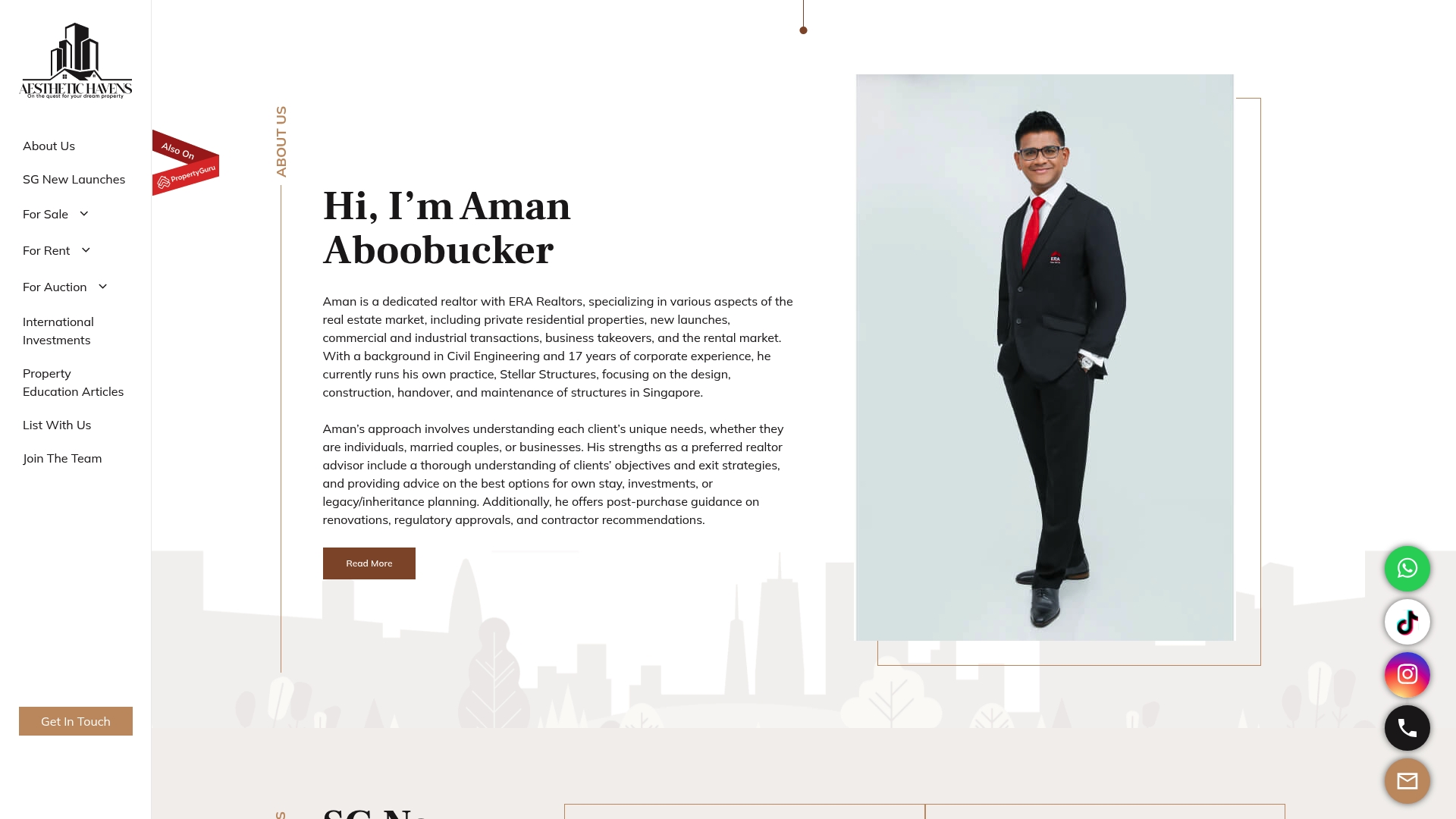
Aman Aboobucker of Aesthetic Havens has seen the same two mistakes surface repeatedly among agents handling dual-key deals: misstating how ABSD applies to the format, and glossing over HDB MOP or tenancy restrictions until after the buyer has committed. Both errors are avoidable with a document check done before the Option to Purchase is signed, not after.
On negotiation, price premiums on dual-key formats often have more room to move than developers initially suggest, particularly on units that have sat unsold for several weeks. Asking for the transaction history of comparable dual-key units in the same building, rather than accepting the listing agent’s asking price as fixed, tends to open that room up.
What Legal Documents Do You Need to Buy a Dual-Key Unit?
The paperwork trail for a dual-key purchase mirrors a standard private property purchase, with a few added checks. You’ll sign an Option to Purchase (OTP), pay the option fee, then exercise the option within the agreed window, typically two to three weeks, to lock in the deal. Your lawyer then handles the Sale and Purchase Agreement and lodges the transfer with the Singapore Land Authority.
Because a dual-key unit carries one strata title covering two sub-units, request the strata title plan directly from the developer or seller before exercising the option. This document shows exactly where the boundary between sub-units falls and confirms both areas are legally recognized as part of the same lot, not an unauthorized subdivision.
Check the MCST’s constitution and by-laws for any explicit restriction on subletting a sub-unit separately from the main unit. Some developments require the entire unit to be leased as a single tenancy even though it has two separate living areas, which changes your rental strategy entirely. If you’re financing the purchase, your bank will also require the strata title plan and floor plan as part of loan underwriting, since valuers price dual-key units differently than standard layouts.
Engage a conveyancing lawyer early. A property consultant who has handled dual-key transactions before can flag missing documentation before it delays your completion date, particularly around strata boundary verification and MCST approval for sub-unit tenancy.

How Do You Manage Rentals on a Dual-Key Property?
Renting out a sub-unit works differently than renting a standalone condo, mainly because you’re often living in the other half. Screening tenants matters more here than in a typical landlord situation, since a difficult tenant in the sub-unit affects your daily life directly, not just your rental account.
Start with a written tenancy agreement that specifies which areas are exclusive to the tenant and which, if any, are shared, such as a common corridor or parking access. Even though the two sub-units are self-contained, ambiguity over shared spaces is the most common source of landlord-tenant disputes in dual-key setups.
Set the tenancy at three months minimum, matching URA’s rule, and decide upfront whether you’ll renew short leases repeatedly or push for a longer one-year term for stability. Longer leases reduce turnover costs and vacancy gaps, which matter more on a dual-key sub-unit than people expect, since the smaller footprint attracts a narrower renter pool than a full-sized standalone unit.
Screen for occupancy limits before signing anyone. If the sub-unit sits under 90 square meters, the six-person cap applies regardless of how the tenant wants to split the space with roommates. Ask for identification for every intended occupant, not just the lease signatory, since breaching occupancy rules creates liability for you as the owner even if the tenant arranged the overcrowding.
Finally, separate your utility accounts or install sub-meters where the MCST allows it. Splitting a single utility bill between two households by estimate causes more tenant friction than almost anything else in a dual-key arrangement.

What Taxes Apply Beyond ABSD?
ABSD is a one-time cost at purchase, but two other tax obligations follow you for the life of the property. Rental income from the sub-unit must be declared to IRAS as part of your annual income tax return, and you can generally deduct allowable expenses such as mortgage interest, MCST fees apportioned to the rented area, and repair costs directly tied to the rental. Keep receipts and a clear allocation method between the main unit and sub-unit, since IRAS expects a reasonable basis for any expense split.
Seller’s Stamp Duty (SSD) applies if you sell within the holding period after purchase, and it’s charged on the full transaction price of the dual-key unit, not split between the two sub-units. Because a dual-key property carries one strata title, you cannot sell just the sub-unit and keep the main unit. The entire property transacts as a single lot, which is worth remembering if your original plan was to eventually split ownership between two family members.
Property tax also applies annually based on the Annual Value assessed by IRAS, and that Annual Value reflects the market rental of the entire unit, including the sub-unit’s rental potential, not just the portion you occupy yourself. Buyers moving from a standard condo into a dual-key format sometimes underestimate this increase because they’re comparing against their previous property tax bill on a smaller unit.
Does a Dual-Key Layout Affect Resale Value?
Valuers price dual-key units against two different benchmarks, and that split explains why resale outcomes vary so much between developments. Against a standard unit of similar total floor area, a dual-key format usually commands a premium, since it offers two livable spaces where a standard layout offers one. Against another dual-key unit in a competing development, though, the difference in demand often comes down to how well the two sub-units are physically separated, not just the presence of the format.
Buyer demand for dual-key formats has stayed concentrated among a specific pool: multi-generational families and owner-occupier investors. That pool is real but finite, and it means a dual-key unit typically takes longer to sell than a comparable standard unit in the same district. Sellers who need a fast transaction should factor that extra marketing time into their planning rather than assuming the format’s dual utility guarantees quick interest.
Looking ahead, demand for multi-generational living arrangements has stayed steady as extended families weigh the cost of separate housing against combined living. That steady demand doesn’t mean dual-key premiums will keep climbing indefinitely. Developers have adjusted supply over recent launch cycles, and a wider selection of dual-key stock in a given district usually compresses the resale premium rather than expanding it. Buyers should treat dual-key as a lifestyle and cash-flow decision first, and a pure appreciation play second.
Publisher Perspective: When We Recommend Dual-Key vs. Alternatives
We point buyers toward dual-key units when the household genuinely needs two private living spaces under one roof, or when the rental offset materially improves affordability after a proper TDSR check. When neither applies, two conventional units or a standard condo usually serves better. If you’re weighing a specific listing, a valuation consultation settles the numbers before you commit.
— Aman
Get a Straight Answer on Your Dual-Key Purchase
Most buyers researching dual-key units in Singapore hit the same wall: the ABSD math looks straightforward until you factor in your specific ownership history, and the rental potential looks strong until you check what a comparable sub-unit actually leases for in that building. These checks are best completed before exercising an option, not after.
A first consultation covers a document review of your buyer profile against current ABSD treatment, a TDSR and MSR affordability run-through against the specific unit you’re eyeing, and a comparison against active listings if you’re still deciding between a dual-key format and a standard layout. If you’re looking at new developments with dual-key configurations, the SG New Launches page tracks current projects, and the team can also pull comparable resale data from the residential listings page for any development you’re considering. Reach out through Aesthetic Havens to book a valuation and affordability check before you sign an Option to Purchase.
Verify the Rules Yourself
Cross-check anything time-sensitive directly at the source. IRAS publishes current ABSD guidance, URA maintains tenancy and occupancy rules, and CEA lists agent conduct cases and consumer guidance for private rentals.
Sources
- URA media release — temporary relaxation and tenancy rules
- CEA — RES fined and suspended for infringing HDB’s rules for renting out bedrooms
- CPF — How to manage your housing loan
FAQ
What is a dual-key unit in Singapore?
A dual-key unit is a single strata-titled residential property containing two self-contained sub-units, each with its own entrance, kitchen, and bathroom. IRAS treats the whole property as one unit for stamp duty purposes, which is the main reason it appeals to multi-generational families and owner-occupier investors.
Is a dual-key condo a good investment?
It depends heavily on your buyer profile and holding period. The single-title ABSD treatment and rental offset potential make it attractive for citizens and permanent residents planning to live in one sub-unit long-term, but the price premium and narrower resale pool make it a weaker fit for foreign buyers or short-term investors chasing pure yield.
Does HDB allow dual-key units?
HDB does not sell dual-key units under that name; instead, it offers multi-generation (3Gen) flats, which serve a similar purpose but fall under different eligibility, resale, and rental rules than private dual-key condos. HDB flats also carry Minimum Occupation Period restrictions that block any sub-letting until that period is satisfied.
How do you turn your HDB flat into a dual-key unit?
You generally cannot convert a standard HDB flat into a legally recognized dual-key layout, since that format requires a strata title arrangement HDB does not offer on its resale or new flats. Families wanting a similar setup within public housing should apply for a multi-generation flat directly through HDB rather than attempting a private renovation conversion.
What documents do I need to buy a dual-key unit in Singapore?
You’ll need the standard Option to Purchase, Sale and Purchase Agreement, and loan documents, plus the strata title plan showing the boundary between the two sub-units. Requesting the MCST by-laws before exercising your option confirms whether sub-unit rentals are permitted in that specific development.


