


Shophouses in Singapore are a scarce, heritage asset class that generally offers low current yields but strong capital-preservation potential. They suit high-net-worth investors who accept restoration complexity and limited liquidity, especially where a commercial zoning avoids ABSD. Proceed only after verifying zoning through URA and running specialist due diligence, not after falling for a heritage facade alone.
TL;DR:
- The current market for Singapore shophouses shows low transaction volume with only 16 deals in Q2 2026, but total sales value reached S$193.7 million, driven mainly by a few large purchases.
- Gross rental yields are typically between 2.5% and 4.5% for prime areas, with net yields often between 1.5% and 2.5%, reflecting high scarcity premiums.
- Most shophouses avoid ABSD if zoned solely as commercial, but mixed-use units with residential upper floors may attract ABSD depending on buyer profile and zoning confirmation.
- Conservation status imposes strict renovation restrictions, with restoration costs often starting in the mid-hundreds or exceeding S$1,000 per square foot for extensive work, requiring thorough due diligence.
- Funding options are limited, as CPF savings usually cannot be used for pure commercial shophouses, and loans are structured through commercial banks with tighter LTV and tenors, demanding careful planning.
Table of Contents
- How Is the Singapore Shophouse Market Performing Right Now?
- What Rental Yields Should You Actually Expect?
- Does ABSD Apply to Shophouse Purchases?
- What Does URA Conservation Status Mean for Renovation Costs?
- How Do You Finance a Shophouse Purchase in Singapore?
- Tax Implications Beyond Stamp Duty
- Shophouses vs. Other Singapore Property Types
- How Government Policy Shapes Shophouse Values
- What Are the Best Exit Strategies for a Shophouse?
- Who Actually Rents Singapore Shophouses?
- What Are the Biggest Risks in Shophouse Investment?
- What Aesthetic Havens Sees in Client Portfolios
- How Aesthetic Havens Supports Your Shophouse Acquisition
- Sources
- FAQ
How Is the Singapore Shophouse Market Performing Right Now?
Shophouse transactions stayed thin in the second quarter of 2026, but total deal value jumped anyway. Only 16 caveated transactions closed, yet total sales value reached S$193.7 million, a gap that tells you everything about how this market actually moves.
A majority of those deals exceeded S$5 million, pushing the quarter’s average transaction price to roughly S$12.1 million. A handful of large purchases, not broad buying activity, drove the headline number. Singapore Business Review’s coverage of the same quarter confirms the pattern: value up, count flat, and a market where a few motivated buyers can swing the entire quarterly total.
Demand keeps concentrating in the same corners: Tanjong Pagar, Chinatown, and pockets of District 8. Buyers also gravitate toward freehold or 999-year tenure over shorter leaseholds, which narrows the pool of “acceptable” stock further. The practical takeaway: liquidity is uneven, price dispersion between similar-looking units can be wide, and a shophouse that looks cheap relative to its neighbor might carry a lease or zoning flaw explaining the discount.
What Rental Yields Should You Actually Expect?
Gross yields on Singapore shophouses run lower than most commercial property investment benchmarks, and net yields run lower still once restoration and holding costs enter the picture.
Industry data points to gross yields around 2.5% to 4.5% for prime commercial-zoned units, with secondary locations and mixed-use buildings sometimes reaching 3.5% to 5.5% depending on tenant mix and lease structure. Net yield typically lands 1 to 2.5 percentage points below gross once you account for restoration amortization, GST on certain services, vacancy voids between tenants, and property management.
| Metric | Prime commercial precinct | Secondary / mixed-use precinct |
|---|---|---|
| Gross yield range | 2.5% to 4.5% | 3.5% to 5.5% |
| Typical net yield drag | 1 to 2.5 percentage points | 1 to 2.5 percentage points |
| Tenure preference | Freehold / 999-year | Mixed leasehold terms |
A quick worked example on a S$6 million purchase:
- Gross rent assumption. At a 3.5% gross yield, annual rent comes to roughly S$210,000.
- Capex drag. Amortizing a moderate restoration budget over 10 years might shave S$40,000 to S$80,000 a year off effective returns.
- Net yield. After voids and management, net yield often settles between 1.5% and 2.5%, well below what a typical residential rental or REIT distribution offers.
That gap is the price of scarcity and heritage status, not a market inefficiency you can arbitrage away.
Does ABSD Apply to Shophouse Purchases?
Zoning decides your tax bill more than almost any other factor in this asset class. Commercial-zoned shophouses generally sit outside Additional Buyer’s Stamp Duty, which is the single biggest reason institutional and HNW buyers favor them over comparable residential stock.
Mixed-use shophouses, where upper floors carry residential zoning, are a different story. Those upper-floor components can attract ABSD at residential rates depending on the buyer’s profile and existing property count. You cannot assume a shophouse is ABSD-free just because it looks commercial from the street. Confirm zoning directly through URA’s Master Plan and Space GIS tools before you make an offer, not after.
Basic Buyer’s Stamp Duty applies regardless of zoning, calculated on a tiered scale against purchase price. IRAS publishes the exact BSD bands and ABSD buyer-profile schedules, and the bands shift often enough that a rate you saw quoted two years ago may already be outdated.
A few practical steps before you sign an option to purchase:
- Verify zoning classification (commercial vs. mixed-use) through URA, not through the listing agent’s summary.
- Model BSD into your offer price, since it changes effective acquisition cost by a meaningful margin on a multi-million-dollar deal.
- Confirm the seller’s GST registration status. A non-GST-registered buyer purchasing from a GST-registered seller absorbs additional cost that residential buyers never encounter.
- Review the hidden costs of stamp duty and caveat registration before finalizing your budget.
What Does URA Conservation Status Mean for Renovation Costs?
Almost every shophouse investment in Singapore carries conservation status, and that status comes with legal teeth. You need written Conservation Permission before any addition or alteration works, and URA issues Specific Restoration Guidelines (SRG) that dictate what you can change on the building’s exterior and, in many cases, its structural bones.
URA’s conservation guidelines require restoration work to follow the building’s original architectural character, which limits your ability to modernize a facade or reconfigure openings on a whim. Because specialist contractors and heritage-grade materials are harder to source, approval timelines and costs both run longer than a standard commercial fit-out.

Restoration budgets vary widely by building condition, but industry guidance suggests provisional budgets starting in the mid-hundreds of dollars per square foot, climbing past S$1,000 per square foot for extensive structural or heritage-fabric work.
Before you commit capital:
- Request the building’s SRG and conservation classification from URA.
- Commission an independent structural survey, not just a visual inspection.
- Build a provisional restoration budget with a licensed conservation contractor before you finalize your offer.
Pro Tip: Ask the seller for any prior SRG correspondence or enforcement notices. A building with unresolved conservation breaches can turn a straightforward restoration into a multi-year approval battle.
How Do You Finance a Shophouse Purchase in Singapore?
Banks generally underwrite shophouses as commercial property, not residential property, and that changes your financing math in several ways at once.
- Loan-to-value and tenor. Commercial LTV ratios and loan tenors tend to run tighter than residential financing, and pricing is typically linked to SORA plus a spread rather than fixed residential board rates.
- CPF usage. CPF savings generally cannot fund a pure commercial-zoned shophouse purchase, which pushes more of the acquisition onto cash or bank debt.
- TDSR and income proof. The Total Debt Servicing Ratio framework still applies to individual borrowers, and lenders will scrutinize income documentation closely for an asset class with thinner rental comparables.
- Liquidity planning. Marketing periods for resale can run long given the shallow buyer pool, and sellers needing a fast exit often concede price. Size your offer, and your expected holding period, with that illiquidity priced in rather than assumed away.
Pre-qualifying with two or three lenders before you shop for a shophouse avoids a late-stage financing surprise on a deal this size.
Tax Implications Beyond Stamp Duty
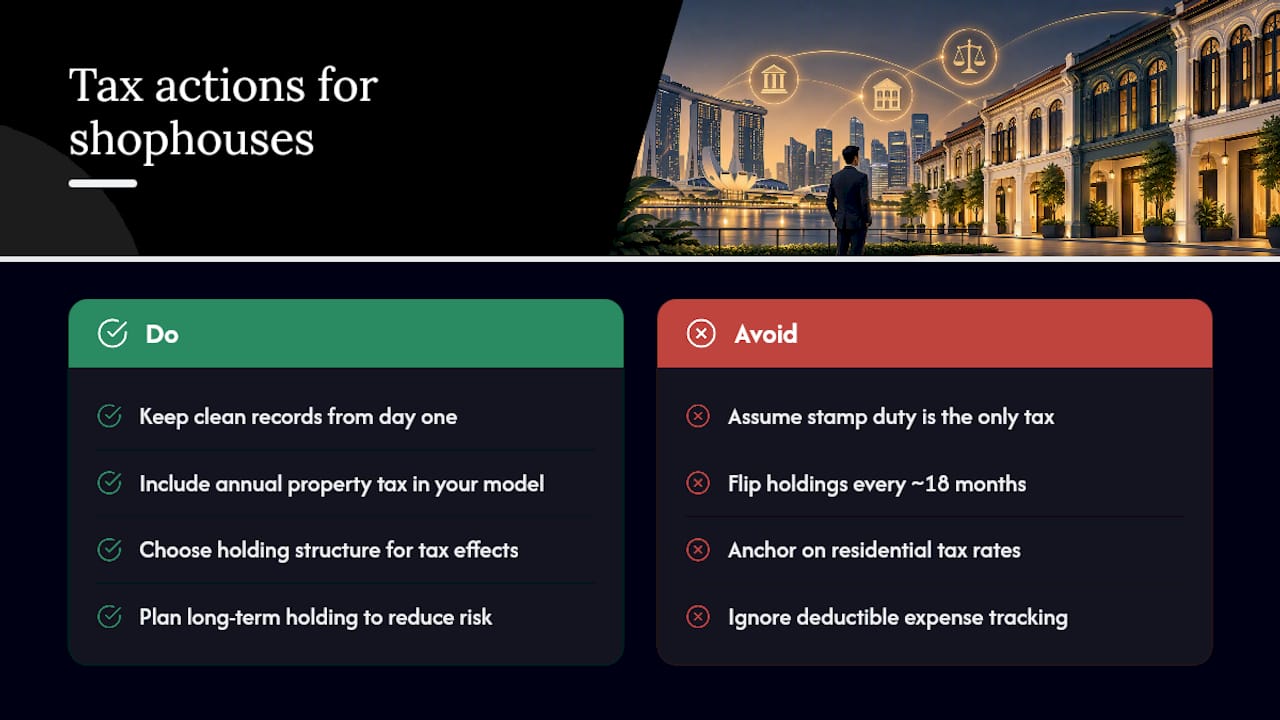
Stamp duty is only the entry cost. Rental income from a shophouse is taxable as ordinary income for individual owners, added to your other Singapore-sourced earnings and taxed at prevailing individual rates, or at corporate rates if held through a company structure. Deductible expenses typically include mortgage interest, property tax, restoration-related depreciation where applicable, and management fees, so keeping clean records from day one matters more than it does with a simple residential rental.
Singapore has no general capital gains tax, which is one of the quieter reasons shophouses appeal to wealth-preservation buyers. A sale profit generally isn’t taxed the way it would be in markets with capital gains regimes. That said, IRAS can and does treat frequent, short-holding-period transactions as trading income rather than capital gain, particularly if a buyer’s pattern of activity looks more like a property dealer than a long-term holder. A single shophouse bought and held for years sits comfortably outside that risk; a portfolio flipped every 18 months invites scrutiny.
Annual property tax also applies, calculated on the Annual Value of the non-residential and residential components separately if the building is mixed-use, at different tax rates. Owners underestimate this line item because they anchor on residential property tax rates, which don’t apply cleanly to a commercial-zoned unit. Building the full tax picture, not just BSD and ABSD, into your acquisition model is what separates a realistic net yield from an optimistic one.
Shophouses vs. Other Singapore Property Types
Shophouses compete for capital against condominiums, office strata units, and industrial property, and each behaves differently as an investment.
Residential condominiums offer far better liquidity and a deeper pool of comparable transactions for valuation, but they lack the ABSD advantage a commercial-zoned shophouse can carry, and their upside is capped by cooling measures aimed squarely at that segment. Office strata units offer cleaner income profiles and easier tenant turnover but come with none of the scarcity premium or heritage cachet that keeps shophouse values resilient through cycles.
Shophouses sit apart because supply is essentially fixed. URA isn’t creating new conservation shophouse stock, while condo and office supply both respond to new launches and rezoning. That fixed-supply characteristic is why family offices treat shophouses more like a heritage art piece with rental income attached than a pure yield play. If your priority is current income, a shophouse usually loses to a well-located commercial strata unit on pure cash flow. If your priority is capital preservation with a story attached, and you can tolerate lower net yields, few Singapore property investment types replicate what a well-located conservation shophouse offers on that specific axis.
How Government Policy Shapes Shophouse Values
Government policy touches shophouse values from more directions than most buyers expect. URA’s conservation program is itself a policy decision, and the number of gazetted conservation areas is essentially fixed by government designation rather than market forces. That fixed inventory is the single biggest reason values have held up through multiple property cooling cycles that hammered residential segments.
Urban development plans around a shophouse precinct can move values meaningfully in either direction. A new MRT line, a rejuvenated retail stretch, or a masterplan update expanding permitted commercial use nearby tends to lift rental demand and, eventually, capital values. Conversely, precincts earmarked for major infrastructure works or road widening can see years of construction disruption that depresses rental appetite temporarily, even if long-term value holds.
Cooling measures aimed at residential property generally don’t touch commercial-zoned shophouses directly, which is exactly why capital has rotated into this segment during past residential ABSD tightening cycles. That rotation effect cuts both ways: any future policy that closes the ABSD gap for mixed-use shophouses, or extends cooling measures into commercial-adjacent segments, would remove one of the asset class’s core appeals overnight. Watching URA masterplan reviews and IRAS stamp duty updates isn’t optional homework for a shophouse investor. It’s the mechanism by which your asset’s relative advantage either persists or evaporates.
What Are the Best Exit Strategies for a Shophouse?
Exiting a shophouse investment takes longer to plan than exiting a condominium, and the buyer pool you’re selling into is narrower by definition.
Outright sale to another investor remains the most common exit, but marketing timelines often run several months to over a year given the shallow pool of qualified commercial buyers with the capital and conservation-savvy risk appetite this asset class demands. Positioning a well-restored, tenanted shophouse with clean lease documentation and a completed SRG history shortens that timeline noticeably, since it removes the biggest sources of buyer hesitation.
Some owners choose to hold through a corporate entity and sell the entity itself rather than the property, which can simplify certain transaction mechanics for institutional buyers, though it introduces its own due diligence layer around the entity’s liabilities. A smaller number of sellers explore auction as a faster, if less price-optimal, route when timeline matters more than maximizing sale price, and auction listings do occasionally surface shophouse stock for buyers comfortable with that process.
Whatever route you choose, valuation credibility matters more here than in liquid residential markets, where comparable sales are abundant. A defensible, well-documented valuation, built on genuine comparables rather than aspirational pricing, is often the difference between a shophouse that sells within a year and one that sits listed for two.
Who Actually Rents Singapore Shophouses?
Tenant demand for Singapore shophouses splits fairly cleanly into a few recognizable profiles, and knowing which one you’re targeting changes how you restore and price the space.
Boutique F&B operators, specialty cafes, and independent restaurants remain the most visible tenant category, drawn to the street-level charm and Instagram appeal that heritage architecture provides. Professional services firms, particularly law practices, architecture studios, and boutique consultancies, favor upper-floor units for the prestige address and quieter working environment. Wellness and lifestyle brands, from private clinics to boutique fitness studios, have grown as a tenant category over recent years, often willing to pay a premium for a location that supports a premium brand image.
Demand concentrates around precincts with strong daytime and evening footfall, walkability to MRT stations, and a critical mass of complementary tenants that keep the whole street relevant. A single well-restored shophouse surrounded by vacant or poorly maintained neighbors struggles regardless of its own condition, since tenant demand in this category is heavily influenced by the immediate streetscape. That’s part of why due diligence on a shophouse purchase should extend to the block, not just the unit, and it’s worth reviewing broader rental market trends before setting rent expectations.
What Are the Biggest Risks in Shophouse Investment?
The risks specific to shophouses go beyond the generic “property can lose value” warning that applies to any asset class.
Restoration cost overruns top the list. Structural surprises hidden behind heritage facades, unresolved conservation breaches from a previous owner, and specialist contractor scarcity can all push a provisional budget well past initial estimates. Remaining lease tenure is a quieter but equally serious risk. Practitioners treat units with shorter remaining leases as materially harder to finance and more prone to price discounting, since fewer lenders and buyers want exposure to a shrinking tenure window.
Pricing mismatch between buyers and sellers has kept 2026 transaction volumes soft, with analysts noting persistent expectation gaps even as safe-haven capital keeps flowing into the segment selectively. That mismatch means patient buyers often get better terms than eager ones. Illiquidity compounds every other risk: if restoration runs over budget or a tenant defaults, you can’t simply list and sell within weeks the way you might with a condominium unit. Concentration risk matters too. Because so much value sits in URA’s conservation designation, any future shift in conservation policy or precinct-level infrastructure disruption affects your entire holding at once, with no diversification cushion inside a single-asset purchase.
What Aesthetic Havens Sees in Client Portfolios
Shophouses earn their place for clients building legacy holdings or a wealth preservation anchor, rarely as a primary income engine. Where a client wants active cash flow with less operational overhead, we usually steer them toward strata commercial or residential alternatives instead.
— Aman
How Aesthetic Havens Supports Your Shophouse Acquisition
Buying a conservation shophouse well means getting the zoning check, the valuation, and the restoration math right before you commit, not after. Professional real estate consultancies can guide clients through zoning checks, valuation, and restoration budgeting steps for commercial property investment in Singapore, to avoid needing to manage URA and IRAS guidance alone.
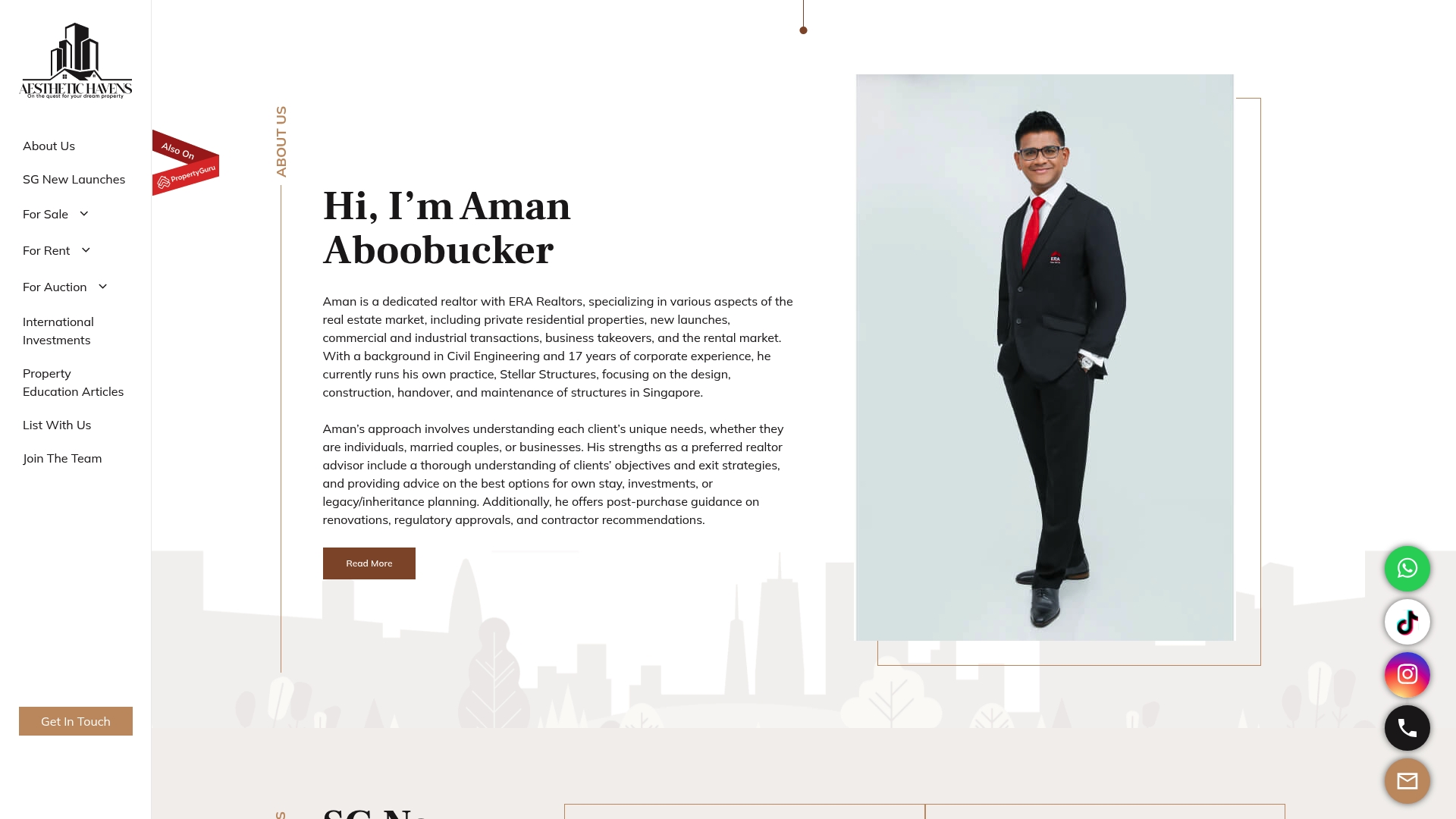
Our services cover property valuation built on genuine comparables, sourcing and negotiation support for off-market and listed stock, pre-purchase structural survey coordination, restoration budget planning aligned to URA’s SRG requirements, and leasing advisory once your unit is tenant-ready. Aman Aboobucker brings both an engineering and real estate background to that process, which matters most at exactly the stage most buyers skip: verifying what a shophouse’s structure and conservation history will actually cost to fix before you sign anything.
If you’re weighing a specific shophouse or want a market briefing on current listings, start with a conversation through Aesthetic Havens to get a tailored valuation and acquisition plan built around your investment goals.
Sources
- Uptick in shophouses sold but fewer rented in 2Q2026: Huttons
- Shophouse sales hit $193.7m in Q2 even as activity stalls | Singapore Business Review
- IRAS | Stamp Duty
- URA conservation guidelines
- Singapore Shophouse Investment Guide 2026 | ShiokNest
FAQ
Are Shophouses a Good Investment in Singapore Right Now?
Shophouses fit HNW investors who prioritize capital preservation and heritage scarcity over current income, particularly with Q2 2026 transaction values reaching S$193.7 million despite low deal counts. They’re a weaker fit for anyone needing strong near-term cash flow or fast liquidity.
Do Shophouses Attract ABSD in Singapore?
Commercial-zoned shophouses generally avoid ABSD, while mixed-use units with residential upper floors may attract it depending on buyer profile. Always verify zoning through URA before assuming either outcome, and check current ABSD schedules through IRAS.
What Is a Realistic Rental Yield for a Singapore Shophouse?
Gross yields typically fall between 2.5% and 5.5% depending on precinct and tenure, with net yields running 1 to 2.5 percentage points lower after restoration and management costs. Prime commercial precincts tend to sit at the lower end of that gross range.
Can I Use CPF to Buy a Commercial Shophouse?
CPF savings generally cannot fund a purchase of a purely commercial-zoned shophouse, unlike residential property purchases. Financing typically runs through commercial bank loans priced against SORA, so budget cash or debt accordingly.
How Does Aesthetic Havens Help With Shophouse Purchases?
Aesthetic Havens provides valuation, sourcing, negotiation, and restoration planning support tailored to conservation shophouse requirements. Reach out through the Aesthetic Havens site for a tailored valuation or market briefing before you make an offer.


