


You must also remit the full purchase price from abroad in foreign currency and secure a bank-issued Foreign Exchange Transaction form before the Land Office will register the title. If the quota is already full, you can’t register freehold and will need to look at resale from an existing foreign owner, a leasehold structure, or another lawful workaround.
TL;DR:
- Foreign buyers must remit the full purchase price in foreign currency and secure a bank-issued Foreign Exchange Transaction form before registration.
- The foreign ownership quota is calculated by square meters per building, not by individual units, making availability dependent on both total saleable area and unit size mix.
- A signed, dated quota confirmation letter from the juristic person is essential, as verbal assurances are not accepted by the Land Office.
- When the quota is full, options include resale from existing foreign owners, leasehold agreements capped at 30 years, or using a Thai company with proper legal structure.
- Delays in FET issuance or seller paperwork are common causes of registration failure, so verifying quota and bank compliance before signing is critical.
Table of Contents
- Thailand Condo Foreign Ownership Quota: What the 49% Rule Actually Means
- What Documents Do You Need to Buy a Condo as a Foreigner?
- How Does the Condo Purchase and Transfer Process Work?
- What Fees and Taxes Will You Pay at Transfer?
- What Are Your Options If the Foreign Quota Is Full?
- Due Diligence: What to Verify Before You Pay a Deposit
- Recent Legal Changes Foreign Buyers Should Know About
- How Aesthetic Havens Supports Foreign Buyers Abroad
- The One Thing Buyers Underestimate About This Process
- Ready to Buy a Condo in Thailand? Here’s Your Next Step
- Sources
- FAQ
Thailand Condo Foreign Ownership Quota: What the 49% Rule Actually Means
That last phrase, floor area, is where most buyers get tripped up. The quota isn’t counted unit by unit. It’s counted by square meters.
This distinction changes how you should think about availability. A sizeable penthouse consumes the same slice of quota as multiple smaller units, according to Thaiger’s breakdown of the quota mechanics.
Picture a 100-unit tower where every unit measures 50 square meters, giving the building 5,000 square meters of total saleable area. Foreigners can legally hold up to just under half of that, which works out to about 49 units at that size. Now change the mix: if 10 of those units are actually 150-square-meter combined suites, the math shifts fast, and fewer total units remain available to foreign buyers even though the percentage rule hasn’t moved.
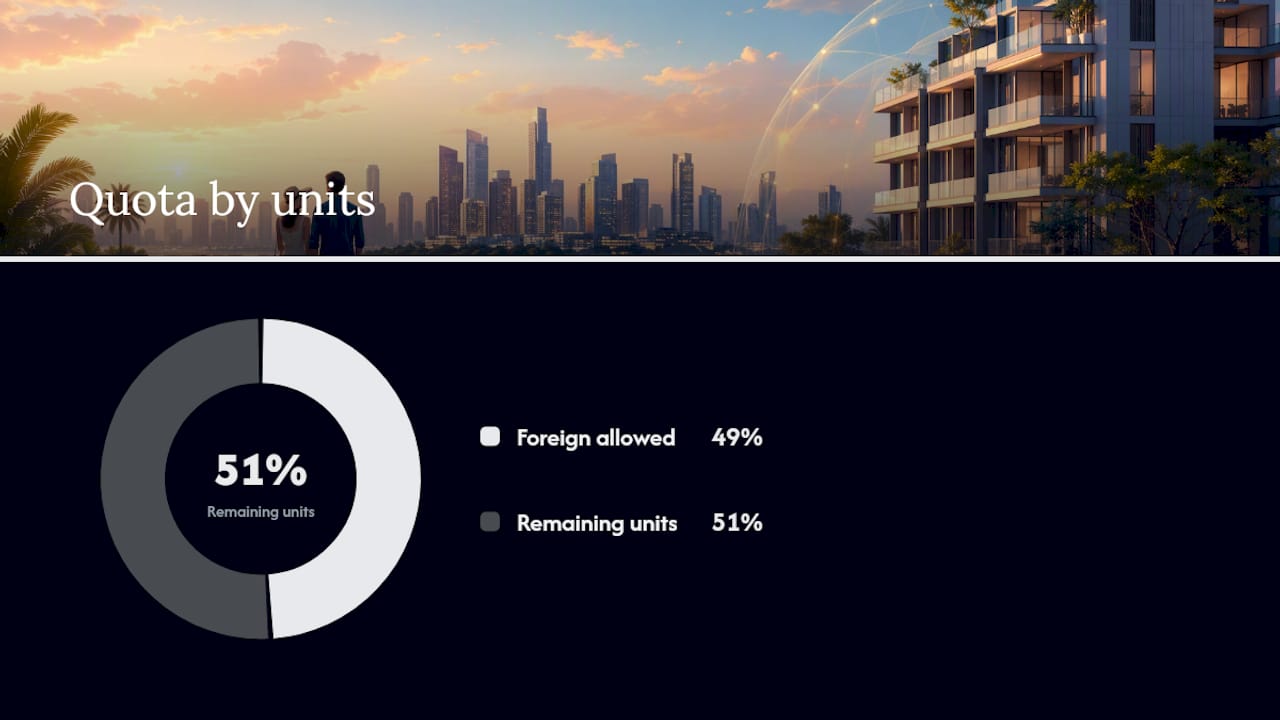
Quota also applies per registered building, not per developer and not nationwide. A single project with three towers, all sold under one marketing name, can have three completely different quota positions. Tower A might be at 47% foreign owned, Tower B might be maxed out, and Tower C might have barely any foreign uptake, based on the per-building counting method Thaiger describes. Proposals to raise the cap significantly and to extend leases to much longer terms have circulated in policy discussions, but as of mid 2026 neither change had been enacted, according to an overview of the current quota rules.
Before you pay anything, get this in writing:
- A dated, signed letter from the condominium’s juristic person confirming the exact remaining foreign quota, expressed in square meters, for that specific building.
- Confirmation of which registered building your unit belongs to if the project has multiple towers.
- A note on how close the building is to its 49% ceiling right now, not at launch.
An agent’s verbal assurance that “there’s still quota” means nothing at the Land Office. Only the juristic person’s letter does.
What Documents Do You Need to Buy a Condo as a Foreigner?
Most individual foreign buyers qualify under the standard Section 19 route, which simply requires legal entry into Thailand and funds properly remitted from abroad. Separate statutory paths exist for BOI-promoted investors and long-term residents, but for the average buyer, the paperwork below is what actually decides whether your name ends up on the title.
- Foreign Exchange Transaction (FET) form. This is the single most transaction-critical document in the entire process. You must wire the purchase funds from an overseas bank account in foreign currency, not baht, and the receiving Thai bank issues the FET naming you as the buyer and stating the purpose as a condominium purchase. Skip this step, or convert your money to baht before sending it, and the Land Office will refuse to register foreign freehold, per Thailand Stuff’s breakdown of the FET requirement.
- Signed Sale and Purchase Agreement (SPA) covering price, unit specification, and a foreign-quota warranty clause.
- Valid passport and, if you’re not present for signing, a properly executed power of attorney.
- Juristic person quota letter, the same document discussed above, confirming quota availability at the time of transfer.
- Debt-free certificate from the juristic person confirming no outstanding common-area fees attach to the unit.
Pro Tip: Call your remitting bank before you sign anything and confirm they can wire in the currency and with the wording your Thai bank needs. Some banks are slow to issue FET-compliant transfers, and discovering that a week before your Land Office appointment is a bad time to find out.
Losing or misdirecting the FET is a common reason Land Office registrations get refused and, worse, a reason sale proceeds later get stuck when a foreign owner tries to resell and repatriate funds, according to a legal overview of the quota system. Get the wording right the first time.
How Does the Condo Purchase and Transfer Process Work?
The path from reservation to registered title generally follows a predictable order, and knowing when quota and FET checks happen lets you avoid nasty surprises at the finish line.
- Reservation and SPA. You pay a reservation deposit and sign the sale and purchase agreement, ideally with a foreign-quota warranty and a deposit-refund clause tied to registration failure.
- Remittance and FET issuance. You wire funds from abroad in foreign currency; your Thai bank converts and issues the FET in your name.
- Due diligence window. Your lawyer verifies the title deed, checks for encumbrances, and confirms the building’s current quota position.
- Fresh quota letter request. Request an updated juristic person letter dated as close to the completion date as possible. Quota positions shift as other units sell, so a letter from three months earlier isn’t reliable proof today.
- Land Office appointment. Both parties, or their authorized representatives, attend with the FET, passport, SPA, seller’s title deed, and juristic person documents.
- Fee payment and registration. Transfer fees and taxes are settled at the counter, and the officer registers you as the freehold owner on the title deed.
Delays usually come from one of two places: a bank taking longer than expected to issue a correctly worded FET, or a seller’s paperwork (unpaid common fees, unresolved liens) not being ready. Build in at least two to three weeks of buffer between remittance and your target closing date, and don’t schedule your Land Office appointment until the bank has confirmed the FET is in hand.
What Fees and Taxes Will You Pay at Transfer?
Budget the full statutory numbers here, because one recent change is easy to misread if you’re not paying close attention.
- Transfer fee: roughly 2% of the appraised property value, split by negotiation between buyer and seller in most deals.
- Specific business tax: 3.3% of the sale price or appraised value, whichever is higher, typically applying when the seller has held the property fewer than five years.
- Stamp duty: 0.5%, applied instead of specific business tax when the seller is exempt from it.
- Withholding tax: calculated differently depending on whether the seller is an individual or a company, deducted at the Land Office on transfer day.
A Royal Gazette notice effective July 1, 2026, cut certain transfer and mortgage fees to a very low rate for qualifying Thai nationals only. That reduction does not extend to foreign buyers, according to Thailand Law Online’s coverage of the fee change, so budget the standard transfer fee unless you personally hold Thai nationality.
Beyond statutory fees, plan for lawyer’s fees, due-diligence costs, and the juristic person’s sinking fund contribution plus ongoing common area maintenance charges, both of which are negotiable in some resale deals. Financing is worth flagging early: Thai banks rarely extend mortgages to non-resident foreign buyers, and where they do, expect conservative loan-to-value terms. Most foreign purchases in Thailand are cash transactions for exactly this reason.
What Are Your Options If the Foreign Quota Is Full?
A full quota doesn’t end your options, it just narrows them to three realistic paths, each with a different risk profile.
- Resale from an existing foreign owner. When a foreigner sells a unit they already hold freehold, that quota allocation transfers with the sale. This is the cleanest route to freehold in a maxed-out building, since you’re not competing for new quota, you’re simply stepping into a slot that already exists.
- Registered leasehold. Thai law caps leases at 30 years. Some developers market “renewable” 30+30+30 arrangements, but treat that marketing with real skepticism.
- Thai limited company ownership. A properly structured Thai company, majority Thai owned, can legally purchase condominium units on the Thai side of the quota. The structure itself isn’t illegal. What’s illegal is using nominee Thai shareholders who hold shares on paper but have no real economic interest, purely to let a foreigner control property beyond what the law allows.
On the leasehold point, Thailand’s Supreme Court has confirmed the 30-year ceiling is absolute and ruled that pre-agreed stacked renewal clauses aren’t enforceable beyond that initial term, according to Thailand Law Online. If a seller or agent promises a lease that functions “just like freehold” through automatic renewals, that promise doesn’t hold up in court.
Pro Tip: Treat any suggestion of a nominee shareholder arrangement as an immediate red flag, no matter how common the agent claims it is locally. Regulators have sharpened enforcement against these structures, and the legal exposure lands on you, not the agent who suggested it.
Due Diligence: What to Verify Before You Pay a Deposit
The deposit you’re about to hand over is unrecoverable in a lot of scam and quota-related disputes, which makes this checklist worth an afternoon of your lawyer’s time before you sign.
- Verify the juristic person quota letter directly. Don’t rely on a copy the agent hands you. Have your own lawyer request it and, where possible, cross-check the building’s status with Land Department records.
- Check the title deed (Chanote). Confirm it’s genuine, correctly registered, and free of mortgages, liens, or court attachments that would block a clean transfer.
- Request the condominium registration certificate, confirming the building is legally registered as a condominium under the Act, not simply a residential building being marketed as one.
- For new or off-plan builds, get the EIA approval and construction permits. Projects that skip environmental impact assessment or lack proper permits face construction halts, and buyers have been left holding deposits on frozen projects.
- Review recent AGM minutes and financial statements. These reveal whether the sinking fund is adequately funded and whether the building has pending disputes or unbudgeted repair costs coming.
- Confirm the sinking fund balance relative to the building’s age and any planned major repairs, a strong predictor of future special assessments.
- Build a foreign-quota warranty into the SPA. Require the seller to warrant current quota availability as of the completion date, paired with a binding deposit-refund clause if registration is later blocked, an approach recommended in Condo Reviews Thailand’s due-diligence guide.
- Use an independent lawyer, not one referred by the seller or developer, to review every document above before you release funds.
This mirrors the same discipline used when checking title types in other markets: verify the paperwork independently, never take a summary at face value.
Recent Legal Changes Foreign Buyers Should Know About
Three developments from the past two years reshape how cautious you should be, and none of them relax the rules in a foreign buyer’s favor.
- Department of Lands circulars have sharpened scrutiny on nominee and proxy arrangements used to dodge foreign ownership limits, meaning any structure leaning on a Thai nominee now carries elevated enforcement risk, per Thailand Law Online.
- The Supreme Court’s ruling on the 30-year lease ceiling closes off the “renewable lease equals freehold” pitch some developers still use in marketing materials.
- The July 2026 transfer fee reduction to 0.01% applies exclusively to Thai nationals. Foreign buyers who see that figure quoted online and assume it applies to them will badly underbudget their closing costs.
The pattern across all three: authorities are tightening interpretation, not loosening it. Treat any agent claim that contradicts these points as unverified until your own lawyer confirms it in writing.
How Aesthetic Havens Supports Foreign Buyers Abroad
Some real estate professionals assist international investors with cross-border purchases, including quota verification, FET coordination, and Land Office representation where a power of attorney is appropriate. Consultations often include document review of target units, quota verification checks against the juristic person’s records, and planning for remittance timing and closing. The same due-diligence discipline applied to Singapore property purchases carries over directly to cross-border condo transactions in Thailand.
The One Thing Buyers Underestimate About This Process
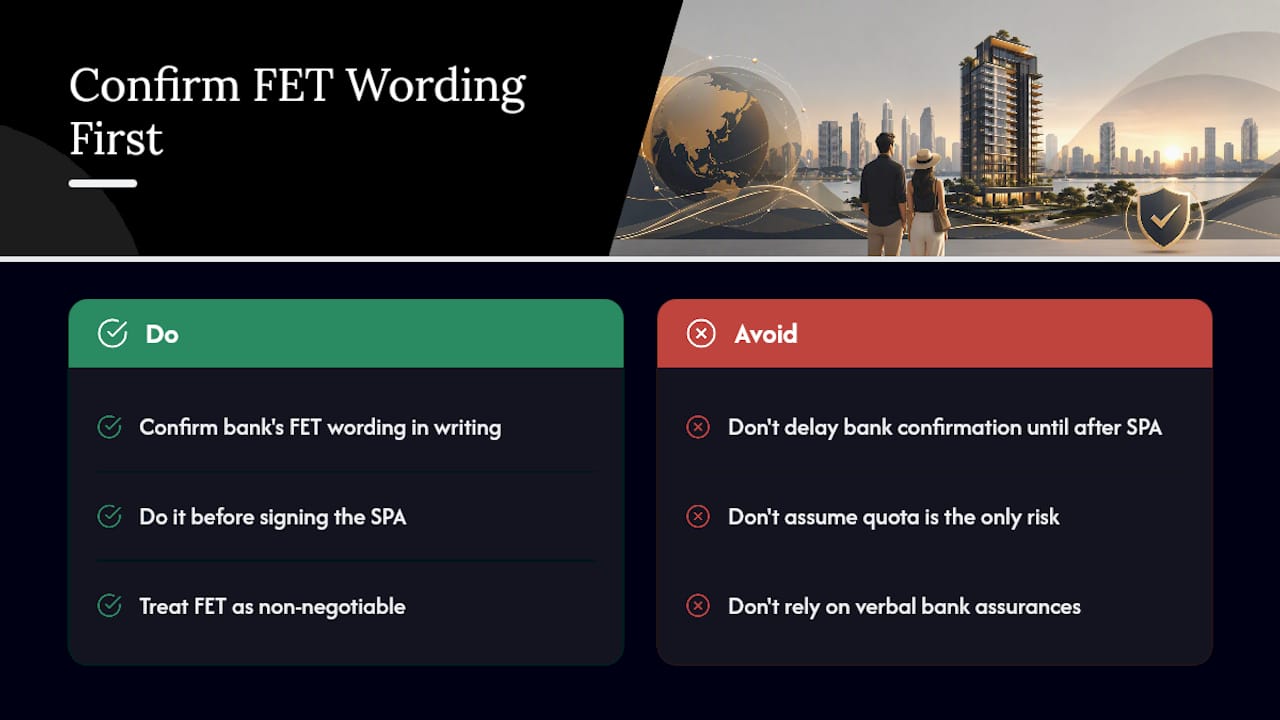
In practice, the FET is where deals actually break. A quota problem shows up early, before you’ve spent real money, when the juristic person tells you there’s no room left. An FET problem shows up late, after you’ve wired six figures overseas, when your bank issues the wrong wording or the Thai bank interprets “purpose of remittance” differently than the Land Office expects.
The conventional advice tells buyers to worry about finding a unit within quota. The better advice is to worry equally about your bank’s paperwork discipline, because that’s the failure point nobody warns you about until it’s already cost someone weeks of delay or a stuck deposit. If you take away one action from this entire guide, make it this: confirm your remitting bank’s FET wording in writing before you sign the SPA, not after. Everything else in this process is negotiable timing. That step isn’t.
— Aman
Ready to Buy a Condo in Thailand? Here’s Your Next Step
Aesthetic Havens’ International Investments service exists for exactly this situation: a buyer who needs someone coordinating quota verification, FET timing, and Land Office logistics from a distance, not another listing site to scroll through alone. Advisory and transaction-support services for cross-border purchases are sometimes provided in cooperation with clients’ legal counsel.
If you’re weighing a Thailand condo purchase against other markets, or you already have a unit in mind and want the juristic person’s quota letter and FET paperwork checked before you commit a deposit, book a consultation through Aesthetic Havens and bring your document checklist. Such reviews typically cover quota status, title verification, and remittance planning prior to fund transfer.
This article is general information, not a substitute for advice from a qualified lawyer. Consult a qualified legal professional about your own circumstances before acting on anything here.
Sources
- Thailand Condo Foreign Ownership Quota: 49% Rule 2026
- What Thailand’s 49% foreign quota means for buyers | Thaiger
- Condo Due Diligence Checklist for Thailand — What to Check Before You Buy | Condo Reviews Thailand
FAQ
Can a Foreigner Legally Own a Condo in Thailand?
The rule comes from Section 19-bis of the Condominium Act, and the 49% cap remains in force with no enacted changes as of mid 2026.
What Are the Main Restrictions on Foreign Property Ownership in Thailand?
Foreigners generally cannot own land outright, which is why condominiums, where you own the unit but not the underlying land, are the main freehold path available.
How Do Foreigners Actually Register a Condo Purchase?
You remit the full purchase price from abroad in foreign currency, obtain the bank-issued FET form, and present it along with your passport and the sale documents at the Land Office. The FET is required for registration and without it, the transfer cannot proceed.
Are There Condos Available for Foreigners to Buy Right Now?
Availability depends entirely on each building’s current quota position, which changes as units sell, so a tower that’s full today may free up if a foreign owner resells. Requesting a dated juristic person quota letter before you make an offer is the only reliable way to confirm current availability.
Can a Foreigner Own a House or Land in Thailand?
No, foreigners generally cannot own freehold land or standalone houses under standard ownership rules, which is why condominium units remain the primary freehold option. Alternatives like registered leasehold, capped at 30 years by law, or a properly structured Thai company exist, but each carries different legal and practical tradeoffs worth reviewing with independent counsel.
Recommended
- Foreigner’s Guide to Buying Property in Singapore (2025 Regulations & Taxes)
- Singapore Conveyancing: Avoid Missed Completions, File IRAS in 1 Month
- From Showflat to Key Collection: The Ultimate 2025 First-Timer’s Guide to Buying a New Launch Condo in Singapore
- How Much Downpayment Do You Need for a Condo in Singapore?


