

Introduction
When you buy a private residential property at a new launch in Singapore, you acquire what is known as a building under construction (BUC) unit – a unit sold off-plan before the development receives certificate of statutory completion (CSC). If you later decide to sell that unit before the project is completed, you are conducting a sub sale. If you wait until after completion and strata titles are issued, you are conducting a resale. In both scenarios, Seller’s Stamp Duty (SSD) may apply, and the financial consequences of getting the timing wrong can run into six figures.
The single most important fact to understand is this: IRAS computes the SSD holding period from the date you exercised your Option to Purchase (OTP) – or signed your Sale and Purchase Agreement (S&P) if no OTP exists – not from the date your project obtains its Temporary Occupation Permit (TOP) or CSC. This means your SSD clock starts ticking months or even years before you can physically occupy the unit.
This article focuses on private residential condos and apartments, including Executive Condominiums (ECs) where relevant. It covers how SSD applies to sub sale and resale of BUC units, the distinct risks for sellers versus buyers, and transaction costs such as buyers’ stamp duty that affect pricing and timing. While HDB flat MOP rules and industrial/commercial SSD have their own frameworks, they fall outside the main scope here except for brief contrasts.
By the end of this guide, you will understand:
-
What counts as a sub sale vs resale for BUC units and how URA classifies each
-
When SSD applies and how the holding period is computed from the OTP exercise date
-
The different SSD risks borne by sellers versus sub sale buyers
-
How the timing of your exit – pre-TOP vs post-TOP – changes the transaction classification and SSD exposure
-
Practical steps and worked examples to avoid costly SSD miscalculations
Understanding SSD, BUC, Sub Sale and Resale in Singapore
Seller’s Stamp Duty was introduced in Singapore in 2010 specifically to curb short-term speculation in the residential property market. For anyone who has purchased properties at a newly launched development from 2010 onwards, SSD is an unavoidable consideration when planning an exit – particularly for BUC units where the temptation to flip for profits early can collide with steep tax rates.
What is Seller’s Stamp Duty (SSD)?
Seller’s Stamp Duty (SSD) is a tax payable by owners selling or disposing of residential property within a specified holding period from the date of acquisition. It is designed to penalise short-term flipping and stabilise the condominium market by making rapid exits financially unattractive.
SSD is calculated on the higher of the selling price or market value of the property at the point of disposal; in practice, IRAS uses the actual price or market value, whichever is higher. It is entirely separate from Buyer’s Stamp Duty (BSD) and Additional Buyer’s Stamp Duty (ABSD), which are taxes on the purchaser’s side.
For residential properties purchased between 11 March 2017 and 3 July 2025, the SSD holding period is three years: sellers pay 12% if they dispose within the first year, 8% in the second year, and 4% if sold within the third year. No SSD is payable if sold after three years. For residential properties purchased on or after 4 July 2025, the regime is stricter – the holding period extends to four years, with rates of 16% in Year 1, 12% in Year 2, 8% in Year 3, and 4% in Year 4, dropping to 0% only after four full years. These changes were announced on 3 July 2025 by the Singapore government to address a significant upswing in sub sales of uncompleted units.
While this article centres on residential BUC and completed properties, it is worth noting that industrial SSD rules also matter for business owners buying BUC industrial units, as those operate under a different rate schedule and holding period.
What is a Building Under Construction (BUC) Unit?
A BUC unit is one sold off-plan before the project receives its Certificate of Statutory Completion (CSC), including almost completed properties that are nearing CSC but are not yet fully completed. Buyers typically acquire such development units at launch, paying a 5% booking fee followed by progressive payments tied to construction milestones.
The key milestones in a BUC purchase are: grant of the OTP by the developer, signing of the sale and purchase agreement within the statutory timeline (typically three weeks), progressive payment obligations as construction advances, the developer obtaining the Temporary Occupation Permit (TOP), and ultimately the issuance of the CSC and subsidiary strata certificates of title.
From IRAS’ SSD perspective, the critical date is neither TOP nor CSC. The “acquisition” date is tied to the date the buyer exercised the OTP or signed the binding S&P – and this is the moment the SSD clock begins. This distinction is the foundation of every SSD calculation discussed in the rest of this article.
Sub Sale vs Resale: Legal Definitions
URA defines sub sale as the sale of a private residential unit by the original purchaser (or a subsequent purchaser) before the issuance of CSC and/or strata title certificates. A sub sale occurs before the Temporary Occupation Permit (TOP) in most cases, and the transaction is considered sub sales when the project is still officially a BUC. Sub-sale transactions generally involve three parties: the original buyer, the new buyer, and the developer, because the developer’s sale and purchase agreement must be assigned or novated.
A resale refers to a standard transaction of selling a completed property unit. In a resale, strata title has been issued, ownership is fully registered, and the transaction typically involves two parties: the current owner and the new buyer. Completed properties transacted in this way are recorded as resale caveats on URA REALIS.
It is essential to understand that URA’s classification of a transaction as “sub sale” or “resale” is separate from how IRAS computes SSD. IRAS does not care about the label – it only looks at the acquisition date and the disposal date. The same BUC unit can be transacted under a “sub sale” classification early in its life or a “resale” classification years later, but SSD calculations are always anchored to the OTP/S&P dates on which the seller first acquired the property.
How the SSD Holding Period is Computed for BUC, Sub Sale and Resale
The core of the SSD question for any BUC owner is straightforward: the holding period is measured from the date you exercised the OTP that led to your purchase, and it ends on the date the buyer exercises the OTP to buy from you (or the date of the sale and purchase agreement if no OTP is used). Everything else – TOP, CSC, key collection – is irrelevant to SSD.
When Does the SSD Clock Start? (OTP vs TOP vs CSC)
IRAS’ principle applies identically to BUC and completed properties: the date of “purchase/acquisition” is the date of exercise of the OTP, or the date of the S&P if no valid OTP exists. The original purchase date dictates SSD liabilities for both sub-sale and resale transactions, and SSD’s holding period starts from the date of purchase, not from construction completion or TOP issuance.
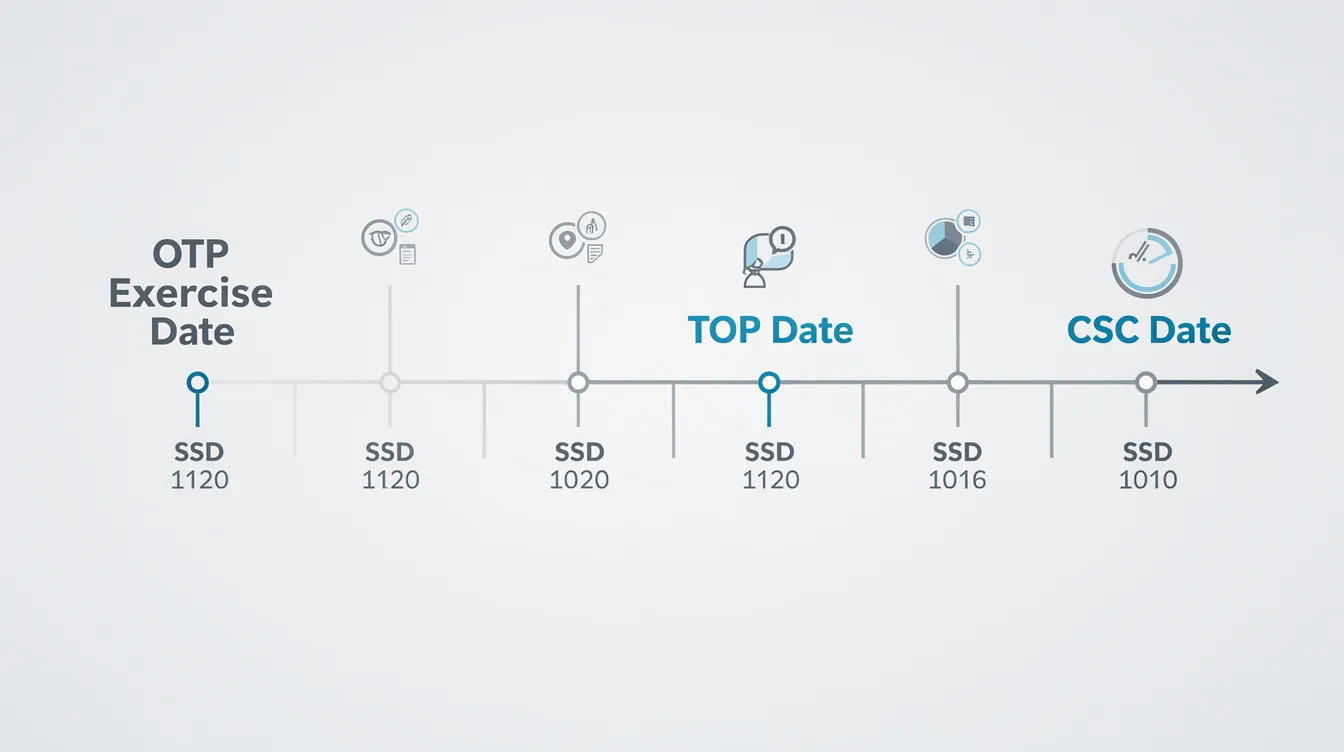
Consider a concrete example: if you exercised the OTP for a new launch unit on 15 March 2023 under the pre-July 2025 regime, your SSD Year 1 runs from 15 March 2023 to 14 March 2024 (12% SSD rate), Year 2 from 15 March 2024 to 14 March 2025 (8%), and Year 3 from 15 March 2025 to 14 March 2026 (4%). After 15 March 2026, SSD drops to 0%. This holds true even if your project’s TOP is only expected in 2027 – you could be SSD-free two full years before you can even move in.
For special scenarios such as joint owners, transfers between spouses, or inheritance, the SSD holding period usually counts from the earliest continuous acquisition date of any current owner. These situations can be complex, and professional advice is recommended.
A common misconception is that SSD runs from the TOP date because that feels like “actual possession.” IRAS explicitly rejects this interpretation. The acquisition date is the purchase date on your stamped OTP or S&P, full stop.
When Does the SSD Clock Stop? (Disposal Date and OTP Mechanics)
The “disposal” date for SSD purposes is the date the buyer exercises the OTP granted by you as the seller. If there is no OTP, it defaults to the date of the sale and purchase agreement. It is not the date of TOP, handover of keys, or when strata title is issued.
For example, if a seller grants an OTP on 1 February 2026 and the buyer exercises on 10 February 2026, the SSD disposal date is 10 February 2026, even if completion and key collection occur in April 2026. The few days between granting and exercising can sometimes make the difference between SSD bands.
Crucially, granting an unexercised OTP does not itself trigger SSD. Only the exercise – the moment the buyer accepts and the transaction becomes binding – counts as disposal. If a buyer does not exercise within the option period, no disposal has occurred and no SSD is triggered by that aborted transaction.
For BUC sub sales, the same principle applies without exception: the disposal is dated by the sub sale buyer’s OTP exercise, not by a future TOP or CSC event.
Sub Sale vs Resale: How SSD Applies Differently in Practice
SSD does not distinguish between “sub sale” and “resale” as labels. It sees only an acquisition date and a disposal date. However, the practical impact differs enormously because BUC owners selling via sub sale are typically exiting within one to three years of launch – squarely inside the SSD holding period.
Consider two contrasting scenarios. First, an owner who sub sells a BUC unit early in the second year after OTP exercise would face SSD at 8% (pre-July 2025 regime) or 12% (post-July 2025 regime), and may try to apply a hefty mark up to cover that cost, yet this can still fail to preserve net profit if the market will not absorb the higher asking price. Second, the same owner who holds until after Year 4 and sells as a normal resale with 0% SSD retains the full upside. Most resale properties are held beyond statutory SSD periods, often resulting in zero SSD liability.
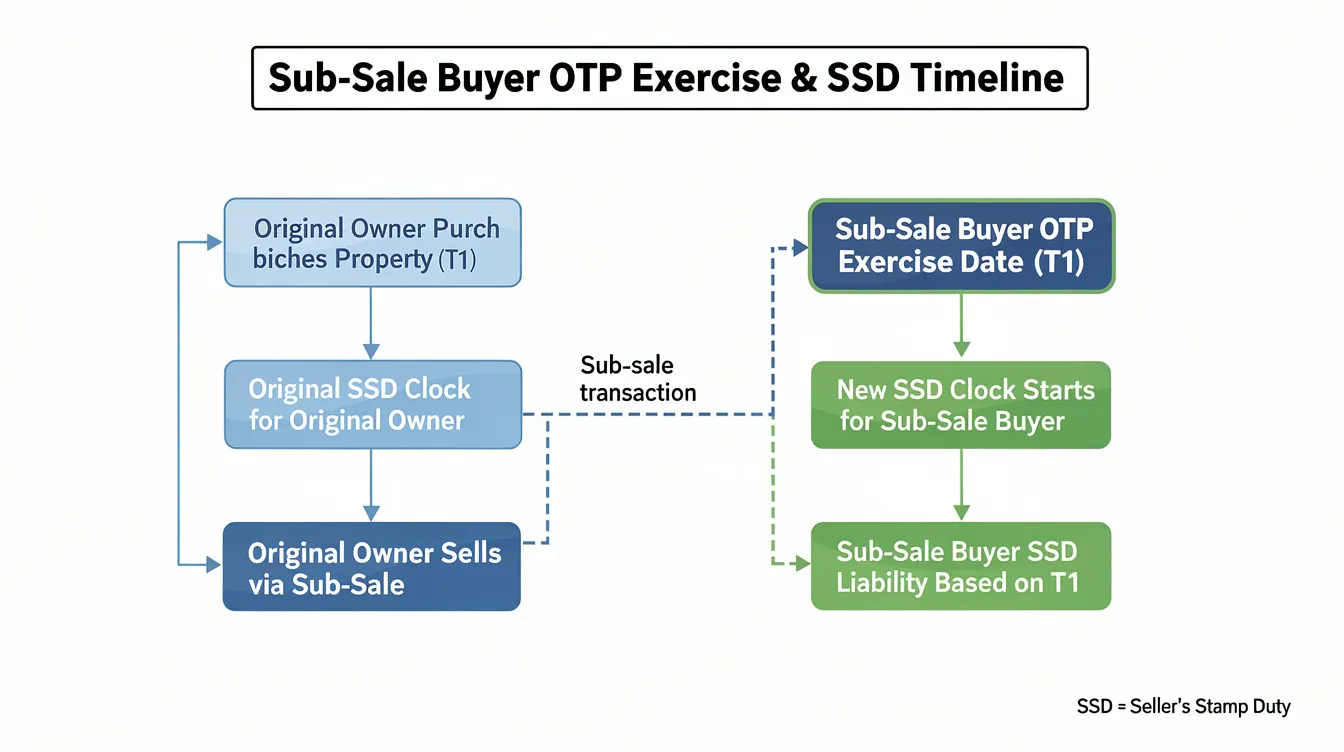
Sub sale buyers themselves are not liable for SSD on their purchase – Buyer’s Stamp Duty (BSD) applies instead. But every sub sale buyer must recognise that their own SSD clock starts from the day they exercise the OTP from the sub sale seller. If they subsequently need to exit the unit early, they face the same SSD framework.
The following section walks through concrete use cases of buying and selling BUC units, step-by-step.
Buying and Selling BUC Units: Sub Sale vs Resale Workflows
The legal and cashflow mechanics differ significantly between buying a BUC unit from a developer, selling it via sub sale before completion, and selling it as a completed resale later. Understanding each workflow helps owners compare sale outcomes, account SSD ranging from 4% to 16%, and account for SSD across different holding timelines.
Scenario 1: Original Purchase of a BUC Unit from Developer
At a typical private condo launch, the process begins with a ballot or queue, unit selection, and paying a 5% booking fee. The developer grants an OTP, and you must exercise it within the prescribed timeline (usually 21 days). Upon exercise, you sign the sale and purchase agreement and pay the next tranche (often 15%), along with BSD and any ABSD within 14 days.
Your SSD clock starts from the OTP exercise date – this is your purchase date for all SSD purposes. For investors and business owners purchasing mixed-use or SOHO-type units for operations, this initial OTP date determines whether an early exit is viable without punitive SSD. If you acquired a unit at a newly launched development on 10 August 2025 under the new regime, you must hold until at least 10 August 2029 to avoid SSD entirely.
Scenario 2: Sub Selling a BUC Unit Before TOP
Sub selling a BUC unit involves several additional steps. The seller must first check the SPA for assignment or novation clauses, obtain the developer’s consent (which typically involves an admin fee), and engage lawyers for both parties. Sub-sale caveats must be registered within 14 days on URA REALIS.
Suppose you acquired a BUC unit in January 2024 (pre-July 2025 regime) at a purchase price of $2,000,000 and decide to sub sell in October 2025 at an asking price of $2,200,000. The disposal falls within Year 2 of your SSD holding period, triggering SSD at 8%. The SSD payable would be $176,000 (8% × $2,200,000, assuming sale price is higher than market value). After deducting SSD, legal fees, agent commission, and developer admin fees, some sub-sale units fetched low prices in net terms, leaving little profit or even a loss.
The sub sale buyer in this transaction pays BSD (and ABSD if applicable) on their purchase price. Only the original seller faces SSD, which is based on the sub sale price or market value, whichever is higher. Property valuation risks are higher for sub-sale transactions due to market fluctuations, which can make both pricing and SSD exposure unpredictable.
Progressive payments already made by the original buyer are accounted for in the completion accounts and adjusted at settlement. The sub sale buyer takes over remaining progressive payment obligations to the developer.
Scenario 3: Selling the Same Unit as a Completed Resale After TOP/CSC
Once TOP, CSC, and strata titles are issued, the transaction shifts to a normal resale process. The seller grants an OTP (with a typical 1% option fee), and the buyer exercises within the option period (paying an exercise fee, often 4% of the price).
If you acquired via OTP on 1 May 2022 and sell in June 2027, your SSD holding period of three years (under the pre-July 2025 regime) expired on 1 May 2025. No SSD is payable regardless of when the project obtained its TOP. The “label” on URA caveats shifts from “sub sale” to “resale,” but IRAS’ SSD decision hinges solely on elapsed time between your acquisition OTP and the disposal OTP. A resale is exempt from SSD if the holding period exceeds the statutory duration following the original purchase date.
Scenario 4: Buyer Purchasing a Sub Sale BUC Unit
If you are purchasing a sub sale unit, you receive an OTP from the sub sale seller, exercise it within the option period, and pay BSD (and ABSD if applicable) within 14 days. Some buyers purchase properties in this segment to secure a near-completion unit without waiting for a fresh launch build cycle. You then step into the developer’s SPA via assignment or novation. The buyer pays Buyer Stamp Duty on sub-sale transactions.
Your own SSD clock begins from the date you exercise your OTP – entirely independent of the original owner’s acquisition date. You do not inherit the seller’s SSD risk.
Practical example: if you, as a sub sale buyer, acquire on 10 January 2026 under the new regime, and then sell post-TOP in August 2028, you will have held for approximately two years and seven months. Under the four-year SSD holding period, you fall within Year 3 and would face SSD at 8%. To avoid SSD entirely, you would need to hold until at least 10 January 2030.
Step-by-Step: Checking SSD Exposure Before You Sell a BUC or Recently TOP Unit
Before you grant an OTP to a potential buyer, follow this simple procedure to determine whether SSD applies and how much it will cost. This applies equally to investors exiting early and business users with BUC holdings they need to liquidate.
4-Step SSD Check for Potential Sellers
-
Confirm your acquisition date. Locate the date you exercised your original OTP or the date you signed the S&P if no OTP was issued. This date appears on your lawyer’s completion file, IRAS stamp certificate, or your copy of the stamped OTP. This is your purchase date for SSD purposes – not your TOP date or key collection date.
-
Determine your intended disposal date. Use a realistic estimate – specifically, the date you expect the buyer to exercise the OTP you will grant. Remember that granting the OTP is not disposal; exercise is what counts. Factor in the typical 14–21 day option period.
-
Compute your holding period and applicable SSD rate. Count the time precisely from acquisition date to disposal date. Map this to the correct SSD rate schedule for your acquisition date. For residential property acquired between 11 March 2017 and 3 July 2025, use the three-year schedule (12%/8%/4%/0%). For residential property acquired on or after 4 July 2025, use the four-year schedule (16%/12%/8%/4%/0%). The difference between the second and third year bands, for instance, can mean tens of thousands of dollars.
-
Estimate SSD amount and net proceeds. Multiply the applicable SSD rate by the expected selling price (or market value whichever is higher). Then subtract SSD, agent commission, legal fees, bank fees for early loan redemption, and any developer admin fees for sub sales. The resulting figure is your true net proceeds – and it often surprises owners selling units early.
Worked SSD Examples for BUC Sub Sale vs Resale
Example A – BUC sub sale in Year 2 (significant SSD): You exercised your OTP on 1 September 2025 for a BUC unit at a purchase price of $2,000,000. In July 2027, a buyer exercises the OTP at $2,200,000, falling within Year 2 of the new SSD regime. SSD payable = 12% × $2,200,000 = $264,000. After agent commission (~$44,000), legal fees (~$3,000), and developer admin fees (~$5,000), your net gain before loan adjustments is roughly negative – despite a $200,000 price increase. Sub-sales typically see premiums of 10 to 25% over launch prices, but SSD can consume much of that hefty markup.
Example B – Same unit sold 4+ years later as resale (0% SSD): You hold the same unit until October 2029, four years after your OTP. The property is now completed. You sell at $2,300,000. SSD = 0%. After agent commission and legal fees, your net gain is approximately $240,000+. In other words, sales prices meaning should be read after SSD and transaction costs, not just from the headline increase. The difference in net proceeds compared to Example A is stark – more than $500,000 in favour of waiting.
Example C – Sub sale crossing into a lower SSD band by timing the exercise date: You acquired on 1 September 2025. A buyer wants to purchase and the OTP is granted with an expiry of 30 September 2027. If the buyer exercises on 25 August 2027 (still within Year 2), SSD is 12%. If the buyer exercises on 2 September 2027 (entering Year 3), SSD drops to 8% – saving $88,000 on a $2,200,000 transaction. This is why option expiry dates and timelines matter enormously.
Always verify numbers with IRAS’ latest SSD information or your conveyancing lawyer.
Sub Sale vs Resale: SSD, Cashflow, and Risk Comparison
Beyond SSD percentages, sub sale vs resale differ in risk, financing, and operational impact – especially for investors and business owners who may need certainty around occupancy dates or working capital.
SSD and Cost Comparison: Sub Sale vs Resale
|
Criterion |
Sub Sale (BUC Unit) |
Resale (Completed Unit) |
|---|---|---|
|
Typical holding period before exit |
1–3 years from OTP |
4+ years from OTP |
|
Likelihood of SSD being payable |
High – most exits fall within SSD window |
Low – most resale properties are held beyond SSD periods |
|
SSD rate exposure |
4–16% depending on year and regime |
Usually 0% |
|
Stamp duty borne by seller |
SSD on disposal |
Typically none |
|
Stamp duty borne by buyer |
BSD (and ABSD if applicable) |
BSD (and ABSD if applicable) |
|
Exposure to SSD rate changes |
Significant – new regimes can increase rates mid-hold |
Minimal – holding period usually exceeds any regime window |
|
Sensitivity to market value swings |
Higher – property valuation risks are elevated during construction |
Lower – completed units have comparable transaction data |
Sub sales concentrate SSD risk because most are attempted within one to three years of launch. Average sub-sale prices surpassed average prices for all sales last year, and the current average price is a practical buyer benchmark when comparing sub-sale units against new sales prices. These average price trends also help show whether a sub-sale asking price is competitive, but after accounting for SSD, the seller’s actual net may be a lower price than expected.
Cashflow and Financing Differences
Sub sale sellers may have paid only a small percentage of the purchase price via progressive payments (sometimes as little as 20–30% of the total), meaning their capital outlay is relatively low. In contrast, resale sellers have usually fully drawn their mortgage and been servicing it for years, which involves higher cumulative interest costs but no outstanding progressive payment obligations.
For sub sale buyers, the attraction lies in deferring full loan drawdown – progressive payments continue from where the original buyer left off, potentially easing near-term cashflow. Resale buyers, by contrast, must secure full financing at the point of purchase and begin immediate loan servicing.
For corporate or SME buyers acquiring mixed-use or industrial BUC units, the SSD framework can amplify downside if the business needs to exit early. Construction delays hindered by manpower and materials shortages can extend the BUC phase, keeping you locked in during the SSD window. The impact on working capital and business cashflow deserves careful modelling before any purchase decision.
Operational and Timing Risks
BUC sub sale buyers must accept construction risk and the possibility of TOP delays, including the defects liability period that follows. Resale buyers can inspect the actual condition of the unit and move in shortly after completion. For buyers who need occupancy certainty – whether for personal use or business operations – resale offers a clear advantage.
Timing the SSD window is a recurring risk. Owners selling must coordinate the buyer’s exercise of OTP so that the disposal date clearly falls after the SSD-free period. Misjudging by even a few days can result in SSD at 4% or more on a multi-million-dollar transaction.
Market liquidity also diverges. A buoyant resale hdb market can support sub-sale demand by creating upgrader demand for near-completion condos, while projects with stronger locational or pricing appeal tend to attract interested buyers. Some projects – particularly popular sub sale condominiums with smaller 1-bedder or 2-bedder units near MRT stations and numerous food centres – command a more active sub sale market with higher sub sales volume. Niche or large-format units, including units in a leasehold development located farther from transport nodes or daily amenities, may be harder to exit early without accepting a lower price. Sub-sales peaked at 4,858 transactions in 2007, but in most years only a small percentage of total private residential transactions are considered sub sales, and recent sub sales showed a spike last year after a decline. When demand is strong, these conditions can mean so interested buyers driving higher transaction activity in active projects.
Common SSD and BUC Pitfalls (and How to Avoid Them)
Both retail investors and business owners often miscalculate SSD by anchoring on TOP dates or hearsay, leading to six-figure mistakes. Here are the most common errors and how to prevent them.
Mistake 1: Counting SSD Holding Period From TOP Instead of OTP
This is the single most frequent misconception. An owner who exercised OTP on 1 June 2023 and whose project obtained TOP on 1 June 2026 might assume that selling in September 2026 means they have only “held for three months” and expect heavy SSD – or, more dangerously, might assume their three-year SSD period started at TOP and therefore hasn’t expired yet when in fact it has. Conversely, an owner might think TOP equals acquisition and try to sell in August 2025, believing they are outside the SSD window, when the actual OTP-based calculation shows they are still in Year 3 at 4% SSD.
Remedy: Always refer to your stamped OTP or sale and purchase agreement. Never rely solely on the project’s TOP or CSC date. IRAS is explicit: the holding period SSD rate is determined from OTP exercise, not completion.
Mistake 2: Granting OTP Too Early or With the Wrong Expiry
A seller might grant an OTP that the buyer can exercise before the seller’s SSD-free date, triggering accidental SSD liability. For instance, if your SSD expires on 15 March 2027, but you grant an OTP on 1 February 2027 with a 21-day exercise window, the buyer could exercise on 15 February – a month before your SSD window closes – leaving you with 4% SSD on the entire transaction value.
Solution: Coordinate option grant and expiry dates so that even the earliest possible exercise falls after the SSD period ends. Work closely with your conveyancing lawyer and agent on the dates stated in the OTP. This is a straightforward planning step that can save significant money.
Mistake 3: Ignoring Partial Exits, Transfers, or Multiple Acquisitions
Transferring a share of a unit to a spouse, selling a part-share to a business partner, or acquiring additional share in stages can each create separate SSD computations. Each part-share may have its own acquisition date, and IRAS will compute SSD based on those individual dates.
Advice: For any non-standard scenario – including family transfers, corporate restructuring, or inheritance – consult a conveyancing lawyer or tax professional early. Avoid DIY restructuring aimed at dodging SSD, as IRAS may challenge arrangements that appear artificial.
Mistake 4: Assuming Sub Sale is Always More Profitable Than Waiting for Resale
It is tempting to note sub sale premiums of 10–25% over launch prices and assume early exit makes financial sense, but buyers should look past the lowest priced transaction and assess full net proceeds after SSD and fees. But after including SSD (which can be 8–16% of the sale price or market value), developer admin fees, agent commission, and legal fees, many sub sales yield lower net gains than a later resale. The SSD structures for residential properties vary and can change, meaning a rate increase mid-hold can further erode returns. In normal markets and for most sub sale property transactions, patience delivers better results.
Recommendation: Run a realistic feasibility calculation that includes SSD, time value of money, and all transaction costs before deciding to sub sell. If the numbers do not show a decent profit after all deductions, holding to resale is typically the better strategy.
Conclusion and Next Steps
The SSD clock starts from the date you exercise the OTP or sign the binding sale and purchase agreement – not from the TOP, CSC, or key collection date. This rule applies identically whether you sub sell a BUC unit in Year 1 or resale a completed property in Year 5. The only question is whether enough time has elapsed between your acquisition and disposal dates to clear the SSD holding period.
Sub sale buyers do not pay SSD on their purchase, but savvy buyers understand that their own SSD clock begins the moment they exercise the OTP from the sub sale seller. Every subsequent exit decision must account for this. With the July 2025 regime extending the holding period to four years with steeper rates, the penalty for early exit has become even more punitive.
Your immediate next steps:
-
Retrieve and record the OTP exercise date for each property you own – this is your definitive SSD reference point
-
Map out SSD windows in a simple calendar, marking the exact dates each SSD tier expires
-
Run net proceeds scenarios comparing sub sale vs resale timing, including all costs and taxes
-
Speak with a conveyancing lawyer before granting any OTP to ensure the disposal date falls safely outside your SSD window
-
Engage a property advisor for portfolio-level or site-specific analysis, particularly if you hold multiple BUC units or mixed-use assets
Related topics worth exploring next include updated ABSD and BSD rules, SSD on industrial assets for business users, and how progressive payment schedules affect overall investment returns in the residential property market.
Additional Resources and Visual Aids
A simple timeline is the most effective way to internalise SSD mechanics for BUC units. Picture a horizontal line starting at your OTP exercise date, with clearly marked bands for SSD Year 1, Year 2, Year 3, and Year 4 (under the new regime). Along that line, mark the expected TOP date and CSC date – these will typically fall somewhere within Year 2 to Year 4, reinforcing visually that “completion” has no bearing on SSD computation. If you later include a price comparison chart, the dark blue line can represent average new sales prices for visual benchmarking against sub-sale transactions.
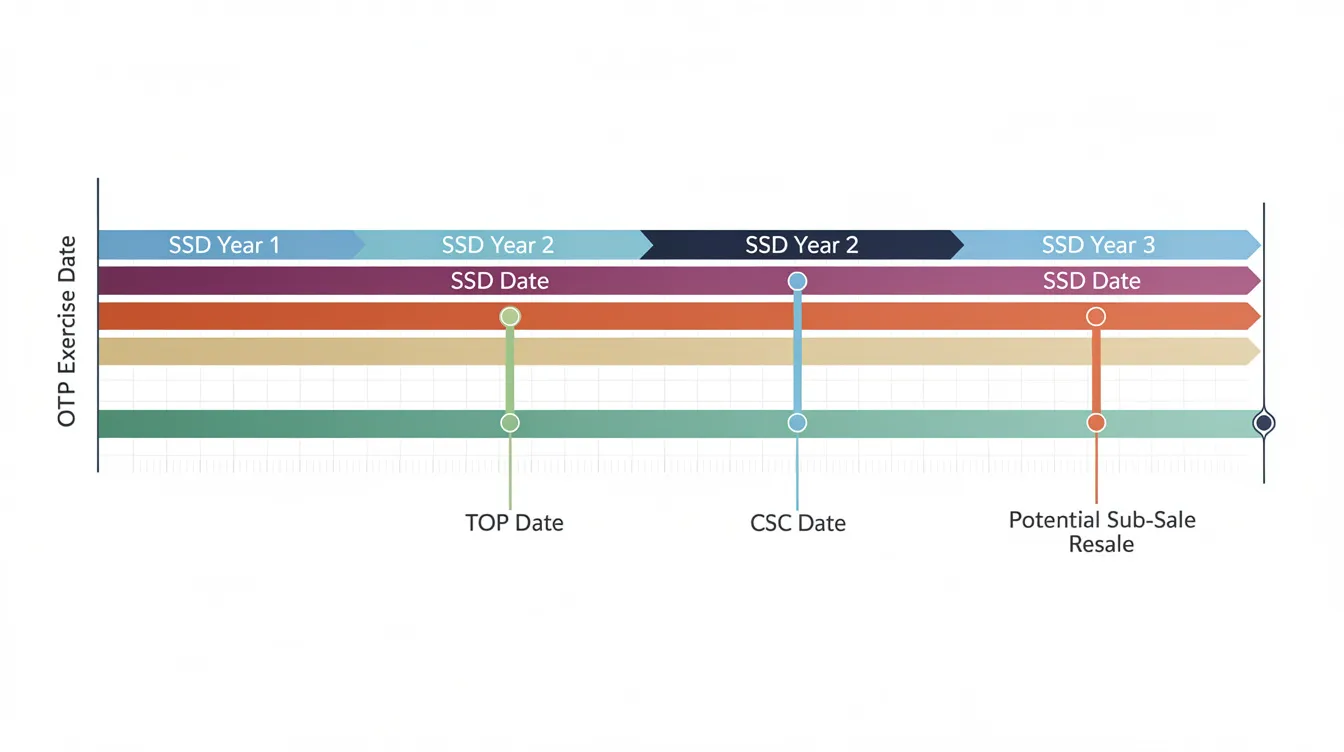
For a sample holding-period calculator, input your acquisition date and proposed disposal date, then refer to the applicable rate table. The computation is: identify which SSD “year” the disposal falls into, apply the rate to the higher of sale price or market value, and the result is the SSD payable.
Useful references:
-
IRAS SSD guide for residential property – official rates, FAQs, and acquisition/disposal date definitions
-
IRAS SSD FAQ document (PDF) – detailed scenarios including BUC-specific questions
-
URA REALIS – for checking sub sale vs resale transaction data and caveats
-
99.co analysis on SSD rate hike effects on sub sales – market commentary and recent trends
FAQs on Sub Sale vs Resale and SSD for BUC Units
Does SSD for a BUC condo start from the TOP date or my OTP date? SSD starts from the date you exercised the OTP or signed the binding S&P – never from the TOP or CSC date. IRAS is explicit that the acquisition date is the purchase date on your stamped documents, regardless of when the building is physically completed.
If I buy a sub sale BUC unit, do I inherit the seller’s SSD risk? No. You start a fresh SSD clock from your own acquisition date – the date you exercise the OTP from the sub sale seller. The seller is solely liable for any SSD triggered by their disposal. However, you must plan your own future exit with your new SSD holding period in mind.
Is there SSD on industrial BUC units? Yes, but industrial SSD operates under a separate framework with different rates and holding periods. Business owners purchasing industrial BUC units should consult IRAS’ dedicated industrial SSD guidelines, as the rules differ significantly from the residential regime covered in this article.
Can I avoid SSD by signing an Option but delaying exercise? IRAS focuses on the exercise date, not the date the OTP was issued. If you were granted an OTP before 4 July 2025 but exercise on or after that date, the new four-year SSD regime applies. Artificial arrangements designed to manipulate timing may be challenged by IRAS.
What happens if my buyer backs out after exercising the OTP? If a transaction is properly rescinded (e.g. the S&P is annulled), the tax implications may differ from a completed disposal. However, this is a complex area – seek legal and tax advice immediately, as the circumstances of rescission determine whether SSD applies or can be reversed.
How does SSD work if I transfer my share of a BUC unit to my spouse or company? Such transfers may still be treated as disposals subject to SSD. The acquisition date for each share is assessed separately, and IRAS applies SSD based on the holding period for that specific share. Professional advice is essential before executing any transfer.
Does using my BUC or completed unit for my business change SSD treatment? Usage does not usually alter SSD rules for residential property. If the property’s permitted use is residential at the date of disposal, residential SSD rates apply regardless of whether you use it for personal or business purposes. However, how you treat rental income or business-use deductions may affect income tax – a separate matter from stamp duty.
What regime applies if I paid option fee before 4 July 2025 but exercise OTP after? If you exercised the OTP on or after 4 July 2025, you are treated as having purchased the property on the exercise date, and the new four-year SSD regime with higher rates applies – even if the option fee was paid weeks or months earlier under the old regime.

