

Introduction
Flipping property in Singapore – buying a residential unit and selling it within one to three years for a quick profit – sounds straightforward until you account for the stamp duties, legal fees, and financing costs that the government has deliberately stacked against short term investors. Seller’s Stamp Duty (SSD), Buyer’s Stamp Duty (BSD), Additional Buyer’s Stamp Duty (ABSD), agent commissions, conveyancing charges, and bank penalties routinely consume most or all of a flipper’s headline gain, turning what looks like a S$220,000 “profit” into a negligible return or an outright cash loss.
This article focuses on Singapore residential property flipping from 2017 through 2026, with one detailed worked case study using real duty rates, fee ranges, and financing assumptions observed in actual transactions. We exclude long-term buy-to-hold strategy and detailed tax planning for licensed developers. The target readers are individual property investors, business owners, and SMEs who are tempted by the idea of an “easy flip” in private condominiums or landed homes. At AESTHETIC HAVENS, we advise clients on real-world deal economics – not just headline gains – because the gap between gross and net is where fortunes disappear.
The direct answer: after SSD of up to 16% (from 4 July 2025), BSD of 3–6%, ABSD where applicable, loan interest, legal fees, agent commissions, and prepayment penalties, most 1–3 year residential flips in Singapore produce negligible or negative net returns. Short-term property flipping in Singapore is heavily regulated, and the combined impact of SSD, BSD, and legal fees creates a massive cost hurdle for flippers.
After reading this article, you will:
-
Understand exactly how SSD and BSD are computed, including the revised SSD rates effective 4 July 2025
-
Walk through a fully worked 2024–2026 flipping case study showing gross capital gain versus net result after all costs
-
Learn a simple stress-test checklist to evaluate any potential flip before committing capital
-
Recognise the common miscalculations and psychological traps that lead to expensive mistakes
-
Know when flipping might still make sense – for example, in industrial properties or with sufficiently long holding periods
Understanding Property Flipping and Transaction Frictions in Singapore
Property flipping in Singapore’s context means acquiring a private residential unit and disposing of it within a short window – typically one to four years – to capture capital appreciation. This practice directly collides with Singapore’s layered cooling measures, which were designed to curb short term speculation and promote market stability in the property market.
What “Flipping” Actually Means in Singapore
There are two main forms. A sub-sale (or sub sale transactions) involves assigning an uncompleted unit – say, a new launch condo bought in 2023 – to another buyer before the Temporary Occupation Permit (TOP) is issued. A resale flip means selling a completed unit within the first few years of ownership. Both attract SSD if disposed of within the specified holding period.
The typical flipping thesis from 2010–2013, and again from 2020–2024, ran like this: buy a new launch unit on the progressive payment scheme, pay only a fraction of the purchase price during construction milestones, and sell near TOP to “lock in” construction-phase appreciation before fully drawing down the mortgage. Sub-sales rose from 178 in 2020 to 1,306 in 2024, reflecting a sharp rise in speculative activity despite the punitive duty regime.
For private residential properties acquired on or after 4 July 2025, SSD applies for disposals within four years – the new SSD holding period directly targets this flipping window. The SSD holding period was extended to four years in 2025, with rates increased by four percentage points in each year band compared to the prior regime.
It is worth noting that industrial properties and commercial properties often have different duty treatment. Industrial units generally do not attract the same residential SSD, and ABSD is typically not triggered unless there is a residential-use component. This is one reason AESTHETIC HAVENS often helps clients explore operationally-driven opportunities in business-use property rather than speculative residential plays.
The Main Friction Costs: SSD, BSD, ABSD, Legal and Financing
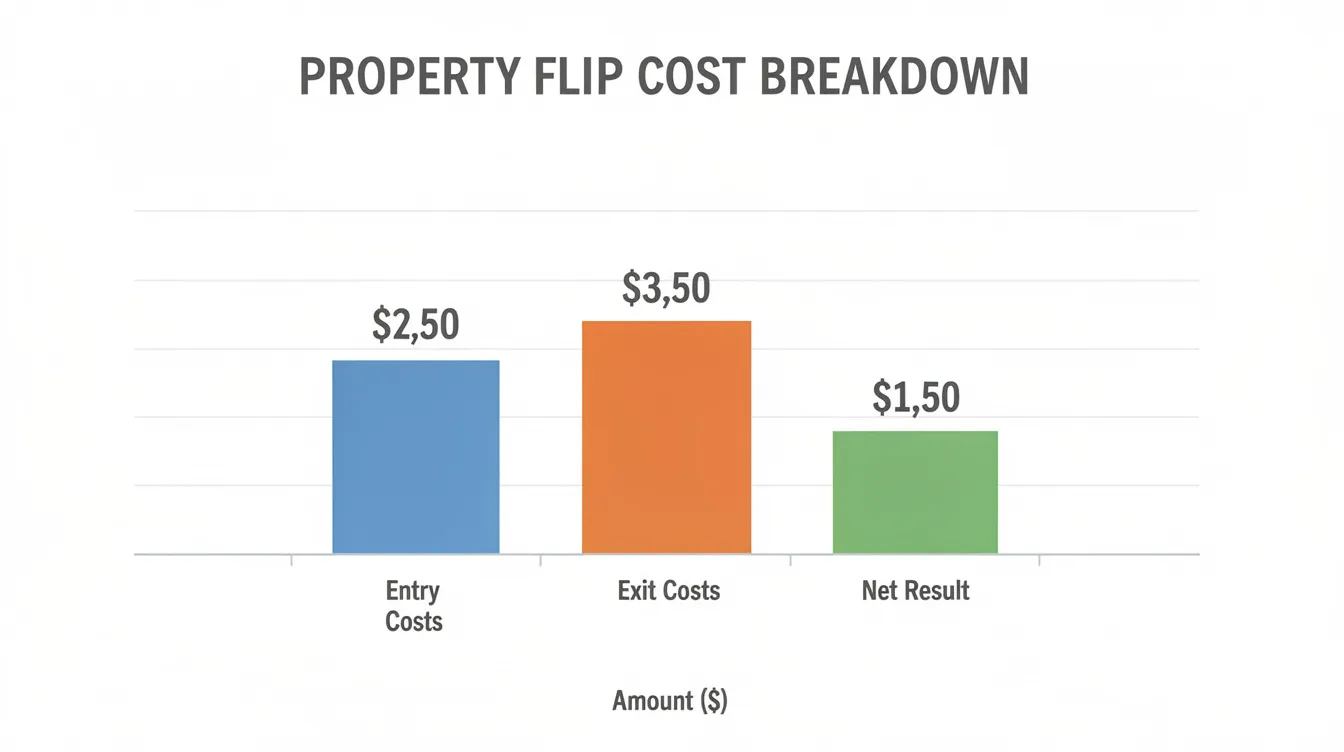
Every property flip involves three buckets of cost, and ignoring any one of them will produce a dangerously optimistic projection:
-
Entry costs: Buyer’s stamp duty (BSD), Additional Buyer’s Stamp Duty (ABSD) if applicable, legal and conveyancing fees (mandatory for property transactions), option fee, and down payment
-
Running costs: Loan interest, maintenance and sinking fund contributions, property tax, insurance, and vacancy drag
-
Exit costs: Seller’s Stamp Duty (SSD), agent commissions (typically 2%–3% of selling price plus 9% GST), conveyancing fees on the sale side, and early loan redemption penalties
Legal and conveyancing fees are mandatory for property transactions – flippers incur double legal fees when buying and selling within a short period. Agent commissions alone can run to S$40,000–S$60,000 on a S$2 million unit. And cumulative taxes and fees create a high barrier for profitable property flipping in Singapore.
The critical mistake most buyers make is framing a flip as “bought at S$1.5m, sold at S$1.7m, made S$200k.” That calculation ignores every cost listed above. To see how destructive these frictions really are, we need to examine SSD and BSD mechanics in detail.
How SSD and BSD Really Work Against Short-Term Flips
Now that we know the friction types, we zoom into the two unavoidable stamp duties that anchor Singapore’s anti-speculation stance: SSD and BSD. Together, they can consume 15–20% of a property’s value before a single agent fee or interest payment is counted.
Seller’s Stamp Duty (SSD): The Anti-Flipping Hammer
Seller’s Stamp Duty is a tax on sellers of residential property who dispose of their unit within the SSD holding period. SSD was introduced in February 2010 to curb speculation and discourage short-term property flipping to stabilize the market. It is calculated based on the higher of selling price or market value – crucially, regardless of whether the seller makes a profit or a loss.
SSD rates will increase from 4 July 2025. The new SSD holding period is four years. For properties acquired on or after that date, the current SSD ratesy) are:
|
Year of Disposal |
SSD Rate (Pre-4 July 2025) |
SSD Rate (From 4 July 2025) |
|---|---|---|
|
Within Year 1 |
12% |
16% |
|
Year 1–2 |
8% |
12% |
|
Year 2–3 |
4% |
8% |
|
Year 3–4 |
0% |
4% |
|
Beyond Year 4 |
0% |
0% |
SSD rates are 16% for the first year under new rules – an increase of four percentage points across every band compared to the prior regime. The holding period is measured from the date of exercising the Option to Purchase or signing the purchase agreement, not from TOP.
A point that catches many property flippers off guard: SSD applies regardless of profit or loss. If triggered, it is generally payable in full based on the higher of the selling price or market value. If you bought at S$2 million and are forced to sell at S$1.8 million within Year 1 under the new regime, you still owe 16% SSD on the S$1.8 million selling price or the market value, whichever is higher. This deepens losses substantially in a falling market.
Industrial and most commercial assets currently do not attract residential SSD, which is why some business owners shift focus there – but other risks (lease decay, zoning restrictions, JTC approval requirements) remain.
Buyer’s Stamp Duty (BSD): The Hidden Entry Drag
Buyer Stamp Duty (BSD) is payable on property purchases – every single one, with no exceptions for flippers. BSD rates for residential properties are tiered based on price, calculated on the higher of purchase price or market value. As of February 15, 2023, BSD rates start at 1%. The maximum BSD rate is 6% for properties over $3 million. BSD must be paid within 14 days of signing the document.
The current residential BSD tiers are:
|
Value Band |
BSD Rate |
|---|---|
|
First S$180,000 |
1% |
|
Next S$180,000 (S$180,001–S$360,000) |
2% |
|
Next S$640,000 (S$360,001–S$1,000,000) |
3% |
|
Next S$500,000 (S$1,000,001–S$1,500,000) |
4% |
|
Next S$1,500,000 (S$1,500,001–S$3,000,000) |
5% |
|
Above S$3,000,000 |
6% |
For a S$2,000,000 condo bought in 2025, BSD works out to approximately S$69,600. That money must be paid upfront – in cash or CPF – meaning property flippers are effectively starting every deal with a ~3.5% handicap before the unit even appreciates a dollar.
Why These Duties Kill Short-Term Speculation
Combine the two duties and the arithmetic becomes brutal. A 2-year flip must first recover roughly 3–4% BSD at entry and up to 12% SSD at exit (under the new regime), totalling approximately 15–16% of property value in stamp duty alone. For a S$1.8m–S$2.0m unit, this can easily exceed S$300,000 in stamp duty friction – before agent fees, legal costs, or financing charges enter the picture.
In a stable property market where annual property prices grow at 2–3%, a 2-year hold generates roughly 4–6% cumulative appreciation. That falls far short of the 15–16% stamp duty burden. The entry and exit costs for short-term flipping often exceed S$600,000 for high-value properties when ABSD is included. Short-term flipping is financially challenging due to high transaction costs at every stage.
To see exactly how this plays out with real numbers, let us walk through a detailed case study.
Case Study: A “Profitable” 2-Year Flip That Ends in Net Loss
This section presents a realistic, time-specific numerical example of a private condo purchased in 2024 and sold in 2026. Every line item uses current duty rates and fee ranges observed in actual transactions. The goal is to show the chasm between headline capital gain and net result after SSD, BSD, and other costs.
Deal Setup: Purchase in 2024, Exit in 2026
The property: A 2-bedroom new launch private condo in an Outside Central Region (OCR) location, purchased in August 2024 for S$1,800,000 under the progressive payment scheme.
Investor profile: A Singapore citizen already owning one HDB flat, buying this private residential property as an investment. As this is their second property, Additional Buyer’s Stamp Duty of 20% applies under the ABSD rates effective since 27 April 2023. Additional Buyer’s Stamp Duty (ABSD) can significantly raise upfront costs for buyers – in this case, 20% × S$1,800,000 = S$360,000.
Loan terms: 75% loan to value, 30-year tenure, floating interest rate averaging approximately 3.3% per annum over the hold period, subject to the total debt servicing ratio framework administered by the Monetary Authority of Singapore.
Entry cash layout:
-
Option fee (5%): S$90,000
-
Balance of down payment (20%): S$360,000
-
BSD: ~S$59,600
-
ABSD (second property): S$360,000
-
Legal fees (purchase side): ~S$3,500
-
Miscellaneous (valuation, caveat): ~S$1,500
Headline Capital Gain: What the Flip Looks Like on Paper
The investor sells in September 2026 for S$2,020,000 – an approximately 12.2% gross gain over 25 months, which looks attractive in isolation.
|
Purchase (Aug 2024) |
Sale (Sep 2026) |
|
|---|---|---|
|
Price |
S$1,800,000 |
S$2,020,000 |
|
Loan amount |
S$1,350,000 (75% LTV) |
Redeemed on sale |
|
Gross capital gain |
– |
S$220,000 |
Many social media “success stories” stop right here. The S$220,000 headline figure gets shared as proof that property flipping works. But this number ignores every friction cost that follows.
From Gross Gain to Net Reality: Full Cost Breakdown
Here is where the flip unravels. Since the property was acquired in August 2024 (pre-4 July 2025 rules), the SSD holding period is three years. Selling in September 2026 – approximately 25 months later – places the disposal in the Year 2 band, where SSD is 8%. Seller’s Stamp Duty applies to properties sold within the holding period, and SSD is calculated on the higher of selling price or market value.
|
Cost Item |
Amount |
Notes |
|---|---|---|
|
BSD (on purchase) |
S$59,600 |
Tiered BSD on S$1,800,000 |
|
ABSD (second property, SC) |
S$360,000 |
20% × S$1,800,000 |
|
SSD (Year 2, 8%) |
S$161,600 |
8% × S$2,020,000 sale price |
|
Seller’s agent commission + GST |
S$44,036 |
2% × S$2,020,000 + 9% GST |
|
Legal fees (purchase side) |
S$3,500 |
Standard conveyancing |
|
Legal fees (sale side) |
S$3,500 |
Standard conveyancing |
|
Loan interest (~25 months) |
S$40,000 |
~3.3% p.a. on progressive drawdown |
|
Bank prepayment penalty |
S$20,250 |
1.5% × S$1,350,000 outstanding |
|
Maintenance, property tax, insurance |
S$15,000 |
~S$7,200/year × ~2 years |
|
Staging and minor renovation |
S$8,000 |
Marketing preparation |
|
Total costs |
S$715,486 |
Net result: S$220,000 – S$715,486 = negative S$495,486.
Even if we remove ABSD (for example, if this were a genuine upgrade by owner-occupiers buying a home to live in, rather than a short-term speculative purchase), the remaining costs still total approximately S$355,486 – consuming the entire S$220,000 gross gain and producing a net loss of roughly S$135,000.
Alternative Scenario: Buying in 2025 Under the New SSD Regime
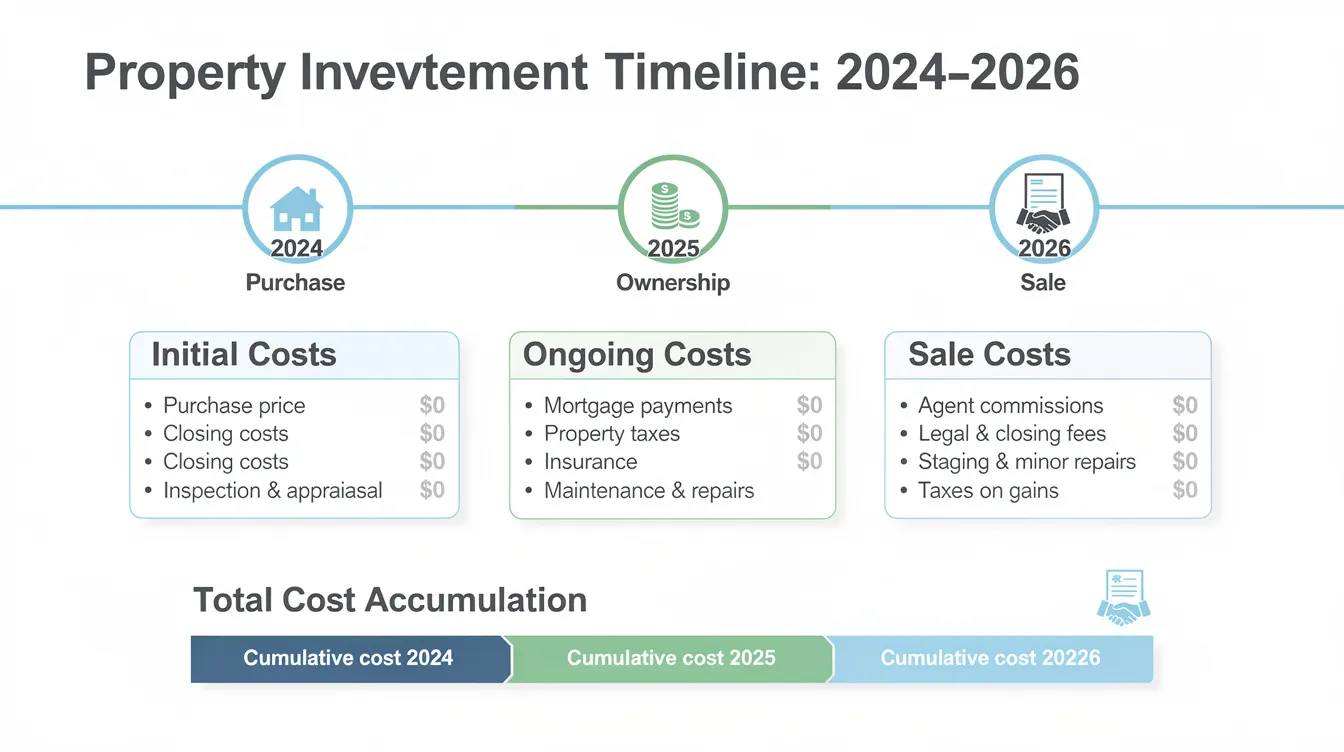
Now consider the same property purchased in August 2025 – after the 4 July 2025 SSD revision – and sold in August 2027 for S$2,020,000. Under the new rules, selling within Year 2 triggers an SSD rate of 12%.
SSD payable: 12% × S$2,020,000 = S$242,400.
That single line item already exceeds the S$220,000 gross capital gain by S$22,400. Before counting agent fees, legal fees, interest rates on the home loan, or any other cost, the investor is guaranteed a cash loss. The SSD liability alone makes the flip structurally unviable.
|
Factor |
2024 Purchase (Old Regime) |
2025 Purchase (New Regime) |
|---|---|---|
|
SSD holding period |
3 years |
4 years |
|
SSD rate (Year 2 sale) |
8% |
12% |
|
SSD amount on S$2,020,000 |
S$161,600 |
S$242,400 |
|
Gross gain consumed by SSD alone |
73% |
110% |
|
Net viability before other costs |
Marginal |
Impossible |
This is precisely why AESTHETIC HAVENS steers clients to treat Singapore property as a long-term, operational asset – not a trading instrument. The SSD window under the new regime means that to avoid SSD entirely, you must hold for at least four years, which fundamentally changes the risk-return calculus for short term flips.
Beyond Stamp Duty: Other Costs That Quietly Eat Your Flip
Even if SSD and BSD were marginally lower, multiple “small” line items often erode whatever margin remains. Property investors who focus only on stamp duty while ignoring financing, legal, and operational costs are building their projections on incomplete data.
Financing and Bank Penalties
Most residential mortgages in Singapore come with a lock-in period of two to three to four years. Early redemption during this window typically attracts a penalty of around 1.5% of the outstanding loan balance. On a S$1,350,000 loan, that is approximately S$20,250 – a cost that property flippers routinely omit from their spreadsheets.
Interest rate risk compounds the problem. If floating rates rise between purchase and sale, servicing costs during the hold period climb higher than projected. A shift from 3.0% to 4.0% on a S$1 million outstanding balance adds roughly S$10,000 per year in higher costs. For short term investors relying on thin margins, this can be the difference between a small gain and a loss.
Speculative flippers also tend to assume they can refinance or switch lenders without cost. In practice, break-funding fees, minimum notice periods, and partial redemption charges create additional friction that tightens the vice on cash flow.
Legal, Agency and Compliance Costs
Legal fees cover conveyancing, mortgage documentation, lodgement of caveats, liaising with developers and banks, and handling the completion process. These are not optional – they are mandatory for proper completion of any property purchase or sale. For a standard private condo transaction, legal fees generally run S$2,500–S$4,000 per side. Flippers incur double legal fees when buying and selling within a short period.
Agent commissions in the resale and sub sale transactions market typically range from 2% to 3% of the selling price, plus 9% GST if the agency is GST-registered. Achieving top dollar on a resale often requires professional photography, staging, and portal listings – all of which increase costs but may be necessary to realise the target selling price.
On the compliance side, the Inland Revenue Authority of Singapore requires proper stamp duty reporting and payment. Anti-money laundering checks apply to all property transactions. Any attempt to structure arrangements “off the books” to avoid stamp duty is a criminal offence under Singapore law.
Operational and Opportunity Costs
Maintenance fees, sinking fund contributions, property tax, and insurance run throughout the holding period. For a S$1.8m OCR condo, annual operational costs of S$5,000–S$7,000 are typical. Over a 2-year hold, that adds S$10,000–S$14,000 to total costs.
Vacancy risk matters too. If the unit sits empty while awaiting sale – or if rental yields are lower than projected – the flipper absorbs carrying costs with no offsetting income. Missing 6–12 months of rent can undermine flip economics entirely, especially when property prices are flat.
Then there is opportunity cost: capital tied up in a marginal flip – the down payment, BSD, ABSD, and legal fees – could be deployed into better-yielding assets. Industrial properties, commercial properties, or business-use spaces aligned with the buyer’s own operations often provide more stable returns. These are the areas where AESTHETIC HAVENS focuses, helping clients match real estate to business needs rather than speculative impulses.
Understanding these hidden costs sets the stage for the most dangerous element of all: the psychological traps that lead investors to ignore the numbers.
Common Misconceptions and How to Avoid Expensive Mistakes
AESTHETIC HAVENS regularly encounters the same errors in client spreadsheets and in online flipping “courses” that promise easy returns. Here are the three most damaging misconceptions – and clear counter-guidance.
“SSD Won’t Matter Because Prices Always Go Up”
This is the most persistent and expensive belief among property flippers. The assumption is that 8%–16% SSD will be easily absorbed by capital appreciation. But even at a healthy 4% annual growth rate, a 2-year hold produces only approximately 8.2% cumulative appreciation – often less than SSD alone under the new regime.
Singapore’s government has repeatedly demonstrated willingness to intervene aggressively. Cooling measures in 2013, 2018, December 2021, and April 2023 each tightened ABSD rates or SSD rules, sometimes with minimal warning. Property prices can stagnate or decline for extended periods after such interventions, trapping over-leveraged flippers who assumed perpetual growth.
A simple stress test: assume 0% price growth for the first two years and run your SSD calculation. If the deal only works with optimistic appreciation assumptions, it is speculation – not investment.
Ignoring BSD and ABSD in Profit Calculations
Many “ROI” screenshots circulating on social media ignore BSD and ABSD entirely, treating them as sunk entry costs rather than part of deal economics. This is a fundamental accounting error.
For Singapore citizens purchasing a second property post-April 2023, ABSD of 20% on a S$1.8m property purchase amounts to S$360,000. For permanent residents buying their first residential property, ABSD is 5%; for subsequent properties, it rises to 30% or 35%. Foreigners face a flat 60% ABSD on any residential property purchase. Entities and trusts pay up to 65%. These ABSD rates make flipping almost mathematically impossible for most buyer categories beyond first-time Singapore citizens.
The correct approach: always calculate returns on total cash outlay including all stamp duties, not just headline price gain versus purchase price.
Underestimating Timeline and Liquidity Risk
Selling a unit at the “ideal” price may take 3–6 months. During that period, the SSD clock continues ticking, interest accrues, and market sentiment can swing. In such cases, a property that would have been sold profitably at the 25-month mark might not find a buyer until month 30, potentially crossing into a lower SSD band – or remaining in a higher one if the minimum holding period has not been met.
Life events add another layer of risk. Business cash flow stress, relocation needs, or family circumstances can force a sale at exactly the wrong time, amplifying the SSD pain. HDB owners upgrading to private condominiums and HDB flats owners looking at new launches face similar timing pressures if they need to coordinate sale-and-purchase timelines.
Build a conservative exit window into every projection. Ensure sufficient liquidity so you are never forced into a fire-sale during the SSD window. And remember that for properties acquired from 4 July 2025, you need to hold for at least four years to avoid SSD entirely – a minimum holding period that fundamentally changes what “flipping” means.
After understanding all these frictions, costs, and risks, the conclusion is clear: investors need to rethink their approach to Singapore real estate.
Conclusion and Practical Next Steps
From SSD’s introduction in February 2010 through the latest SSD revision effective 4 July 2025, Singapore’s policy direction has been unambiguous: short-term flipping of residential units is structurally penalised. SSD was introduced in February 2010 to curb speculation, and every subsequent revision has tightened the screws further. The new SSD holding period of four years, with SSD rates starting at 16% in Year 1, makes the economics of short term flips increasingly untenable for most buyers.
The real question is no longer “Can I flip?” but “What holding period and asset type make sense for my objectives and risk profile?” National development policy in Singapore treats residential property as shelter first and investment second – and the stamp duty regime enforces that priority.
Here are your practical next steps:
-
Run a full net-of-all-costs calculator on any potential flip, including SSD, BSD, ABSD, loan interest, agent fees, legal fees, and prepayment penalties. Never evaluate a deal on headline gain alone.
-
Stress-test your numbers with 0% price growth and a 6-month delayed exit. If the deal only works under optimistic assumptions, walk away.
-
Consider pivoting to long-term holding strategies or to industrial and commercial properties where stamp duty dynamics and income yields differ materially from private residential.
-
Consult an independent advisory like AESTHETIC HAVENS to review your real estate portfolio and align it with your business or wealth-building goals instead of chasing quick flips. Specific advice tailored to your situation – whether you are looking at new launches, sub sales, or inherited property – can prevent six-figure mistakes.
-
Monitor policy changes actively. The Monetary Authority of Singapore and the Ministry of National Development have shown they will adjust cooling measures rapidly when speculative activity or a sharp rise in property prices warrants intervention.
Related topics worth exploring include industrial property yields, how to value mixed-use or logistics assets as part of an SME’s overall strategy, and structuring long-term holds for public housing upgraders moving into private condominiums.
Additional Resources and Tools
-
IRAS Stamp Duty Calculator: Use the Inland Revenue Authority of Singapore’s online calculator to verify BSD and SSD numbers for your specific property and timeline before committing to any deal.
-
Flipping Feasibility Checklist: AESTHETIC HAVENS provides a downloadable worksheet – “From Gross Gain to Net Reality” – that walks through every cost line from entry to exit, including SSD calculation, BSD tiers, financing costs, and agent commissions.
-
Case-Driven Property Analyses: AESTHETIC HAVENS regularly publishes case studies on industrial and business-use properties that offer more sustainable, income-based strategies than residential flipping – designed for business owners who want real estate to serve their operations, not their speculation instincts.

