


You will pay in cash upfront, then switch to a mix of CPF Ordinary Account funds and bank loan drawdowns as the building rises. The single biggest number to plan for is the TOP payment, typically about a quarter of the price, on top of stamp duty that comes due weeks before any of this even starts.
TL;DR:
- The biggest payment, usually around 25%, is due when the Temporary Occupation Permit is granted, typically around three to four years into construction.
- The initial booking fee must be paid in cash and cannot be covered by CPF or loans, which surprises many first-time buyers.
- Construction milestones trigger payments certified by the architect, not by dates, so delays can shift deadlines without changing percentage targets.
- Bank disbursements match certified stages, often with interest-only periods during construction, requiring early mortgage approval and careful planning of available funds.
- Variations like deferred payment schemes and HDB BTO schedules can shift payment timing and risk, so verifying your specific project’s schedule in the contract is essential.
Table of Contents
- How Does the Progressive Payment Schedule Work?
- What Triggers Each Payment Stage?
- Which Payments Use Cash, CPF, or a Bank Loan?
- How Do Bank Loan Disbursements Affect Your Repayments?
- Do All Projects Follow the Same Payment Structure?
- How Do You Budget for Each Payment Stage?
- What Happens If You Miss a Payment Deadline?
- A Consultant’s View on Planning Around the Schedule
- Plan Your Payment Schedule With Local Guidance
- Where to Verify Your Payment Figures
- Sources
How Does the Progressive Payment Schedule Work?
Singapore’s PPS follows a fixed sequence set by law, not by the developer’s marketing team. The Housing Developers (Control) Rules lock the milestone percentages, so every licensed private launch runs on roughly the same skeleton, even though timing between projects varies.
Here is the standard breakdown buyers can expect to see in their Sale and Purchase Agreement:
That adds up to 100% across the standard milestone structure used across most new-launch condos. Your actual S&P may group some construction stages differently, so treat this table as the pattern, not a substitute for reading your contract.
What Triggers Each Payment Stage?
Every stage in the schedule is tied to a physical construction event, certified by the project’s architect, not to a calendar date. That is why timelines shift when work is delayed, but the percentages themselves rarely do.
- Booking (OTP): you sign the Option to Purchase with a booking fee, commonly a percentage of price that credits toward the 5% due at this stage.
- S&P signing: within three weeks of OTP, you sign the Sale and Purchase Agreement and pay 15%. Stamp duty becomes payable around the same window, separate from this milestone.
- Foundation: 10% is billed once the foundation work is certified complete, usually within the first year after S&P.
- Reinforced concrete framework: another 10% follows as the structural skeleton goes up, typically 12 to 18 months into construction.
- Partition walls, roofing, doors/windows/wiring, car park/roads: four smaller stages of 5% each mark the building’s fit-out phases, spread across the following year or so.
- TOP: the largest single bill, around 25%, lands when the Temporary Occupation Permit is granted and you can legally collect keys.
- CSC: the final 15% is due at Certificate of Statutory Completion, usually 6 to 12 months after TOP.
For private launches, the full run from OTP to TOP typically takes three to four years, with CSC following six to twelve months later. HDB Build-To-Order flats run on a similar logic but stretch to three to five years, since BTO payments are spread across eleven separate construction milestones rather than the roughly ten used for private condos.
Which Payments Use Cash, CPF, or a Bank Loan?
Your booking fee has to be cash, full stop. No CPF and no loan can touch that first payment, which is one of the most common surprises for first-time buyers who assume everything can run through the mortgage from day one.
From the S&P stage onward, most buyers switch to a blend of CPF Ordinary Account savings and bank loan disbursements, once the necessary CPF approvals and loan documentation are in place. Here is how the switch typically plays out:
- Booking fee (5%): cash only, no exceptions.
- S&P and beyond: CPF OA becomes usable once you have submitted the required forms to the CPF Board, subject to your available balance and the property’s CPF withdrawal limits.
- Construction milestones: banks disburse loan funds progressively, matching each certified stage, so your loan offer needs to be signed and returned well before the first construction bill arrives.
- TOP and CSC: these two stages usually draw the largest CPF or loan amounts of the entire schedule, so confirm your available balance months in advance.
Pro Tip: Call your bank and check your CPF OA balance the moment you receive your S&P, not when the first construction milestone notice lands. Funding gaps discovered with only 14 days to pay are far harder to fix than gaps discovered with three months’ notice.
How Do Bank Loan Disbursements Affect Your Repayments?
Banks release BUC (building under construction) loan funds in step with each certified milestone, not as one lump sum at signing. Your monthly repayments typically begin the moment the first disbursement happens, calculated only on the amount released so far.
- Private property loans generally allow up to 75% Loan to Value, which sets the ceiling on how much of each stage the bank will fund.
- Many banks offer an interest-only period through construction, so your repayment only covers interest on the disbursed portion until TOP, when it usually converts to full principal and interest.
- Total Debt Servicing Ratio and Mortgage Servicing Ratio checks happen at approval, but they matter again later. A rising repayment as more of the loan gets disbursed can strain a budget that was only stress-tested against the initial drawdown.
Getting your mortgage pre-approval sorted early avoids a scramble when the foundation stage bill arrives faster than expected.
Do All Projects Follow the Same Payment Structure?
Not quite. Two variations show up often enough that you should know them before signing anything.
- Deferred Payment Scheme (DPS): some developers push a larger share of the price to TOP or CSC, easing early cash needs but concentrating risk at the back end of the schedule. These schemes are less common now but still surface on select projects, and they need careful financing checks since your loan and CPF timing shift too.
- Executive Condominiums: these generally follow the private PPS structure once fully privatized, but check your specific S&P since EC financing rules differ from both HDB and private condos.
Always verify the exact schedule in your own S&P. The percentages are legislated, but how they are grouped and labeled can vary slightly from project to project.
How Do You Budget for Each Payment Stage?
A calculator turns the abstract milestone table into real numbers you can act on. Before you touch one, run through this sequence:
- Confirm your exact milestone percentages and dates against your signed S&P, not a generic online example.
- Secure your loan offer letter and return it signed, so bank disbursement can happen quickly once a milestone is certified.
- Check your CPF OA balance and top it up if it will fall short of upcoming stages.
- Set aside your Buyer’s Stamp Duty and any Additional Buyer’s Stamp Duty as a separate cash reserve, since neither is part of the staged schedule.
- Reserve extra cash or CPF specifically for the TOP payment, the largest single bill you will face.
A progressive payment calculator takes purchase price, loan amount, interest rate, tenure, and CPF balance as inputs, then outputs your cash and CPF exposure at each stage. Running the numbers early often reveals whether your OA balance covers the S&P payment or whether you need a cash top-up before you even reach the construction stages. For a deeper look at how much you’ll need upfront, the downpayment breakdown for condos is worth reading alongside your calculator results.
What Happens If You Miss a Payment Deadline?
Milestone notices typically give you 14 days to pay once a construction stage is certified, and developers do enforce that window with late penalties. Set a calendar alert the moment your lawyer forwards a notice.
- Stamp duty is due within 14 days of signing, separately from any milestone bill, so budget it as its own line item, not part of your PPS math.
- Keep a small cash buffer beyond your planned CPF and loan amounts in case a disbursement is delayed on the bank’s end while your payment deadline keeps running.
Pro Tip: Loop your conveyancing lawyer into every milestone notice as soon as it arrives. They coordinate directly with the bank and CPF Board, and that handoff is usually where late payments get caught before they become penalties.
A Consultant’s View on Planning Around the Schedule
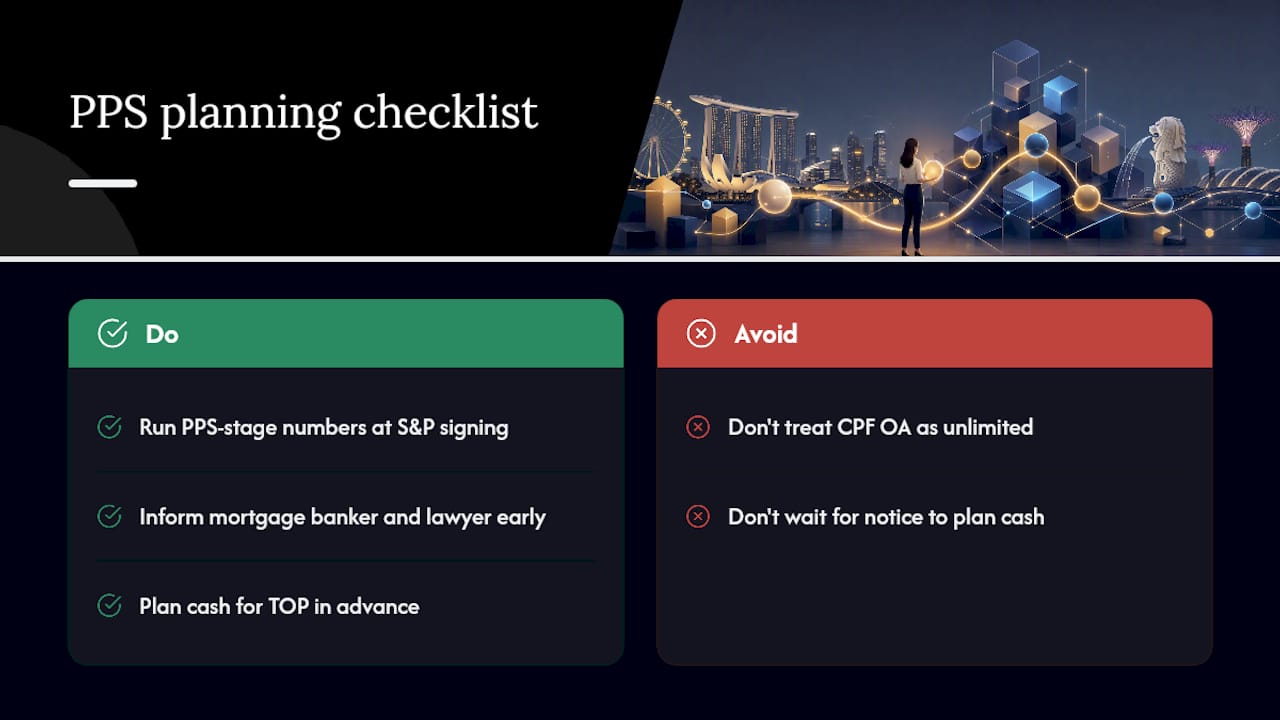
Buyers who get burned by the PPS almost always underestimated the TOP payment, not the smaller early stages. One client treated her CPF OA as a bottomless reserve through the construction milestones, only to find it thin by the time TOP arrived, forcing a late scramble for cash.
The fix is boring but effective: run your numbers against every stage the day you sign S&P, not the day a notice lands. Loop in your mortgage banker and conveyancing lawyer early, since both parties move faster when they already know your schedule.
— Aman
Plan Your Payment Schedule With Local Guidance
Coordinating a milestone cashflow plan across CPF, your bank, and your lawyer takes more than a spreadsheet. It takes someone who has walked other Singapore buyers through the exact same S&P clauses and disbursement timelines you’re facing now.

Professional real estate consultants can help buyers map out their full payment timeline before they sign anything, matching your loan offer, CPF balance, and stamp duty deadlines against the actual milestones in your contract. If you’re weighing a new launch purchase and want a clearer picture of how ownership structure affects your long-term plan, start with our guide to property title types and reach out for a walkthrough of your specific project’s schedule.
Where to Verify Your Payment Figures
- IRAS for current stamp duty rates and deadlines.
- MoneySmart’s calculator to model your own cash and CPF exposure by stage.
Sources
- IRAS – Stamp duty for property
- Construction loan progressive payment explained: Homejourney Guide
- Progressive Payment Calculator — MoneySmart


