


Most Singapore condo owners pay monthly condo maintenance fees that vary significantly depending on unit size, region, and the number of facilities in the development. The number on the price listing matters less than what backs it up: before you sign anything, ask for the audited accounts and the current sinking fund balance. A low monthly fee with a thin sinking fund is a bill you haven’t paid yet.
TL;DR:
- Fees significantly vary based on facility load, with larger developments featuring more amenities like pools and gyms, which raise costs.
- A low quoted fee relative to regional bands may indicate underfunded sinking funds, risking costly special levies for major repairs.
- The management fund covers daily operations, while the sinking fund is reserved for long-term capital repairs, and both are legally separate.
- Rising fees often result from contract inflation, utility costs, aging infrastructure, or increased insurance premiums, with sharp jumps triggered by special levies.
- Due diligence before purchasing should include reviewing audited financial statements and sinking fund trends to assess fee sustainability and potential future costs.
Table of Contents
- Condo Maintenance Fees by Region and Unit Size
- What Do Condo Fees Cover? Management Fund vs. Sinking Fund
- How Are Condo Maintenance Fees Calculated?
- Why Do Condo Maintenance Fees Go Up?
- How to Check a Condo’s Fee Health Before You Buy
- Can You Reduce or Manage Rising Maintenance Fees?
- What Happens if You Don’t Pay Condo Maintenance Fees?
- Author Credentials and How We Evaluate Fee Risk
- When a Low Maintenance Fee Is a Warning, Not a Win
- Get Professional Help With MCST Due Diligence
- Where to Verify These Facts
- Sources
Condo Maintenance Fees by Region and Unit Size
The fee you’re quoted depends heavily on where the development sits and how big your unit is, but the bigger swing factor is often facility load, not location. A 99-unit walk-up in the Outside Central Region (OCR) with a small pool and no tennis court runs a leaner budget than a 600-unit integrated project in the same postal district with three pools, a gym, function rooms, and round-the-clock concierge.
Indicative 2026 monthly bands reported for Singapore condos look roughly like this, according to LovelyHomes’ 2026 maintenance fee guide:
Three things drive the spread within each cell:
- Facility count and quality. A condo with a lap pool, a wading pool, a gym, tennis courts, and a clubhouse spreads those running costs across every unit, regardless of region.
- Unit count. Fixed costs like managing agent fees and security contracts get divided among fewer owners in a boutique development, so per-unit charges often run higher than in a large-scale project with the same amenities.
- Building age and system complexity. Newer condos with more elevators, smart access systems, and mechanical ventilation in basement carparks carry higher recurring maintenance loads than older, simpler designs.
If your quoted fee sits meaningfully below the low end of its band for that region and unit size, don’t treat it as a bargain. Ask why. It could mean a genuinely lean, well-run building, or it could mean the sinking fund is being starved to keep the monthly number attractive to buyers. The only way to tell the difference is to look at the actual reserve balance, which the next sections cover.
What Do Condo Fees Cover? Management Fund vs. Sinking Fund
Every condo maintenance fee splits into two separate, legally ring-fenced pots under the Building Maintenance and Strata Management Act (BMSMA) 2004: the management fund and the sinking fund. They cannot be commingled, and understanding the difference tells you exactly what you’re paying for month to month versus what’s being saved for later.
The management fund covers day-to-day running costs. This is the money that keeps the lights on, the guards at the gate, and the pool clean:
- Security personnel and access control systems
- Cleaning of common areas, corridors, and landscaping
- Utilities for common property, including lighting, water for shared facilities, and pump operation
- Managing agent fees (the professional firm running operations on the MCST’s behalf)
- Routine lift servicing and minor repairs
- Insurance premiums for the common property
- Day-to-day M&E (mechanical and electrical) upkeep
The sinking fund is the long-term capital reserve, set aside for expenses that come around every decade or two rather than every month:
- Lift replacement or full modernization
- Façade repainting and repair
- Waterproofing of roofs, planters, and podiums
- Major M&E overhauls, including pump replacements and switchgear upgrades
- Structural repairs and large-scale common property refurbishment
The BMSMA sets a statutory floor: sinking fund contributions must equal at least 10% of total maintenance levies collected, though many well-managed developments allocate more given the capital cycles ahead. Building maintenance practices published by the Building and Construction Authority (BCA) frame this split as central to responsible estate management. Most invoices also carry GST on top of the base contribution, so check whether a quoted figure is inclusive or exclusive before comparing two developments side by side.
How Are Condo Maintenance Fees Calculated?
Condo maintenance fees aren’t set by unit size alone. They run on a formula: share value × contribution rate, approved annually by the Management Corporation Strata Title (MCST) at its Annual General Meeting.
Every unit in a strata development is assigned a share value when the project is registered. This number reflects the unit’s proportionate stake in the common property, typically weighted by floor area, unit type, and sometimes attributes like a private garden or a larger balcony. You’ll find it in the strata title plan lodged with the Singapore Land Authority, and it’s worth checking directly rather than assuming it tracks floor area in a simple straight line.
Here’s the calculation in practice:
- The MCST council prepares an annual budget covering projected management and sinking fund expenditure.
- The budget goes to the AGM (or an EGM if urgent) for owner approval, where the contribution rate per share value unit gets set.
- Your monthly fee equals your unit’s share value multiplied by that approved rate, plus GST where applicable.
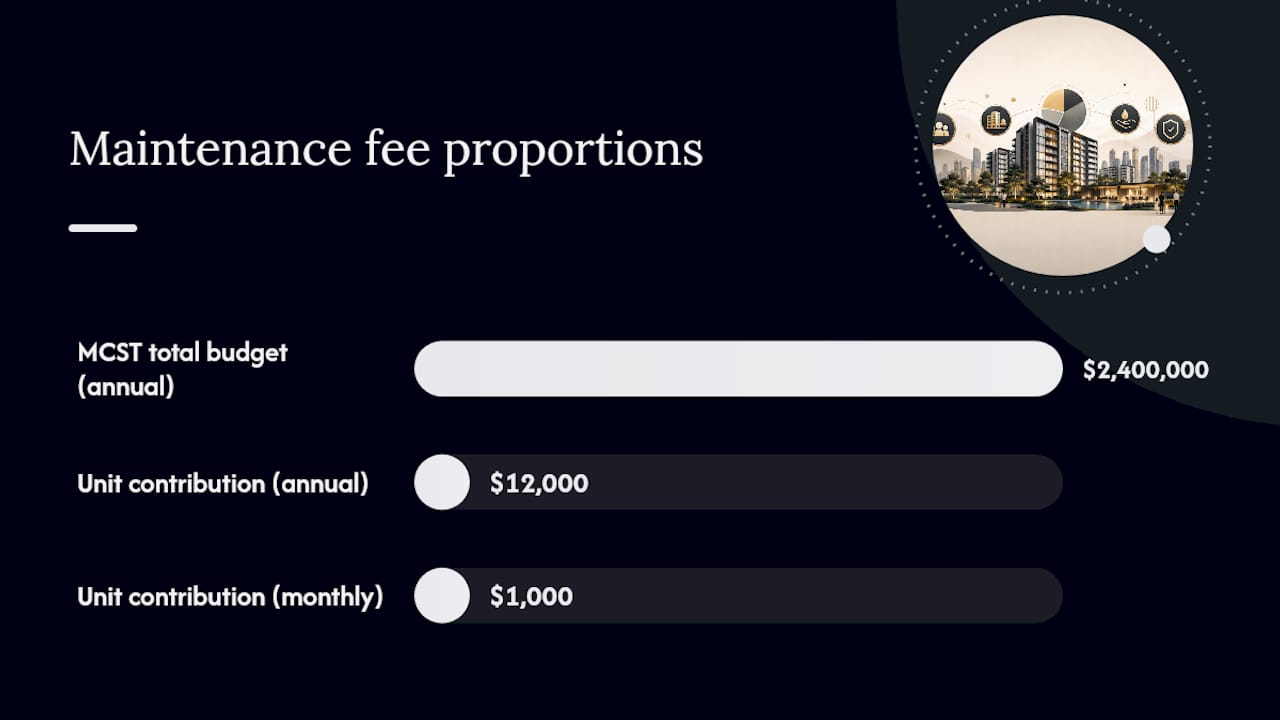
If the MCST approves a $2,400,000 total budget for the year, that unit’s annual contribution works out to about $12,000, or $1,000 a month before GST. Ask for the total share value figure at any AGM you attend so you can run this math yourself.*
Share value is fixed at registration and is nearly impossible to change after the fact, requiring unanimous consent from every subsidiary proprietor plus approval from the Commissioner of Buildings. It also doubles as your voting weight at general meetings, so a unit’s share value determines both its fee burden and its say in how the estate is run.
Why Do Condo Maintenance Fees Go Up?
Fees rarely fall. They climb almost every year for reasons that are predictable if you know where to look, and they occasionally jump sharply when a special levy gets called.
Recurring increases come from a handful of sources:
- Contract and wage inflation. Security and cleaning contracts get renegotiated every few years, and labor costs in Singapore have been rising steadily across facilities management.
- Utility and supply cost increases. Water, electricity for common areas, and replacement parts for pumps and lifts all track broader price trends.
- Aging plant. A 15-year-old lift needs more frequent servicing than a 2-year-old one, and older switchgear and pumps fail more often as they approach end of life.
- Rising insurance premiums, particularly after regional claims events push underwriters to reprice common property cover.
Special levies are a different animal entirely: a one-off charge layered on top of your regular condo maintenance fees to fund a specific capital project the sinking fund can’t cover on its own. Lift modernization, major façade works, or a full waterproofing overhaul commonly trigger them. Reported cases in Singapore have ranged from a few thousand dollars to tens of thousands per unit, depending on the scope of works and how underfunded the sinking fund was going in, according to SGInfoProperty’s analysis of fee shock by unit type.
Pro Tip: A sinking fund that’s been quietly underfunded for years doesn’t announce itself until the lift needs replacing. By then, the MCST has one option: a special levy, often due within a tight window. Check the trend, not just the snapshot.

How to Check a Condo’s Fee Health Before You Buy
Due diligence on maintenance fees happens before you commit, not after you’ve moved in and received your first AGM notice about a special levy. Request these documents from the seller’s agent or the managing agent directly:
- Audited accounts for the past three years. These show actual income and expenditure against budget, and reveal whether the MCST has been running deficits.
- Current sinking fund balance and recent contribution history. A number in isolation means little; you want to see the trend.
- Minutes from the last two or three AGMs. Look specifically for any special levy votes, deferred maintenance discussions, or disputes over the managing agent’s performance.
- The current year’s approved budget. Compare it against last year’s to see how fast contributions are rising.
- Share value schedule. Confirms your unit’s proportionate obligation and voting weight.
While reviewing these, watch for red flags that suggest trouble ahead:
- A sinking fund balance that’s flat or declining year over year despite regular contributions
- Repeated special levies within a five-year window, suggesting chronic underfunding rather than one bad year
- An unusually high staff headcount relative to unit count, often a sign of inefficient contracts rather than better service
- Integrated developments sharing infrastructure across a residential MCST and a commercial or retail MCST, which can create disputes over cost allocation between the two bodies
For a rough benchmark, a well-run development that’s five to ten years old should be holding sinking fund reserves equal to roughly 24 months of total management levies, a guideline cited in LovelyHomes’ 2026 guide. Compare that per-unit reserve figure and the fee trend over the last three to five years against similar developments nearby. If you’re also weighing total ownership costs, our breakdown of condo down payment requirements covers how maintenance fees fit into the bigger monthly picture, and our MCST homeowner’s guide walks through the governance structure in more depth.
Can You Reduce or Manage Rising Maintenance Fees?
Owners aren’t powerless here, and MCST councils have real levers to slow fee growth without cutting service quality.
On the procurement side, competitive tendering every contract cycle, rather than automatically renewing with the incumbent vendor, keeps security and cleaning costs honest. Building in clear key performance indicators and locking contract length with a CPI-linked escalation clause (instead of an open-ended annual increase) protects the budget from arbitrary hikes. Detailed guidance on structuring maintenance contracts and phasing major works, including door and access-system upkeep, is covered in this condo maintenance planning resource.
Operational efficiencies add up over time:
- Switching common-area lighting to LED cuts electricity costs measurably across a large property
- Scheduling pool and pump maintenance preventively, rather than reactively after a breakdown, extends equipment life and avoids emergency callout premiums
- A structured preventive M&E program catches small failures before they become five-figure repairs
Pro Tip: If you own a unit, the single highest-leverage move is joining the management council. You get direct visibility into invoices, audit findings, and vendor contracts, and a vote on whether a big-ticket item gets funded through a staged levy or an immediate lump sum. Staged CapEx phasing almost always beats a surprise special levy.
Owners who don’t want a council seat can still push for accountability by reading the audited accounts before every AGM and asking pointed questions about any line item that jumped year over year.
What Happens if You Don’t Pay Condo Maintenance Fees?
Non-payment isn’t a soft consequence in Singapore. Under the BMSMA, the MCST has statutory recovery powers, and an owner cannot be lawfully exempted from an AGM-approved levy just because they disagree with the amount or dispute a specific expense, as outlined in LovelyHomes’ guide to MCST mechanics.
Unpaid fees typically escalate in stages:
- A formal demand letter, usually with interest accruing on the overdue amount
- Legal action in the Small Claims Tribunal or State Courts for the outstanding sum
- A charge registered against the unit’s title, which can block a future sale or refinancing until cleared
If you believe a charge was levied unfairly, the Strata Titles Board (STB) is the first stop for dispute resolution, handling disagreements over contribution amounts, by-law interpretation, and MCST decisions before matters escalate further. The practical move if you’re disputing a demand is to raise it in writing immediately, request the underlying invoice or budget line, and pursue it through the STB rather than simply withholding payment, since withholding doesn’t pause the interest or the recovery process.
Author Credentials and How We Evaluate Fee Risk
This guide reflects the due-diligence approach Aman Aboobucker applies when advising buyers under ERA Realtors on private residential purchases in Singapore, drawing on the governance framework set out in the BMSMA and BCA’s estate management guidance.
The method is straightforward: pull three years of audited accounts, model a 10-year capital expenditure forecast against the current sinking fund trajectory, and flag the probability of a special levy within that window based on the building’s age and system inventory. This isn’t guesswork. A 20-year-old development with original lifts and no façade work since TOP carries a materially different risk profile than a 5-year-old building with the same monthly fee.
Buyers weighing multiple shortlisted units, particularly across different regions or developer track records, tend to benefit most from a professional review when the numbers on paper look similar but the underlying reserve health doesn’t. A typical review takes a few days once the seller’s agent releases the MCST documents, and the deliverable is a plain comparison of fee sustainability across your shortlist.
When a Low Maintenance Fee Is a Warning, Not a Win
I’ve seen this pattern often enough to trust it completely: a buyer falls for a condo because the maintenance fee is $200 cheaper than a comparable unit two blocks over, only to discover eighteen months later that the sinking fund covers barely four months of operating expenditure. Then the lifts need replacing, and everyone gets a letter about a special levy that costs more than two years of the savings they thought they’d locked in.
Low fees feel like a win at signing. They rarely stay that way once the building hits its first major capital cycle. The number that actually protects you is the sinking fund balance relative to the building’s age and system inventory, not the line item on the listing.
If a fee looks unusually low for the region and unit size, that’s not a reason to walk away. It’s a reason to ask harder questions before you commit to years of ownership under that MCST’s decisions.
— Aman
Get Professional Help With MCST Due Diligence
Reading three years of audited accounts and projecting a sinking fund’s ten-year trajectory takes time most buyers don’t have during an active offer window. Professional services are available that review MCST financials, AGM minutes, and share value schedules as part of the purchase process, helping buyers understand a development’s fee history and reserve health with respect to future costs.

The service covers three concrete pieces: a review of the audited accounts and sinking fund trend, a capital expenditure forecast flagging likely special-levy exposure, and support preparing questions or objections ahead of an AGM if you’re already an owner. For buyers still comparing options, this pairs naturally with a broader look at property title types and ownership structures, since how a unit is held affects your standing in strata disputes down the line. Reach out through our site to start a review before your option period closes.
Where to Verify These Facts
Every figure and legal claim in this guide traces back to a source you can check directly.
- URA’s private residential ownership guidance covers the regulatory context around condo ownership.
- LovelyHomes’ 2026 maintenance fee guide provided the regional fee bands and sinking fund benchmarks used throughout this article.
Sources
- URA: Buying property — private home: condominiums
- Singapore Condo Maintenance Fees & MCST Guide 2026 | LovelyHomes


