


Singapore Permanent Residents can buy private condominiums and apartments with no restrictions, and can buy HDB resale flats once they clear specific eligibility hurdles. The three constraints that trip up most PR buyers: HDB resale generally requires three years of PR status, the PR Additional Buyer’s Stamp Duty ladder adds a steep cost on top of Buyer’s Stamp Duty, and CPF or bank financing comes with tighter limits than what citizens get. Before you make an offer, check your HFE eligibility, confirm SPR/EIP quota space, and run the numbers on CPF lease-to-95 limits.
TL;DR:
- PR buyers must verify quota levels and family eligibility before viewing HDB resale flats, as these restrictions often cause purchase failures.
- The three-year PR holding period is crucial for HDB resale eligibility, but family nucleus requirements and quota limits are common pitfalls to check early.
- PRs face higher Additional Buyer’s Stamp Duty rates on second and third property purchases, significantly impacting short-term investment returns.
- Bank financing is more limited for PRs due to the lease-to-95 rule and the inability to access HDB concessionary loans, requiring careful financial planning.
- Approval for mainland landed properties involves discretionary screening by SLA, with longer PR tenure and local ties improving chances but not guaranteeing approval.
Table of Contents
- PR Property Rules Singapore: What You Can and Cannot Buy
- Can a PR Buy an HDB Resale Flat After Three Years?
- How Much Stamp Duty Does a PR Pay on Property?
- What Financing and CPF Rules Apply to PR Buyers?
- Do PRs Need Approval to Buy Landed Property?
- How Long Does the PR Property Buying Process Take?
- What Mistakes Do PR Buyers Commonly Make?
- Why PR Buyers Should Rethink the Capital Gains Playbook
- An Editorial Take on Buying Property as a PR in 2026
- Get Help Navigating PR Property Purchase Rules
- Where to Verify These Rules Yourself
- Sources
PR Property Rules Singapore: What You Can and Cannot Buy
Your PR status opens most of the private market immediately, but public housing and landed property come with real gatekeeping. Here’s the category breakdown that actually matters when you’re deciding where to put your money.
- Private condominiums and apartments: Fully accessible from the day your PR is approved, with no waiting period and no quota checks.
- Executive Condominiums (ECs): New ECs are reserved for citizen households during the initial sales launch. PRs can only buy an EC on the resale market, and only once it has passed its five-year Minimum Occupation Period and been privatized after ten years for full open-market eligibility.
- HDB Build-To-Order, Prime, and Plus flats: Off the table entirely. These new-flat schemes are reserved for citizen applicants.
- HDB resale flats: The main public-housing route open to PRs, but gated by the three-year holding rule and family nucleus requirements, covered in detail below.
- Landed property on mainland Singapore: Requires approval under the Residential Property Act, administered by the Singapore Land Authority, and that approval is discretionary rather than automatic.
- Sentosa Cove landed homes: Subject to the same Residential Property Act framework, but SLA has historically approved owner-occupation purchases there more readily than mainland landed applications.
If you’re weighing HDB against private ownership as your entry point, the trade-offs in our HDB versus private property comparison are worth reading before you commit to either path.
Can a PR Buy an HDB Resale Flat After Three Years?
Yes, but the three-year clock and your household composition both need to check out before you go house hunting. Here’s how the eligibility actually works.
- Confirm your three-year PR holding period. HDB calculates this from the date PR status was granted, and at least one applicant in the resale purchase typically needs to meet this threshold. A common exception: if a Singapore citizen co-buys with you, the three-year rule sometimes does not apply to the citizen party, though the PR applicant’s own eligibility is still assessed.
- Verify your family nucleus qualifies. HDB accepts a PR married to a citizen spouse, two PRs married to each other, or a PR buying with parents or children under specific schemes. A single PR applying alone generally cannot buy an HDB resale flat under the standard Public Scheme.
- Check the SPR quota and Ethnic Integration Policy limits for the specific block and neighborhood. These caps exist independently of your personal eligibility, and HDB’s EIP and SPR quota e-service lets you check before you commit to viewing a unit, let alone making an offer.
- Understand your grant and loan position as a PR household. Most CPF housing grants are reserved for citizen households or citizen-PR combinations under narrower conditions, and PR buyers cannot access HDB’s concessionary loan at all, a distinction covered fully in the financing section below.
Skipping step three is the single most common reason PR offers fall through after they’ve already been made.
How Much Stamp Duty Does a PR Pay on Property?
Every property purchase in Singapore triggers Buyer’s Stamp Duty, calculated on a progressive scale based on purchase price, with exact thresholds published by IRAS). On top of that, PRs face their own Additional Buyer’s Stamp Duty ladder, which is what actually reshapes the economics of a purchase.
- A PR buying their first residential property pays ABSD at a rate higher than a citizen’s first purchase, but lower than a foreigner’s.
- A PR buying a second residential property jumps to a substantially higher ABSD rate.
- A PR buying a third or subsequent property faces the steepest tier on the ladder.
Pro Tip: Run the ABSD math before you fall in love with a unit. For joint purchases, IRAS calculates ABSD based on the profile of the buyer with the higher liability, so pairing a PR with a citizen spouse does not automatically get you the citizen rate.
ABSD is due within a strict window after you exercise the Option to Purchase, and IRAS enforces that deadline without much flexibility. Some buyers try “decoupling,” transferring partial ownership to a spouse to reset ABSD exposure on a future purchase, but IRAS scrutinizes these transactions closely and reliefs only apply under narrow, specific conditions. If ABSD math is new territory for you, our breakdown of ABSD rates and exemptions walks through the calculation in more depth.
What Financing and CPF Rules Apply to PR Buyers?
PR buyers finance property differently than citizens in three specific ways, and each one affects how much you can actually offer on a unit.
- CPF Ordinary Account funds can go toward your purchase, but the lease-to-95 rule caps usage when a flat’s remaining lease can’t cover the youngest buyer until age 95. Older leasehold units can quietly shrink your CPF-funded budget.
- HDB’s concessionary loan is off-limits to PRs. You’ll need bank financing, which comes with different Loan-to-Value caps than HDB loans offer, generally requiring a larger cash or CPF downpayment upfront.
- MAS’s Total Debt Servicing Ratio and Mortgage Servicing Ratio rules cap how much of your income can go toward debt repayments, and for joint applications, banks generally weight both incomes but apply haircuts to variable income sources.
Pro Tip: Get your Letter of Offer from a bank before you exercise the Option to Purchase, not after. PR applicants sometimes assume approval is a formality and end up racing the clock once ABSD deadlines start ticking.
Before applying, gather your income documents, CPF statements, and existing loan records, and check the unit’s remaining lease against your CPF eligibility. Our guide to CPF usage on property covers the lease-to-95 mechanics in more detail, and understanding tenure helps you spot lease risk before it becomes a financing problem.

Do PRs Need Approval to Buy Landed Property?
Mainland landed property purchases by PRs typically require approval under the Residential Property Act, and SLA does not treat that approval as a formality.
- SLA reviews applications against criteria that consider your economic contribution and ties to Singapore, and processing an assessment typically takes about 30 working days once your documentation is complete.
- Expect to submit proof of PR status duration, financial standing, and sometimes a statement on how the property will be used.
- Sentosa Cove sits under the same Residential Property Act but runs through a distinct approval channel, and SLA has generally tended to approve owner-occupation purchases there more readily than mainland landed property applications.
- Buyers with longer PR tenure and stronger documented local ties tend to see smoother outcomes, though SLA’s discretion means no application is guaranteed.
How Long Does the PR Property Buying Process Take?
The resale process runs on a specific sequence, and missing a step out of order is where most delays happen.
- Apply for your HFE letter through the HDB Resale Portal using SingPass. The HFE letter confirms your eligibility, your CPF usage limits, and any grant entitlement before you start viewing units.
- Exercise the Option to Purchase once you’ve found a flat and negotiated terms, using HDB’s prescribed OTP form rather than any private agreement.
- Pay ABSD within the statutory deadline, which IRAS ties to the date you exercise the option, not the completion date.
- Complete the resale transaction, finalizing financing, CPF disbursement, and the transfer with HDB.
Prepare your PR approval date documentation, marriage certificate if applicable, proof of disposal for any prior private property, and bank pre-approval well before you start the HFE application. HFE letters carry a limited validity window, and letting one lapse mid-search means restarting the eligibility check from scratch.
What Mistakes Do PR Buyers Commonly Make?
Most aborted PR purchases trace back to the same handful of oversights, and catching them early saves both time and money.
- Making an offer before confirming SPR/EIP quota space in the specific block, only to discover the quota is full.
- Assuming overseas property ownership doesn’t matter, when HDB requires disposal within a specified window of any private residential property, local or foreign.
- Relying on CPF funds for a unit with a short remaining lease, then discovering the lease-to-95 rule caps usage below what’s needed.
- Attempting ABSD decoupling or short-hold speculative purchases without modeling Seller’s Stamp Duty exposure on a fast resale.
| Risk area | What to check | When to check it |
|---|---|---|
| SPR/EIP quota | Block and neighborhood quota via HDB e-service | Before viewing any unit |
| Overseas property | Disposal window requirement | Before applying for HFE letter |
| CPF lease-to-95 | Remaining lease versus youngest buyer’s age | Before relying on CPF for downpayment |
| ABSD exposure | Buyer profile and joint-purchase calculation | Before exercising Option to Purchase |
Why PR Buyers Should Rethink the Capital Gains Playbook
The PR ABSD ladder changes the math on residential property in a way that a lot of buyers underestimate until they’re staring at the stamp duty bill. A second residential purchase now carries a cost that eats meaningfully into any short-term appreciation, which means the properties that make sense for PRs today are the ones that earn their keep through rental yield or genuine owner-occupation utility, not a quick flip.
That’s part of why some PR investors look past residential altogether. Commercial and industrial strata units fall outside ABSD entirely, and while they come with their own leasehold and tenant-risk trade-offs, they’re worth modeling alongside a straight condo purchase. Our guide to assessing commercial property walks through what that comparison actually looks like.
The gap between a good PR property decision and a costly one usually isn’t the purchase price. It’s whether the buyer modeled ABSD, quota checks, and financing limits before falling for a unit, rather than after.
Aman Aboobucker and the Aesthetic Havens team work through exactly this sequence with PR clients: eligibility review, quota verification, SLA liaison where landed property is in play, and financing coordination with lenders familiar with experienced real estate agents for PR loan structures.
An Editorial Take on Buying Property as a PR in 2026
The rules haven’t gotten simpler this year, and I don’t expect them to. What’s changed is how much the ABSD ladder now dominates the decision tree for PR buyers, more than eligibility technicalities ever did. A lot of PR buyers still approach this the way a citizen would, chasing appreciation on a second unit, and get blindsided by a stamp duty bill that erases years of expected gains.
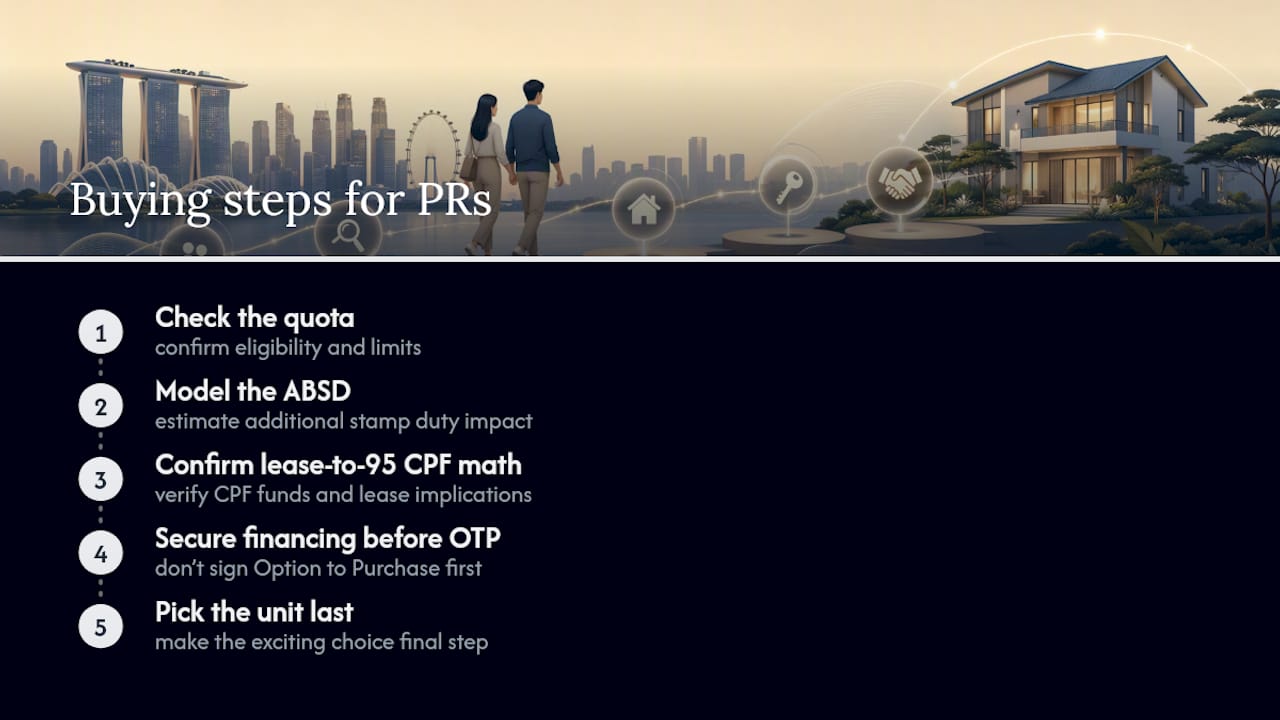
Where the conventional advice falls short is treating HDB resale eligibility as the hard part. It isn’t. The three-year rule and family nucleus checks are mechanical. What actually derails purchases is sequencing: buyers who exercise an Option to Purchase before confirming financing, or who assume a foreign property they still own won’t matter.
If you’re a PR reading this before you’ve made an offer, do the boring things first. Check the quota. Model the ABSD. Confirm your lease-to-95 CPF math. The exciting part, the unit itself, should be the last decision you make, not the first.
— Aman
Get Help Navigating PR Property Purchase Rules
Aesthetic Havens works through eligibility reviews, HFE checks, SPR/EIP quota verification, SLA application support for landed purchases, and mortgage coordination with lenders who understand PR loan structures. Every one of those steps has a deadline or a document requirement that’s easy to miss on your own, especially when you’re juggling ABSD timing against your Option to Purchase.
If you’re weighing your first HDB resale purchase against a private condo, or trying to figure out whether landed property approval is realistic given your PR tenure, a property consultant can save you from the costliest mistakes before they happen. Book an eligibility review with our team and get a clear picture of what you can buy, what it will cost, and how long approvals will actually take before you make an offer.
Where to Verify These Rules Yourself
Every rule in this guide traces back to a regulator, and checking directly is always worth the ten minutes.
- HDB for HFE letters, resale eligibility, and the EIP/SPR quota checker.
- SLA for Residential Property Act approvals and landed property criteria.
- MAS publishes current TDSR and MSR frameworks that determine your borrowing capacity as a PR applicant.
Sources
- Housing & Development Board (HDB) — Buying a flat / Resale / Eligibility
- HDB — Buying a flat (HFE letter guidance)
- Singapore Land Authority — Foreign ownership of property
Recommended
- Foreigner’s Guide to Buying Property in Singapore (2025 Regulations & Taxes) | Aesthetic Havens
- Singapore Property Cooling Measures in 2025 | Aesthetic Havens
- New Launch vs Resale 2026: Singapore Property Market Guide | Aesthetic Havens
- CCR vs OCR in 2026: Where is the Better Value for Money? | Aesthetic Havens


