


Progressive payment in Singapore spreads your purchase price across certified construction milestones instead of one lump sum at completion. If you’re buying a new launch, an executive condo (EC), or any private property still under construction (BUC), the Progressive Payment Scheme (PPS) governs how and when you pay.
Your earliest cash hit is the biggest surprise for most first-time buyers: roughly 5% at booking, then another 15% to 20% on signing the Sale & Purchase Agreement (S&P). That’s about a quarter of your purchase price committed before a single wall goes up. After that, payments follow certified construction stages until Temporary Occupation Permit (TOP) and Certificate of Statutory Completion (CSC).
Three funding sources cover these calls, and the order matters:
- Cash, usually needed first for booking and often for stamp duty
- CPF Ordinary Account funds, subject to CPF Board withdrawal rules
- Bank loan disbursement, released progressively depending on your loan-to-value (LTV) ratio
Key Takeaways
Progressive payment in Singapore ties every payment to a certified construction milestone, with roughly a quarter of your price due before S&P signing and your LTV ratio determining how much cash you need at every stage after that.
| Point | Details |
|---|---|
| Early cash exposure | Expect about 5% at booking and 15% to 20% at S&P signing, paid mostly in cash before CPF or loan funds apply. |
| TOP is the biggest call | The Temporary Occupation Permit stage often triggers a single significant payment. |
| LTV changes your timeline | A 75% LTV buyer sees loan funds cover stages earlier than a 45% LTV buyer, who carries more cash and CPF exposure longer. |
| Budget beyond the schedule | Stamp duty, legal fees, and post-TOP costs like sinking funds need their own cash buffer of 5%. |
| Get your S&P reviewed | Aesthetic Havens models your cash and CPF exposure stage by stage and checks your S&P against your bank’s drawdown terms. |
Table of Contents
- How Does the Progressive Payment Scheme Work in Singapore?
- What Are the Typical Payment Stages and Percentages?
- When Can You Use CPF and Bank Loans for Each Stage?
- What Other Costs Should You Budget Alongside PPS?
- How Do You Plan Cashflow Across the Payment Timeline?
- What Happens If a Payment Is Disputed or Delayed?
- Get Your Payment Schedule Reviewed Before You Sign
- Frequently Asked Questions
- Sources
How Does the Progressive Payment Scheme Work in Singapore?
The mechanism is straightforward once you see it laid out. A developer completes a construction milestone, an architect or professional engineer certifies it, and the developer’s lawyer issues a payment notice to you or your conveyancing lawyer. You typically have 14 days to pay from the date of that notice, though the exact window sits in your S&P.
PPS applies almost universally to three property categories in Singapore:
- Private new launch condominiums sold while under construction
- Executive condominiums (ECs), which follow a near-identical structure to private BUC projects
- Any private residential unit still classified as “building under construction” at the point of purchase
HDB’s own new-flat process follows a comparable staged logic, tying payments to milestones in the agreement for lease, though the percentages and documentation differ from private PPS.
Here’s the part buyers skip and shouldn’t: your S&P is the only document that legally controls your payment schedule. Marketing brochures, showflat agents, and even this article describe typical patterns. Your S&P states the actual numbers, deadlines, and penalty clauses that apply to your unit. Read it before you sign, not after your lawyer forwards it for record-keeping.
What Are the Typical Payment Stages and Percentages?
Every S&P sets its own numbers, but most private BUC projects in Singapore follow a recognizable rhythm as explained in pre-construction deposit structures explained for Canadian buyers. The table below reflects the pattern used across most new launches and ECs, consistent with how MoneySmart’s progressive payment calculator frames instalment stages for buildings under construction.
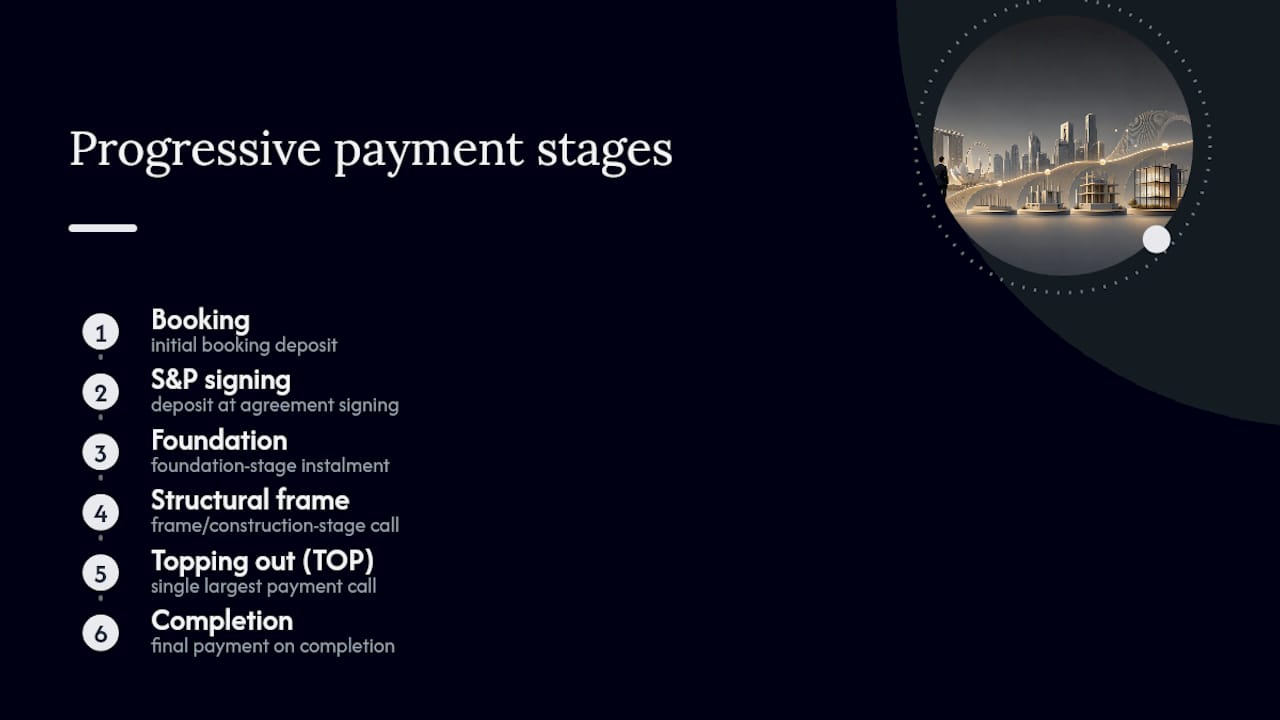
Statistic to remember: the jump at TOP is the single largest payment call in the entire schedule, typically a sizable portion of your purchase price in one notice.
Percentages above are illustrative. UProperty’s calculator breakdown shows near-identical stage structures across projects, but your S&P is what actually binds you, and small variations between developers are common.
When Can You Use CPF and Bank Loans for Each Stage?
CPF and bank financing don’t kick in on day one. Understanding the sequence prevents a nasty surprise at booking.
Your booking fee almost always needs cash. CPF Board rules generally require the Option to Purchase to be exercised and the S&P in place before Ordinary Account funds can be applied, so confirm the exact timing with your lawyer or CPF usage rules for property before assuming CPF will cover it.
Bank loans behave differently depending on your LTV:
- Higher LTV (75%): your bank starts disbursing loan funds earlier in the schedule, covering a larger share of each stage call from the foundation stage onward.
- Lower LTV (45%): you shoulder more of each call in cash or CPF well into the framework and finishing stages, since the bank’s exposure is capped lower relative to price.
Consider two simplified profiles on a $1,200,000 unit.
Pro Tip: Ask your bank for its exact BUC drawdown schedule in writing before you sign the S&P. Some banks disburse strictly per certified milestone, others batch calls, and that timing difference changes how much cash you need on hand at any given month.

Homejourney’s construction loan guide confirms that LTV materially shifts when loan funds start replacing your own cash, which is exactly why two buyers on the same project can have wildly different monthly cash pressure.
What Other Costs Should You Budget Alongside PPS?
Progressive payments aren’t the only cash calls on your calendar. Several other costs land at specific, predictable points, and missing them is how buyers blow their contingency fund.
- Stamp duty (Buyer’s Stamp Duty and, where applicable, Additional Buyer’s Stamp Duty) is due within 14 days of signing the S&P, and IRAS generally requires cash or a bank draft upfront before any CPF reimbursement processes through.
- Conveyancing legal fees are usually requested in two or three tranches: on engagement, at S&P signing, and near TOP or CSC.
- Post-TOP costs include your share of the sinking fund, monthly maintenance once the management corporation forms, and key collection administrative charges.
- Renovation costs arrive almost immediately after key collection, often before your first CPF top-up cycle resets.
That buffer has saved more than one buyer from a scramble when stamp duty and a stage call landed in the same month.
How Do You Plan Cashflow Across the Payment Timeline?
A calculator turns an abstract schedule into real numbers you can act on. Before you open one, gather these six inputs:
- Purchase price of the unit
- Booking deposit percentage (usually fixed at 5%)
- Your approved or expected LTV ratio
- Available CPF Ordinary Account balance
- The construction stage at which your bank loan disbursement begins
- Your loan’s interest rate, since it affects monthly servicing once disbursement starts
The gap between those two scenarios is the single biggest variable in PPS planning, and it’s exactly why Homejourney’s LTV analysis treats LTV as the decisive number, more than purchase price itself.
Run your own numbers through MoneySmart’s progressive payment calculator or a similar tool, but treat the output as a planning estimate. Your S&P and your bank’s actual drawdown letter are what ultimately confirm your figures.
What Happens If a Payment Is Disputed or Delayed?
Before signing anything, verify four things in your S&P: the full payment schedule with dates, defect liability period terms, the developer’s completion timeline, and any late payment penalty clauses. A new launch checklist helps you cross-check these against what your agent or developer describes verbally.
If you dispute a payment call, ask for the certification documents backing it (the architect’s or engineer’s sign-off), check the relevant S&P clause, and loop in your lawyer before the payment deadline passes, not after.
Construction delays don’t cancel your obligations, but they do pause the trigger. Homejourney notes that disbursement follows certified milestones, so a delayed milestone means a delayed call, and your loan servicing (EMI) generally starts only once the bank makes its first disbursement.
Pro Tip: Keep every payment notice and certification document in one folder from day one. If a dispute ever reaches the Council for Estate Agencies or legal counsel, a clean paper trail settles it faster than memory ever will.
Who Is Behind This Guide and How Aesthetic Havens Helps
Aman Aboobucker runs Aesthetic Havens under ERA Realtors, advising Singapore buyers on new launches, EC purchases, and portfolio planning. The consultancy works through cashflow modeling for your specific S&P, coordination between your bank and conveyancing lawyer, and line-by-line S&P review before you commit.
What I’ve Learned From Buyers Who Got the Timing Right
I’ve seen a near-miss where a buyer nearly missed a TOP payment because their bank’s disbursement letter arrived two weeks after the developer’s notice. A five-minute call to the lender beforehand would have closed that gap. Confirm your bank’s drawdown schedule with your lender and lawyer before you sign the S&P, not after.
Get Your Payment Schedule Reviewed Before You Sign
A progressive payment calculator gives you a planning estimate. That gap between the generic schedule and your actual contract is where most buyers get caught off guard.
Aesthetic Havens reviews your S&P line by line, models your specific cash and CPF exposure by stage, and liaises directly with your bank and conveyancing lawyer so the numbers match before you sign anything. Bring your S&P draft and your CPF Ordinary Account balance to a short consultation, and read more about why buyers work with a property consultant before committing to your next stage payment.
Frequently Asked Questions
What is the progressive payment scheme in Singapore?
It’s the payment structure for buildings under construction, where you pay in stages tied to certified milestones like foundation, framework, and TOP, rather than one lump sum.
Does progressive payment apply to resale properties?
No. It applies only to new launches, ECs, and other private properties still under construction. Completed resale units are paid in full or via standard loan disbursement at transfer.
Can I use CPF for the booking deposit?
Generally not in cash form before the S&P is signed. CPF Ordinary Account funds typically become usable once the S&P is in place, so confirm exact timing with the CPF Board or your lawyer.
How much cash do I need before my bank loan kicks in?
It depends on your LTV. A higher LTV means the bank starts covering stage calls earlier; a lower LTV means you fund more stages with cash and CPF before loan disbursement meaningfully begins.
What happens to payments if construction is delayed?
Delayed milestones delay the associated payment call, since banks disburse on certification. Your loan repayment typically starts only after the first actual disbursement, not on the original projected date.
Sources
- Stamp duty on property | IRAS
- Progressive payment calculator | MoneySmart
- Construction loan progressive payment explained: Singapore guide | Homejourney


