


Yes, real estate creates lasting wealth — but only when you align strategy to capital, time horizon, and risk tolerance. The most dependable routes are buy-and-hold single-family rentals, small multifamily, syndications and REITs for passive exposure, and disciplined portfolio scaling through refinancing and equity recycling. These approaches work because they stack four concurrent return engines: rental cash flow, tenant-funded mortgage pay-down, long-term price appreciation, and tax efficiencies including depreciation, 1031 exchanges, and step-up in basis.
Here is what to expect going in:
- Timeline: Multi-decade. Most investors see meaningful equity accumulation in years 7–15 and generational wealth potential beyond year 20.
- Capital shape: Entry points range from $10,000–$25,000 for a house-hack or REIT position to $50,000–$100,000+ for a conventional investment property down payment.
- Primary trade-off: Liquidity versus control. Direct ownership gives you maximum control over returns but ties up capital for years; REITs and syndications offer more liquidity but less influence over the underlying asset.
- Key metric to know upfront: Debt Service Coverage Ratio (DSCR) — the ratio of net operating income to annual debt service. Most lenders require a Debt Service Coverage Ratio (DSCR) above 1.0, and conservative underwriters target a higher safety margin.
Table of Contents
- How does real estate actually build wealth over time?
- What are the proven strategies for building property wealth?
- Which strategy fits your goals? A quick comparison
- How do you get started in the first 6–12 months?
- How do you scale from one property to a generational portfolio?
- What risks and mistakes should you watch out for?
- Aesthetic Havens helps you build a property portfolio that lasts
- Key Takeaways
- The long game is the only game worth playing
- Useful sources and where to learn more
How does real estate actually build wealth over time?
The short answer: four engines running simultaneously, compounding on each other. Understanding each one separately is useful; understanding how they interact is what separates investors who build durable portfolios from those who get stuck after one or two properties.
Rental cash flow is the most visible engine. After paying the mortgage, taxes, insurance, and maintenance, the remaining income is yours. It is not always large in the early years, especially in higher-priced markets, but it covers holding costs and keeps the asset from becoming a liability. Institutional research shows that income-driven returns often dominate during softer appreciation cycles, which means cash flow is not just a bonus — it is the return that keeps the portfolio alive when prices stall.
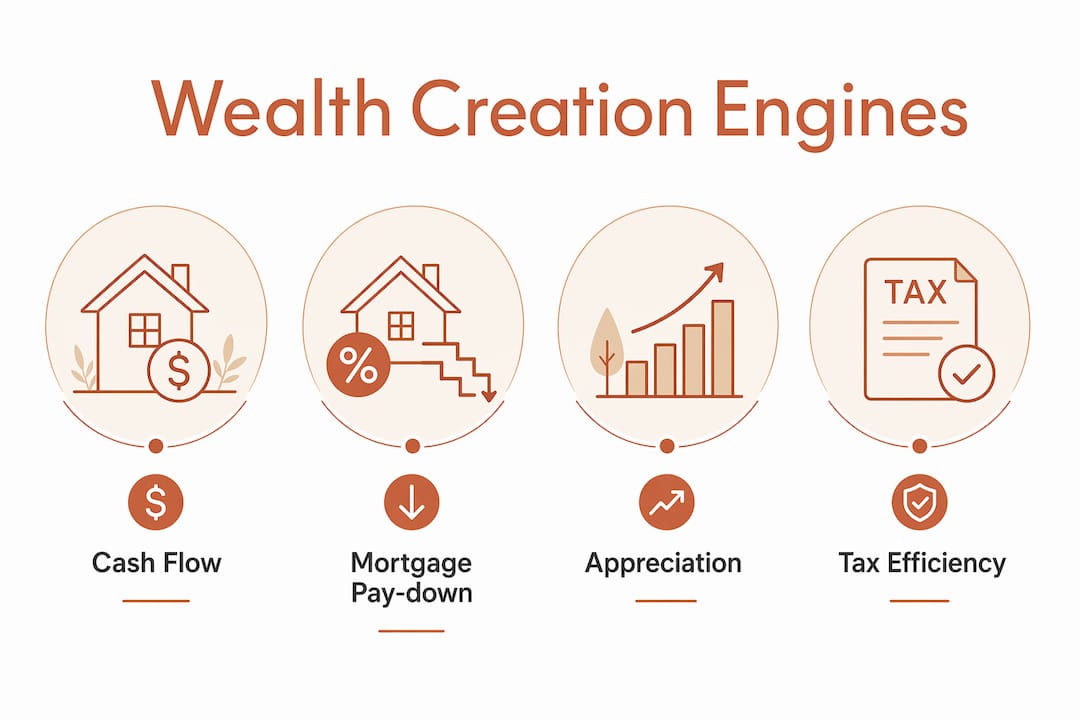
Mortgage pay-down is the engine most beginners underestimate. Every month, your tenant’s rent payment chips away at the loan balance. On a 30-year fixed mortgage, the equity gain from principal reduction is modest in year one but accelerates significantly after year ten as the amortization schedule shifts. This is forced savings you do not have to think about.
Appreciation is the engine everyone focuses on, but it is the least controllable. U.S. residential prices have trended upward over long periods, as tracked by the Case-Shiller Home Price Index, but appreciation is cyclical, local, and never guaranteed in any given decade. Treat it as a tailwind, not a plan.
Tax efficiencies are the engine most investors leave on the table. Depreciation lets you deduct the cost of a residential building over 27.5 years, sheltering rental income from ordinary tax rates. 1031 exchanges let you defer capital gains taxes when you sell one property and roll proceeds into another. At death, a step-up in basis can eliminate decades of embedded gains for heirs entirely.
Key metrics every investor needs
| Metric | What it measures | Why it matters |
|---|---|---|
| Cap rate | NOI ÷ purchase price | Compares income potential across markets and asset types |
| Cash-on-cash return | Annual pre-tax cash flow ÷ cash invested | Measures actual return on your out-of-pocket capital |
| DSCR | NOI ÷ annual debt service | Lender benchmark; signals deal safety margin |
| IRR | Time-weighted total return | Accounts for the timing of cash flows; best for comparing strategies |
| Equity multiple | Total distributions ÷ invested capital | Simple long-hold return check |
Income-driven vs. appreciation-driven returns: These two return profiles suit different markets and risk tolerances.
| Return driver | Typical market | Holding period | Risk profile |
|---|---|---|---|
| Income (cash flow) | Midwest, Southeast, secondary cities | 5–15 years | Lower; returns visible early |
| Appreciation | Coastal metros, high-growth Sun Belt | 10–20+ years | Higher; returns back-loaded |
| Blended | Suburban growth corridors | 7–15 years | Moderate; both engines active |
Worked illustration (hypothetical): A $250,000 single-family rental purchased with a $50,000 down payment at a 7% fixed rate generates roughly $1,800/month in rent. After mortgage, taxes, insurance, and a 10% vacancy/maintenance reserve, net cash flow might be $150–$250/month. Over ten years, the tenant pays down approximately $25,000 in principal. If the property appreciates at a modest 3% annually, it is worth roughly $336,000 by year ten. Add depreciation deductions sheltering a portion of rental income each year, and the combined return on that $50,000 investment is substantially higher than the cash flow alone suggests.
Pro Tip: The underwriting shortcut experienced investors use is the “1% rule” as a quick screen: monthly rent should equal at least 1% of the purchase price. A $200,000 property needs $2,000/month in rent to pass. It does not replace full underwriting, but it eliminates deals that cannot pencil before you spend hours on due diligence.
What are the proven strategies for building property wealth?
No single strategy fits every investor. The right choice depends on your available capital, time, tolerance for hands-on work, and return priorities. Here is a clear-eyed look at the major approaches.
Buy-and-hold single-family rentals
Who it suits: First-time investors, those with modest capital, and anyone who wants to start with a familiar asset type.
Capital required: $30,000–$80,000 for a down payment in most U.S. markets; less in lower-cost metros.
Time commitment: Active, especially in years 1–3. Self-managing within a 20-minute radius is a common and effective starter approach.
Return driver: Blended cash flow and appreciation.
Holding period: 7–20 years.

Pros: Low entry barrier, familiar purchase process, financing widely available. Cons: Single-tenant concentration risk, management burden, limited economies of scale.
Small multifamily (2–4 units)
Who it suits: Investors ready to step up from single-family, or those who want to house-hack (live in one unit, rent the others).
Capital required: $40,000–$120,000 depending on market and loan type.
Time commitment: Moderate to active.
Return driver: Cash flow dominant; appreciation secondary.

A duplex in a mid-tier Midwest city purchased for $220,000 with 25% down can generate enough combined rent to cover the mortgage and produce positive cash flow from day one — a profile that is harder to find in coastal markets. Pros: Better cash flow per dollar invested than single-family; owner-occupied financing available for 2–4 units. Cons: More complex management, tenant turnover in multiple units simultaneously.
BRRRR (Buy, Rehab, Rent, Refinance, Repeat)
Who it suits: Investors with renovation experience or a reliable contractor network, and the ability to carry a property through a rehab period.
Capital required: $30,000–$60,000 upfront, much of which is recycled after the refinance.
Time commitment: Highly active.
Return driver: Forced appreciation through value-add rehab, then cash flow.
The appeal is capital efficiency: buy a distressed property below market, add value through renovation, refinance at the new appraised value, and pull out most of your original capital to redeploy. Done well, it accelerates portfolio growth without proportionate new cash. Pros: Capital recycling, forced equity creation. Cons: Execution risk is high; cost overruns and appraisal gaps can trap capital.
House hacking
Who it suits: Owner-occupants, first-time buyers, and anyone who wants to reduce or eliminate their housing cost while building equity.
Capital required: As low as 3.5% down with FHA financing on a 2–4 unit property.
Time commitment: Active (you live there).
Return driver: Reduced personal housing expense plus equity accumulation.
Pros: Best financing terms available (owner-occupied rates), immediate cost reduction. Cons: Limited privacy, tenant proximity, and you are tied to one location.
Syndications and private equity
Who it suits: Accredited investors who want larger-asset exposure (apartment complexes, commercial) without operating responsibility.
Capital required: Typically $25,000–$100,000 minimum per deal.
Time commitment: Passive after due diligence on the sponsor.
Return driver: Preferred returns plus equity upside; often structured as 7–9% preferred return plus profit splits.
Holding period: 3–7 years.
Pros: Access to institutional-quality assets, fully passive, professional management. Cons: Illiquid during the hold period, sponsor risk, limited investor control.
Public REITs and ETFs
Real estate investment trusts trade on public exchanges and are required by law to distribute at least 90% of taxable income to shareholders. Exchange-traded funds that hold REITs offer diversified exposure with daily liquidity.
Who it suits: Investors who want real estate exposure without any operational involvement, or those building a diversified portfolio alongside direct holdings.
Capital required: No minimum beyond a brokerage account.
Time commitment: Passive.
Return driver: Dividend income plus share price appreciation.
Pros: Maximum liquidity, diversification across property types and geographies, no management burden. Cons: Correlated with equity markets during stress events; no leverage benefit, no depreciation deduction.
Pro Tip: REITs and direct ownership are not either/or. Many experienced investors hold REITs for liquidity and income while their direct properties compound equity. The two approaches complement each other in a way that a pure-REIT or pure-direct portfolio does not.
Which strategy fits your goals? A quick comparison
This table uses conservative estimates. Capital figures are ranges, not guarantees, and vary by market and deal structure.
| Strategy | Best for | Typical capital (estimate) | Active vs. passive | Liquidity | Risk profile | Primary return driver | Tax implications |
|---|---|---|---|---|---|---|---|
| Entry-level single-family | First-time investors | $30K–$80K | Active | Low (months to sell) | Moderate | Blended cash flow + appreciation | Depreciation; 1031 eligible |
| Small multifamily | Cash-flow seekers | $40K–$120K | Active to moderate | Low | Moderate | Cash flow dominant | Depreciation; 1031 eligible |
| Value-add rehab/BRRRR | Hands-on, renovation-capable | $30K–$60K recycled | Highly active | Very low during rehab | Higher (execution risk) | Forced appreciation + cash flow | Depreciation; 1031 eligible |
| House hack | Owner-occupants, beginners | 3.5%–10% down | Active | Low | Lower (owner-occupied terms) | Reduced housing cost + equity | Primary residence exclusion on sale |
| Syndication/private equity | Accredited, passive investors | $25K–$100K | Passive | Very low (locked up) | Moderate to higher | Preferred return + equity upside | Pass-through depreciation; 1031 sometimes |
| REITs/public funds | All investors, liquidity-focused | No minimum | Passive | High (daily) | Moderate (market-correlated) | Dividends + price appreciation | No depreciation; ordinary/qualified dividends |
First-time investor sweet spot: Entry-level single-family or a house-hacked duplex. Owner-occupied financing lowers the capital barrier, and the familiar asset type keeps execution risk manageable while you build operating history.
How do you get started in the first 6–12 months?
The biggest mistake new investors make is spending months researching without ever underwriting a real deal. Here is a concrete sequence that moves from preparation to first acquisition.
Step-by-step action plan
- Assess your capital position. Tally liquid savings, retirement accounts (some allow real estate exposure), and any home equity available via a HELOC. Know your number before you look at a single property.
- Pull your credit and get pre-approved. Investment property loans typically require a 680+ credit score and 20–25% down. A mortgage broker who specializes in investor loans will show you what you qualify for and which loan products fit your strategy.
- Define your buy box. Set objective criteria before you see a property: price range, target market, minimum rent-to-price ratio, property type, and maximum deferred maintenance. Write it down. Sticking to it is harder than it sounds.
- Screen local markets. Profitable market indicators include population and job growth, rent-to-price ratios, landlord-friendly regulations, and vacancy rates. Start within a geography you already know.
- Assemble your starter team. At minimum: an investor-focused real estate agent, a mortgage broker, a property manager (even if you self-manage initially, interview one), and a CPA familiar with rental property taxation.
- Run full due diligence on every shortlisted property. See the checklist below.
Due diligence checklist
- Verify current rent rolls and lease terms (month-to-month vs. fixed)
- Request 12 months of actual operating expenses (not seller estimates)
- Order a professional inspection; budget for deferred maintenance separately
- Confirm property taxes, insurance quotes, and HOA fees if applicable
- Review title for liens, easements, or encumbrances
- Check local vacancy rates and comparable rents independently
- Confirm zoning allows your intended use (especially for short-term rentals)
- Verify DSCR at your actual financing terms, not the seller’s pro forma
Financing options and what they cost you
Conventional investor loans (20–25% down, 30-year fixed) are the most common starting point. Portfolio loans from community banks or credit unions are more flexible on property condition and borrower profile but carry slightly higher rates. A cash purchase maximizes cash flow and simplifies closing but concentrates capital in one asset. A HELOC on a primary residence can fund a down payment, though it adds a second layer of debt service to underwrite carefully. Understanding investment property mortgage structures before you commit to a loan type can prevent costly surprises at closing.
Worked starter example
Property: 3-bedroom single-family home in a secondary Midwest market.
Purchase price: $185,000. Down payment (25%): $46,250. Loan: $138,750 at 7.25% for 30 years. Monthly mortgage payment: ~$947.
Income: $1,550/month market rent.
Expenses: $947 (mortgage) + $185 (taxes/insurance) + $155 (10% vacancy reserve) + $155 (maintenance reserve) = $1,442/month.
Monthly cash flow: ~$108. Annual cash flow: ~$1,296.
Cash-on-cash return: $1,296 ÷ $46,250 = 2.8% in year one.
That number looks modest, but add principal pay-down (~$2,400 in year one), depreciation deductions (~$5,000/year on the structure), and even 2–3% annual appreciation, and the total return on invested capital is closer to 12–15% annually. For a deeper look at how to value rental property, the methodology matters as much as the numbers.
Pro Tip: Realtor.com’s Q2 2026 data shows 70% of U.S. markets currently favor buyers or are trending that way, with median list prices down 2.5% year-over-year. That is unusual negotiating leverage. First-time investors entering now have more room to negotiate price, seller concessions, and closing cost credits than at any point in recent years.
How do you scale from one property to a generational portfolio?
Getting from one property to ten is a design problem, not just an acquisition problem. The investors who build durable, multi-decade portfolios treat every new purchase as a portfolio allocation decision, not a standalone transaction.
Portfolio design principles
- Maintain a written buy box. As your portfolio grows, the temptation to chase deals outside your criteria intensifies. A disciplined buy-box approach is what separates investors who scale efficiently from those who accumulate a collection of mismatched assets.
- Diversify by geography and asset type over time. Starting locally makes sense; staying entirely local concentrates your portfolio in one economic cycle. By years 5–10, consider adding a second market or a different asset class (small multifamily, commercial) to reduce single-market exposure. International property investment is one route some investors explore at this stage.
- Each asset must earn its place. Assign every property a role: equity growth, cash flow, or portfolio capacity (collateral for future financing). If a property serves none of those roles, it is a candidate for a 1031 exchange into something that does.
Governance and entity structure
LLCs, limited partnerships, and trusts each serve different purposes. An LLC provides liability separation between properties and personal assets. A family limited partnership can facilitate wealth transfer to heirs with valuation discounts. A trust structure supports succession planning and can avoid probate. The right structure depends on your state, your estate size, and your family situation. Tax and legal considerations around step-up in basis and 1031 exchanges can materially affect multigenerational outcomes, and the specifics require a qualified attorney and CPA, not a blog post.
Decade-by-decade roadmap
- Years 1–10: Acquisition-focused. Build 3–5 properties with conservative leverage, establish operating history, and develop your team. Cash flow may be modest; equity accumulation is the primary goal.
- Years 10–20: Equity recycling. Use cash-out refinances or 1031 exchanges to move equity from lower-performing assets into higher-capacity ones. How 1031 exchanges support portfolio growth is a topic worth understanding deeply at this stage.
- Years 20–30: Governance and succession. Reduce leverage, formalize entity structures, and begin estate planning. The portfolio should be generating significant passive income and building toward transfer.
Pro Tip: The most capital-efficient scaling move is a cash-out refinance on an appreciated property, not a new cash investment. If a property you bought for $200,000 is now worth $320,000, a 75% LTV refinance pulls out roughly $40,000 in tax-free proceeds (it is a loan, not income) that you redeploy as a down payment on the next asset. You have effectively used the same dollar twice. For a structured look at expanding your portfolio efficiently, the sequencing of refinances matters as much as the timing.
What risks and mistakes should you watch out for?
Most real estate failures trace back to a small set of avoidable errors. Here is where investors consistently go wrong and what to do instead.
- Overleverage. Buying at the maximum loan amount leaves no buffer for vacancies, repairs, or rate resets. Target a DSCR of 1.25 or higher at your actual financing terms, not the seller’s optimistic rent projections.
- Weak due diligence. Skipping the inspection, trusting seller-provided expense figures, or failing to verify actual rents are the fastest routes to a money-losing property. The checklist in the previous section is a floor, not a ceiling.
- Ignoring local market indicators. A property that pencils in a growing market can destroy capital in a declining one. Population trends, employment base, and landlord-tenant law matter as much as the purchase price.
- Poor property management. Property management quality directly affects vacancy rates, maintenance costs, and tenant quality. A bad manager can turn a profitable property into a break-even one within 12 months.
- No liquidity reserves. A common rule of thumb is to hold three to six months of gross rent per property in accessible reserves. A single major repair (roof, HVAC, foundation) without reserves forces distressed decisions.
- Chasing appreciation without cash flow. Negative cash flow properties require you to fund the gap from personal income every month. That works until it does not — a job loss, a rate reset, or an extended vacancy can force a sale at the worst time.
On tax and legal structure: Depreciation recapture, 1031 exchange timelines, Opportunity Zone eligibility, and estate planning thresholds are all areas where a mistake costs real money. The IRS publishes guidance on depreciation basics and like-kind exchange rules, but applying them to your specific situation requires a CPA and a real estate attorney. General articles, including this one, are not a substitute for personalized professional advice.
Aesthetic Havens helps you build a property portfolio that lasts
Most investors know what they want to build. The gap is execution: finding the right properties, structuring the financing, and making decisions that hold up across market cycles. That is where Aesthetic Havens, operated by Aman Aboobucker under ERA Realtors, adds the most value.

The advisory practice covers the full transaction lifecycle: property sourcing and valuation, investment strategy alignment, portfolio planning, sales and leasing facilitation, and post-purchase guidance including property management referrals. Whether you are underwriting your first rental or restructuring a multi-property portfolio, the process starts with a clear picture of your capital, goals, and timeline, then maps those to the strategies most likely to deliver. For investors considering cross-border diversification, the role of international property consultants in navigating unfamiliar markets is a service the practice extends as well.
If you are ready to move from research to action, start with a property consultant conversation to map your first or next acquisition to a concrete plan.
Key Takeaways
Real estate builds lasting wealth when you combine cash flow, mortgage pay-down, appreciation, and tax efficiency across a multi-decade holding period with disciplined underwriting at every step.
| Point | Details |
|---|---|
| Four engines compound together | Cash flow, principal pay-down, appreciation, and tax efficiency each contribute; no single engine is sufficient alone. |
| Strategy must match your profile | Single-family and house hacking suit beginners; syndications and REITs suit passive investors; BRRRR suits hands-on operators with renovation capacity. |
| Start with one underwritten deal | Run full due diligence on a real property before committing capital; the worked example above shows how modest cash-on-cash becomes strong total return. |
| Reserves and DSCR protect you | Target a DSCR of 1.25+ and hold three to six months of gross rent per property in reserves to survive vacancies and repairs. |
| Aesthetic Havens guides the process | From first acquisition to portfolio scaling, Aesthetic Havens provides advisory, transaction facilitation, and market intelligence for investors building property wealth. |
The long game is the only game worth playing
Most articles on property wealth focus on the entry: which market, which strategy, which financing structure. Those decisions matter, but they are not what separates investors who build generational wealth from those who stall after two or three properties.
What actually determines long-term outcomes is governance: a written buy box you stick to when a shiny deal appears outside it, a team that keeps operating costs honest, and an entity structure that protects what you have built. The investors I see succeed over 20-year horizons are not the ones who found the best deal in year one. They are the ones who treated every acquisition as a portfolio decision, kept leverage conservative enough to survive a bad year, and never confused a rising market with their own skill.
Cycles turn. The buyer-friendly conditions in mid-2026 will not last indefinitely, and the next seller’s market will tempt investors to overpay and over-leverage. The discipline you build now, in a market that rewards patience, is what carries you through the next one.
Tax and legal specifics, including depreciation recapture, 1031 timelines, and estate planning thresholds, vary by situation and change with legislation. Confirm the current rules with a qualified CPA and real estate attorney before making structural decisions.
Useful sources and where to learn more
The following references informed this guide and are worth bookmarking for deeper reading.
- Shoora Capital: Building Generational Wealth Through Real Estate — A practitioner-level breakdown of the four compounding engines and how tax transfer techniques affect multigenerational outcomes.
- Realtor.com Market Clock Q2 2026 — Current buyer/seller balance across 100 U.S. metros; useful for market selection and timing decisions.
- Business Insider: How to Start Investing in Real Estate — Profiles of first-time investors and practical starter-to-scale guidance.
- IRS: Like-Kind Exchanges — The primary source for 1031 exchange rules and timelines.
- SEC: REITs Overview — Regulatory definition and distribution requirements for real estate investment trusts.
- Investopedia — Reference definitions for cap rate, cash-on-cash return, IRR, and DSCR.
Internal resources for next steps:
| Resource | What it covers |
|---|---|
| Property Wealth Progression | Stages of portfolio growth from first property to multi-asset wealth |
| How to Select Investment Property | Practical selection criteria and underwriting checklist |
| Role of REITs in Property Investment | Passive exposure options and how REITs fit a broader portfolio |


