


Property asset planning is defined as a systematic, long-term process of managing real estate holdings to achieve specific financial goals, including wealth accumulation, risk mitigation, and legacy preservation. Unlike casual property ownership, it treats every asset in your portfolio as a working financial instrument. For Singapore investors, where property represents a significant share of personal net worth, this distinction matters enormously. The process integrates cash flow analysis, market benchmarking, legal structuring, and exit planning into one coordinated approach. Done well, it turns a collection of properties into a purposeful wealth creation engine.
What is property asset planning and what does it involve?
Property asset planning is a systematic, long-term strategic process that goes well beyond basic maintenance or reactive decision-making. The industry term for this discipline is real estate asset management, and the two phrases describe the same core practice. The goal is to align every property decision with defined financial objectives, whether that means growing rental income, reducing tax exposure, or preparing assets for the next generation.

The process begins with a full inventory of your holdings. You document each property’s current market value, outstanding debt, rental yield, and occupancy status. This baseline tells you exactly where you stand before you make any strategic decisions.
From there, the work splits into several ongoing activities:
- Cash flow analysis: Tracking rental income against mortgage payments, maintenance costs, and property taxes to measure net returns.
- Market benchmarking: Comparing your portfolio’s performance against Singapore’s broader residential and commercial property indices.
- Risk assessment: Identifying exposure to interest rate changes, tenant default, regulatory shifts, and market downturns.
- Strategy formulation: Deciding whether to acquire, hold, refurbish, or divest each asset based on performance data and market outlook.
- Exit planning: Mapping out optimal timing and structure for property disposals to maximize after-tax proceeds.
Pro Tip: Build a simple one-page property summary for each asset you own. Include purchase price, current valuation, monthly cash flow, and your target exit timeline. Reviewing this sheet quarterly keeps your decisions grounded in data, not sentiment.
What legal and financial structures protect your property assets?
The legal and financial layer of real estate asset planning is where most investors leave money on the table. Layered asset protection strategies combine insurance, entity structures such as LLCs or partnerships, and irrevocable trusts to shield assets from liabilities before problems arise. The critical word is “before.” Structures put in place after litigation begins are routinely challenged or invalidated.
For investors holding multiple properties, a Series LLC structure legally isolates each asset into its own cell. A liability tied to one property cannot reach the others. This is far more efficient than setting up a separate standalone LLC for every single asset.
Tax strategy sits at the center of this layer. Asset planning integrates tax strategies to reduce avoidable burdens, including net investment income taxes and estate taxes. Proper titling, coordinated beneficiary designations, and trust structures work together to transfer wealth with minimal friction. Singapore investors dealing with cross-border holdings face additional complexity around withholding taxes and double-taxation treaties, making early legal advice non-negotiable.
Common structures used in property asset planning include:
- Revocable living trusts: Allow you to retain control during your lifetime while simplifying estate transfer.
- Irrevocable trusts: Remove assets from your taxable estate and provide stronger creditor protection.
- Family limited partnerships: Useful for transferring property interests to heirs at discounted valuations.
- Strategic debt encumbrance: Encumbering assets with debt reduces their appeal to creditors by lowering available equity, while giving the owner liquidity. This approach is a nuance many investors overlook entirely.
Pro Tip: Review your Singapore property inheritance arrangements at least every three years. Tax laws, family circumstances, and property values all shift. A structure that worked perfectly five years ago may now create unnecessary exposure. Aesthetic Havens covers this in detail in its Singapore property inheritance guide.
How does property asset planning differ from property management?
The confusion between these two roles costs investors real money. Property management focuses on operational tasks like tenant relations, lease renewals, and building maintenance. Property asset planning, or real estate asset management, focuses on financial strategy, portfolio performance, and long-term value creation. Both roles are necessary, but they operate at different levels.
| Focus area | Property management | Property asset planning |
|---|---|---|
| Primary concern | Day-to-day operations | Long-term financial returns |
| Key activities | Leasing, repairs, tenant relations | Portfolio strategy, risk management, capital planning |
| Time horizon | Monthly and annual | 5–20 years |
| Success metric | Occupancy rate and tenant satisfaction | Total return on investment and net asset value growth |
| Decision type | Operational | Strategic and financial |
Asset managers work strategically to maximize investment returns through portfolio strategy, risk management, and capital planning. They decide when to refinance, when to sell, and when to redeploy capital into higher-performing assets. A property manager keeps the building running. An asset planner decides whether the building should still be in your portfolio at all.
The best-performing portfolios coordinate both functions. The property manager feeds occupancy and maintenance data upward. The asset planner uses that data to make hold, sell, or reinvest decisions. When these two roles work in isolation, opportunities get missed and risks go undetected.
How do you implement effective property asset planning?
Putting a plan into practice requires structure, discipline, and the right advisors. Regular review and adaptation of your property asset plan is not optional. Market conditions, family circumstances, and tax laws all change. A set-and-forget approach creates gaps that compound quietly over time.
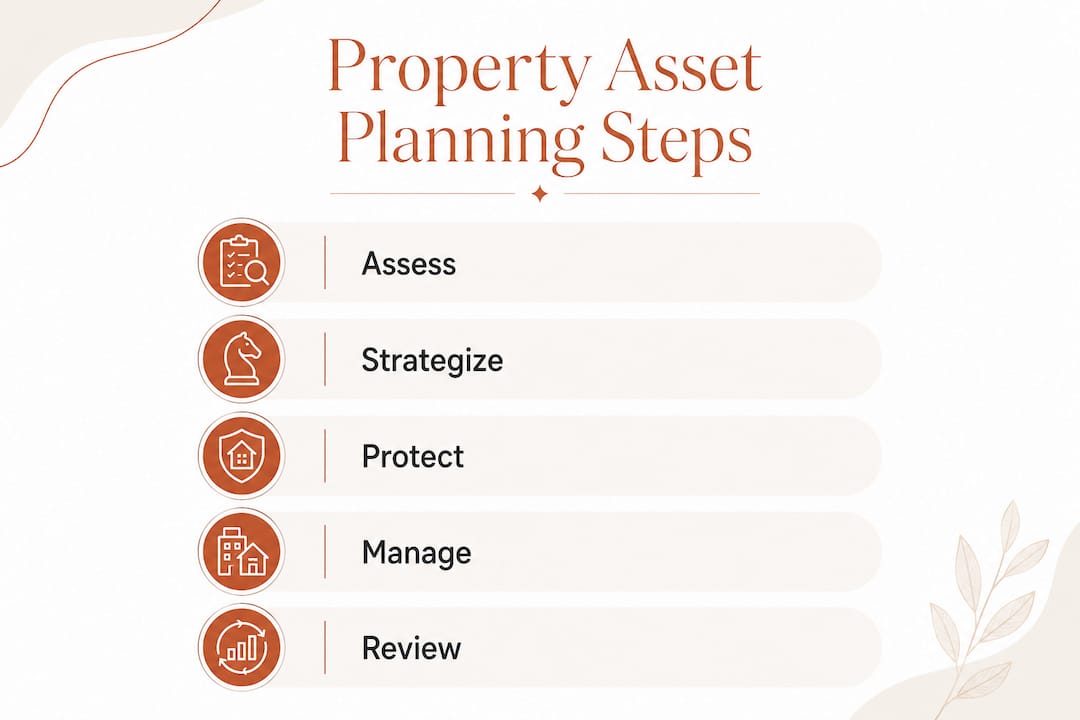
Follow this sequence to build and maintain an effective plan:
- Audit your current portfolio. List every property with its current value, debt position, monthly cash flow, and tenure type. This is your starting point for all future decisions.
- Define your financial objectives. Are you building passive income, accumulating capital for retirement, or creating a legacy for your children? Your objectives determine which assets to keep and which to exit.
- Engage the right advisors. A financial planner, a property-specialized lawyer, and a tax specialist each cover a different dimension of your plan. No single advisor covers all three well.
- Apply diversification across property types. Holding only residential property in one district concentrates risk. Singapore investors can spread exposure across residential, commercial, and international property investment to reduce correlation risk.
- Use benchmarking to measure performance. Compare each asset’s yield and capital growth against relevant Singapore market indices annually. Assets that consistently underperform the benchmark deserve a disposal review.
- Review and update the plan every 12–24 months. Life events like marriage, divorce, inheritance, or a change in income require plan adjustments. So do major market shifts.
Many investors fail to convert unprotected wealth into protected assets or review their estate plans for liability risks. This creates critical financial gaps that surface at the worst possible moments. Beginners often repeat this pattern, and a review of common value investing mistakes shows that neglecting asset protection ranks among the most costly errors new investors make.
Pro Tip: Set a recurring calendar reminder every January to review your property portfolio against your financial goals. Treat it like a business review, not a casual check-in. Bring your advisor into that conversation at least once every two years.
Key Takeaways
Property asset planning is the structured process of aligning real estate decisions with long-term financial goals through performance analysis, legal structuring, and ongoing portfolio review.
| Point | Details |
|---|---|
| Core definition | Property asset planning is a systematic process focused on financial objectives, not just property maintenance. |
| Legal structures matter | Use trusts, entity structures, and strategic debt proactively to protect assets before risks arise. |
| Asset planning vs. property management | Asset planning sets financial strategy; property management handles daily operations. Both roles must coordinate. |
| Regular review is non-negotiable | Plans become obsolete without periodic updates for market changes, tax law shifts, and personal circumstances. |
| Professional advisors are essential | A financial planner, property lawyer, and tax specialist each cover distinct and critical dimensions of your plan. |
What I have learned from watching Singapore investors plan their property assets
Most investors I work with in Singapore arrive with the same blind spot. They have accumulated properties over the years, but they have never sat down to treat those properties as a unified portfolio with a defined purpose. Each purchase made sense at the time. But together, the assets often point in three different directions at once.
The investors who build real wealth do one thing differently. They decide what they want their property portfolio to do for them, and then they build backward from that goal. That sounds obvious. In practice, very few people actually do it.
The second pattern I see is over-reliance on a single advisor. A property agent can tell you what to buy. A lawyer can structure the ownership. A financial planner can model the cash flows. But none of them alone can see the full picture. The investors who avoid costly mistakes are the ones who get all three advisors in the same conversation at least once a year.
The third thing I would stress is this: the most resilient asset protection plans maintain flexibility. Ownership structures that cannot adapt to changing family circumstances or tax laws become liabilities in themselves. Build in optionality from the start, and revisit it regularly. Singapore’s property market rewards patience and preparation in equal measure.
— Aman
Working with a property consultant on your asset plan
Property investors who work with a dedicated consultant consistently make better-timed decisions. A consultant brings market data, transaction experience, and portfolio perspective that most individual investors cannot replicate on their own.

At Aesthetic Havens, Aman Aboobucker works with Singapore investors to translate their financial goals into concrete property strategies. Whether you are building your first portfolio or restructuring an existing one, the process starts with understanding what your assets are actually doing for you. From there, the work covers acquisition analysis, risk review, and exit planning aligned with your wealth timeline. If you are ready to treat your properties as a coordinated financial plan rather than a collection of purchases, working with a property consultant is the most direct path forward. You can also explore real estate advisory for Singapore investors to understand the full scope of support available.
FAQ
What is property asset planning in simple terms?
Property asset planning is the process of managing your real estate holdings with a clear financial strategy. It covers performance analysis, legal structuring, risk management, and exit planning to grow and protect your wealth over time.
How does property asset planning differ from property management?
Property management handles day-to-day operations like leasing and maintenance. Property asset planning focuses on long-term financial strategy, portfolio performance, and capital decisions such as when to buy, hold, or sell.
What legal structures are used in property asset planning?
Common structures include revocable and irrevocable trusts, family limited partnerships, and LLC arrangements. Series LLCs are particularly useful for multi-property investors because they isolate liability to individual assets within the portfolio.
How often should I review my property asset plan?
A review every 12–24 months is the standard practice. Major life events such as marriage, inheritance, or significant market shifts require an immediate review regardless of the scheduled cycle.
Do Singapore investors need a property asset plan?
Yes. Singapore property represents a large share of most investors’ net worth, and the regulatory environment around taxes, tenure, and foreign ownership adds complexity. A structured plan reduces risk and improves long-term returns significantly.
Recommended
- Investment Checklist Singapore: 2026 Property Guide
- Foreigner’s Guide to Buying Property in Singapore (2025 Regulations & Taxes) | Aesthetic Havens
- Singapore Property Inheritance Guide & Legacy Planning: Securing Your Home for the Next Generation | Aesthetic Havens
- How to Buy Commercial Property in Singapore: A Step-by-Step Guide | Aesthetic Havens


