


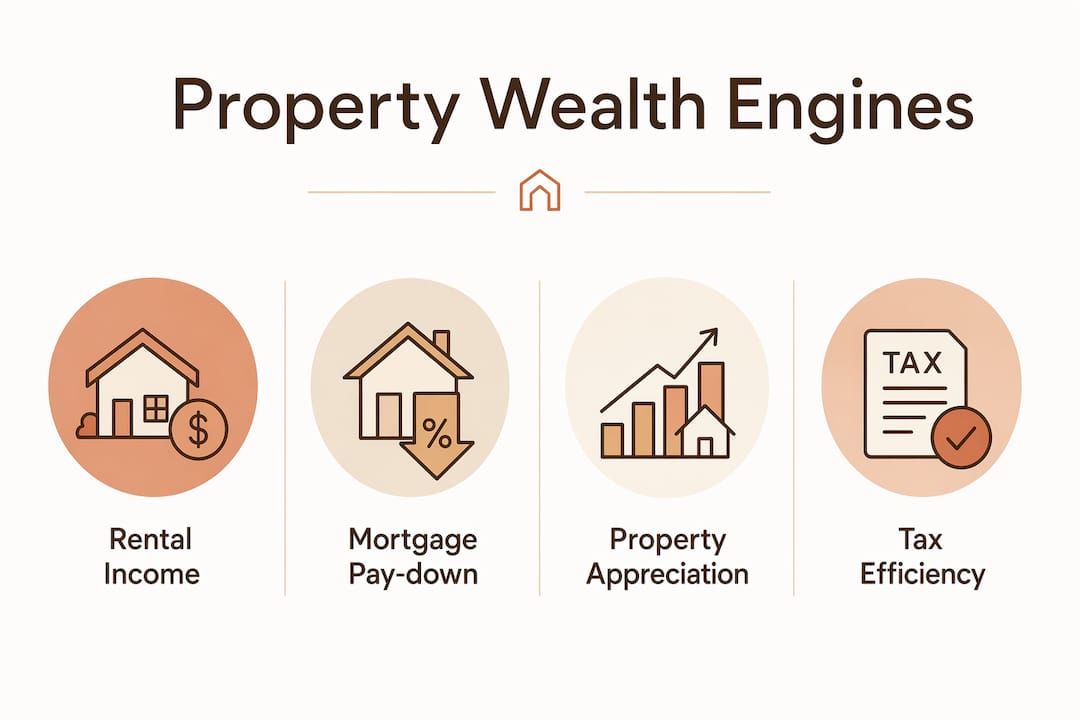
Property wealth progression is the systematic process of growing your net worth by investing in real estate assets that generate cash flow, build equity, appreciate in value, and benefit from tax efficiencies over time. Unlike speculation or short-term flipping, this is a deliberate, long-term strategy built on compounding returns across decades. Four mechanisms drive it simultaneously: rental income, tenant-funded mortgage pay-down, property appreciation, and tax efficiency. Understanding how these engines interact is the foundation of every serious property investment strategy, whether you own one unit in Singapore or manage a portfolio across multiple markets.
What is property wealth progression and how does it work?
Property wealth progression works through four compounding mechanisms operating at the same time, not in sequence. Real estate wealth creation relies on rental cash flow, mortgage principal pay-down, property appreciation, and tax efficiency working concurrently over decades. Each mechanism reinforces the others, which is why time in the market matters more than timing the market.
Rental cash flow
Rental income is the most visible engine. Tenants pay rent monthly, and after covering your mortgage, insurance, and maintenance, the surplus is your cash-on-cash return. As rents rise with inflation and your mortgage payment stays fixed, that surplus grows. Investors who track rental yield by district can identify markets where this engine runs strongest from day one.

Tenant-funded mortgage pay-down
Every mortgage payment your tenant effectively funds reduces your loan balance and transfers ownership from the bank to you. Mortgage amortization schedules show that principal pay-down accelerates after the first 10 years of ownership. For a $300,000 property at 80% LTV, tenant-funded principal reduction can exceed $165,000 after 20 years. That is equity you built without writing a single extra check.
Property appreciation
Property values rise over multi-decade timeframes due to population growth, infrastructure investment, and constrained land supply. Singapore’s land scarcity makes this engine particularly reliable for investors holding freehold or 99-year leasehold assets. Appreciation compounds quietly in the background while your tenants fund the mortgage.
Tax efficiency
Tax rules reward long-term property holders in ways that most investors underuse. Depreciation deductions reduce taxable rental income. The step-up in basis at death resets a property’s tax basis to current market value, which means a $2M property with an original $500,000 basis can save heirs over $225,000 in capital gains taxes at a 15% rate. In the United States, 1031 exchanges allow investors to defer capital gains indefinitely by rolling proceeds into new properties.
Pro Tip: Start tracking all four mechanisms separately from year one. Investors who measure each engine independently make better refinancing and reinvestment decisions at the 5-year and 10-year marks.
| Mechanism | Wealth impact over 20–30 years |
|---|---|
| Rental cash flow | Steady income stream that grows as rents rise and debt stays fixed |
| Mortgage pay-down | Equity exceeding $165,000 on a $300,000 property at 80% LTV |
| Property appreciation | Compounding asset value growth driven by supply constraints and demand |
| Tax efficiency | Depreciation, step-up in basis, and deferral tools preserve generational wealth |
What strategies accelerate property wealth progression?
Wealth progression through real estate speeds up when you use your existing equity to fund new acquisitions rather than letting it sit idle. The core tactic is equity recycling: refinancing every 5–10 years to approximately 75% LTV, extracting the freed capital, and using it as a deposit on the next property. Over 35 years, starting with modest deposits and leveraging at 6% annual growth can transform initial equity into multi-million dollar positions. That is not theory. It is the math of compounding applied to borrowed capital.
The choice of acquisition strategy also matters. Long-term buy-and-hold rentals provide predictable appreciation and cash flow with low active management demands. The BRRRR method (Buy, Rehab, Rent, Refinance, Repeat) offers a faster path. BRRRR can yield 15–25%+ cash-on-cash returns post-refinance, compared to 6–10% for traditional rentals. The tradeoff is higher complexity and active management from day one. Investors should align strategy with risk tolerance and available capital before choosing a path.
Best practices for scaling a portfolio efficiently:
- Select for dual performance. Buy properties with both strong rental yield and appreciation potential. One without the other slows progression.
- Maintain debt service coverage ratios. Keep at least 1.25x coverage between rental income and mortgage payments to absorb vacancy and rate increases.
- Hold a liquidity buffer. Reserve three to six months of operating costs per property before recycling equity into new acquisitions.
- Reinvest cash flow exclusively. A critical habit of successful portfolio builders is reinvesting extracted equity into new acquisitions rather than lifestyle spending.
- Use property management actively. Active management reduces vacancy, protects asset condition, and directly supports rental income growth.
Pro Tip: Plan your first refinance before you buy. If the numbers at purchase do not support an equity extraction in year 5 or 7, the property may not fit a progression strategy.
What are the key nuances and common pitfalls in property wealth progression?
The biggest mistake investors make is confusing property wealth progression with property speculation. Flipping for short-term profit is a business activity, not a wealth-building strategy. Progression requires holding assets long enough for all four mechanisms to compound. Selling too early resets the clock and triggers capital gains tax, erasing years of deferred growth.
Interest rate fluctuations create real risk for leveraged portfolios. When rates rise sharply, mortgage costs increase and cash flow margins compress. Investors who stretched to maximum LTV without a liquidity buffer face forced sales at the worst time. Maintaining conservative debt service coverage ratios is not optional. It is the difference between surviving a rate cycle and losing assets.
Tax and governance planning are areas where investors consistently underinvest until it is too late. Without proper governance, growth in portfolios held through simple corporate structures may face inheritance tax rates up to 40%. That is a wealth transfer to the government, not to your heirs. Succession planning and portfolio structuring should begin by years 20–30 at the latest, and ideally much earlier.
Behavioral pitfalls are equally damaging. Lifestyle inflation from rental income is the silent killer of progression. Investors who spend cash flow instead of reinvesting it break the compounding cycle. Successful portfolio builders treat rental income as capital, not salary, until the portfolio reaches a scale that justifies distributions. Measuring progress by equity-to-debt ratio and cash flow buffers rather than property count keeps the focus on real wealth, not vanity metrics.
How can investors practically implement property wealth progression today?
Building property wealth starts with a clear assessment of your goals, risk tolerance, and available capital. Without that foundation, even the right property in the right market will underperform because the strategy around it is misaligned. Use this sequence to move from intention to execution.
- Define your target outcome. Decide whether you are building for retirement income, generational wealth transfer, or portfolio scale. Each goal implies a different holding period and reinvestment rate.
- Assess your capital and borrowing capacity. Calculate your maximum LTV across existing assets and identify how much equity is available for a first or next acquisition. In Singapore, understanding tenure types affects both financing options and long-term appreciation potential.
- Select properties using investment criteria. Focus on rental yield, vacancy rates, infrastructure pipeline, and land supply constraints. Use a structured approach to select investment property before committing capital.
- Establish operating history. Run the first property for at least 12–24 months before refinancing. Lenders and future partners want to see documented cash flow and occupancy rates, not projections.
- Refinance at the right LTV. When equity has grown sufficiently, refinance to approximately 75% LTV. Use the extracted capital as a deposit on the next acquisition. This is the equity recycling cycle that drives portfolio expansion over decades.
- Repeat with governance in place. As the portfolio grows beyond two or three properties, introduce formal structuring. Review ownership entities, succession plans, and tax positions annually.
For investors using mortgage financing to fund acquisitions, understanding amortization schedules at purchase is non-negotiable. The rate at which principal pays down determines when equity recycling becomes viable. Investors who model this from day one make refinancing decisions with precision, not guesswork.
Identifying the right markets matters as much as the right strategy. Markets with signs of profitable real estate conditions, including rising rental demand, infrastructure investment, and constrained supply, amplify every mechanism in the progression model.
Key Takeaways
Property wealth progression succeeds when rental income, mortgage pay-down, appreciation, and tax efficiency compound together over decades through disciplined reinvestment and equity recycling.
| Point | Details |
|---|---|
| Four mechanisms compound together | Rental income, mortgage pay-down, appreciation, and tax efficiency all work simultaneously. |
| Equity recycling drives scale | Refinancing every 5–10 years to ~75% LTV frees capital for new acquisitions without new savings. |
| Tax planning protects generational wealth | Step-up in basis and proper structuring can save heirs hundreds of thousands in capital gains taxes. |
| Behavioral discipline is non-negotiable | Reinvesting cash flow instead of spending it is what separates portfolio builders from property owners. |
| Governance must start early | Succession planning and entity structuring should begin well before years 20–30 to avoid 40% inheritance tax exposure. |
What I have learned after years of guiding property investors
Most investors I work with understand that property builds wealth. Fewer understand why it builds wealth at a rate that other asset classes rarely match. The answer is not appreciation alone. It is the combination of four mechanisms running at the same time, funded partly by tenants and partly by time.
The investors I have seen struggle most are the ones who treat their first property as a destination rather than a starting point. They buy, they hold, and they wait. They never refinance. They never recycle equity. They end up with one fully paid-off property and a fraction of the wealth they could have built with the same starting capital and a deliberate progression plan.
The other pattern I see consistently is emotional decision-making at the worst moments. Rate cycles create fear. Fear creates early sales. Early sales destroy compounding. The investors who build real wealth are the ones who plan for rate increases before they happen, hold liquidity buffers that let them sleep at night, and treat market downturns as acquisition windows rather than exit signals.
My honest advice: start conservatively, but plan aggressively. Buy a property you can genuinely afford to hold for 20 years. Model the refinancing cycle before you sign. Get your governance structure in place earlier than you think you need it. The compounding does the heavy lifting. Your job is to stay in the game long enough for it to work.
— Aman
How Aesthetic Havens supports your property wealth goals
Aesthetic Havens works with property buyers and investors across Singapore and international markets to build and execute property wealth strategies aligned with 2026 conditions. Whether you are acquiring your first investment property or refinancing to recycle equity into your next acquisition, the team provides expert guidance on property selection, financing structures, and portfolio expansion.

The property sales workflow at Aesthetic Havens is built specifically for business owners and investors who need a clear, efficient process from valuation to closing. For investors ready to scale, the real estate wealth creation strategies guide covers the 2026 market conditions shaping acquisition and refinancing decisions. Reach out to Aman directly for a personalized consultation on your portfolio strategy.
FAQ
What is property wealth progression in simple terms?
Property wealth progression is the process of growing your net worth through real estate by combining rental income, mortgage pay-down, property appreciation, and tax benefits over time. These four mechanisms compound together, building equity and income simultaneously across decades.
How long does property wealth progression take?
Meaningful wealth progression typically requires a 20–30 year horizon for all four compounding mechanisms to reach their full effect. Equity recycling through refinancing every 5–10 years can accelerate the timeline significantly.
What is equity recycling in property investment?
Equity recycling means refinancing a property to approximately 75% LTV, extracting the built-up equity, and using it as a deposit on a new acquisition. This strategy allows investors to scale their portfolio without requiring large amounts of new savings.
Is BRRRR better than buy-and-hold for wealth progression?
BRRRR can produce 15–25%+ cash-on-cash returns post-refinance compared to 6–10% for traditional rentals, but it demands higher active management and upfront complexity. Buy-and-hold suits investors prioritizing stability; BRRRR suits those prioritizing faster scaling.
What is the biggest risk in property wealth progression?
The biggest risk is overleveraging without a liquidity buffer, which forces asset sales during rate increases or market downturns. Maintaining a debt service coverage ratio above 1.25x and holding three to six months of operating reserves per property protects the compounding cycle.


