


Real estate asset management is defined as the strategic oversight of investment properties aimed at maximizing investor returns while minimizing risk across the full property lifecycle. Unlike property management, which handles daily operations, asset management in real estate focuses on capital markets decisions: when to buy, how to reposition, when to sell, and how to allocate capital for the greatest financial impact. For real estate professionals and investors in Singapore and beyond, understanding this distinction is the foundation of building a portfolio that compounds wealth rather than just generates rent.
What is real estate asset management, exactly?
Asset management in real estate is the discipline of making strategic financial decisions about a property portfolio to grow its value and protect investor capital. The real estate management definition centers on a capital markets perspective: every decision, from lease structure to refinancing to exit timing, is evaluated through the lens of risk-adjusted return.
This is not about fixing leaky faucets or chasing late rent. Asset managers analyze income and expense performance, assess market conditions, and determine whether a property should be held, improved, or sold. They work at the portfolio level, not the building level.

The role of real estate asset management sits between the investor and the property. Asset managers translate ownership goals into operational directives and financial strategies. They are the people who decide that a commercial building in Tanjong Pagar needs a lobby renovation to justify a 15% rent increase, or that a residential block in Jurong should be divested before a rate cycle peaks.
Pro Tip: If you cannot articulate the exit strategy for a property you own, you are managing it operationally, not as an asset. Start with the end in mind.
What are the core responsibilities of an asset manager?
Asset management covers the full property lifecycle from acquisition through disposition, with active oversight at every stage. The responsibilities are broader and more financially complex than most investors initially expect.
Here are the primary activities that define the role:
- Acquisition analysis. Asset managers evaluate potential purchases using metrics like net operating income (NOI), capitalization rates, and projected cash-on-cash returns. They set the investment thesis before a dollar is committed.
- Cash flow monitoring. Monthly and quarterly performance reviews compare actual income and expenses against underwriting assumptions. Variances trigger strategic responses, not just operational fixes.
- Value-enhancement planning. Renovations, tenant mix changes, and lease restructuring are evaluated based on their return on investment, not just their cost. A $500,000 lobby upgrade that lifts NOI by $80,000 annually is a financial decision, not a maintenance one.
- Capital allocation and refinancing. Asset managers decide when to pull equity out through refinancing, when to inject capital for improvements, and how to balance debt service against cash distribution goals.
- Hold/sell decisions. Exit timing is a key lever in long-term returns. Asset managers track NOI trends, valuation cycles, and leverage effects to identify the optimal window for disposition.
- Reporting and compliance. Institutional-grade asset management requires structured data capture. The 2026 NCREIF/PREA reporting standards call for consistent, machine-readable data on income, expenses, capital activity, and valuations at the property level.
Pro Tip: Track your NOI variance monthly, not quarterly. A two-month lag in identifying a leasing shortfall can cost you an entire quarter of corrective runway.
How does real estate asset management differ from property management?
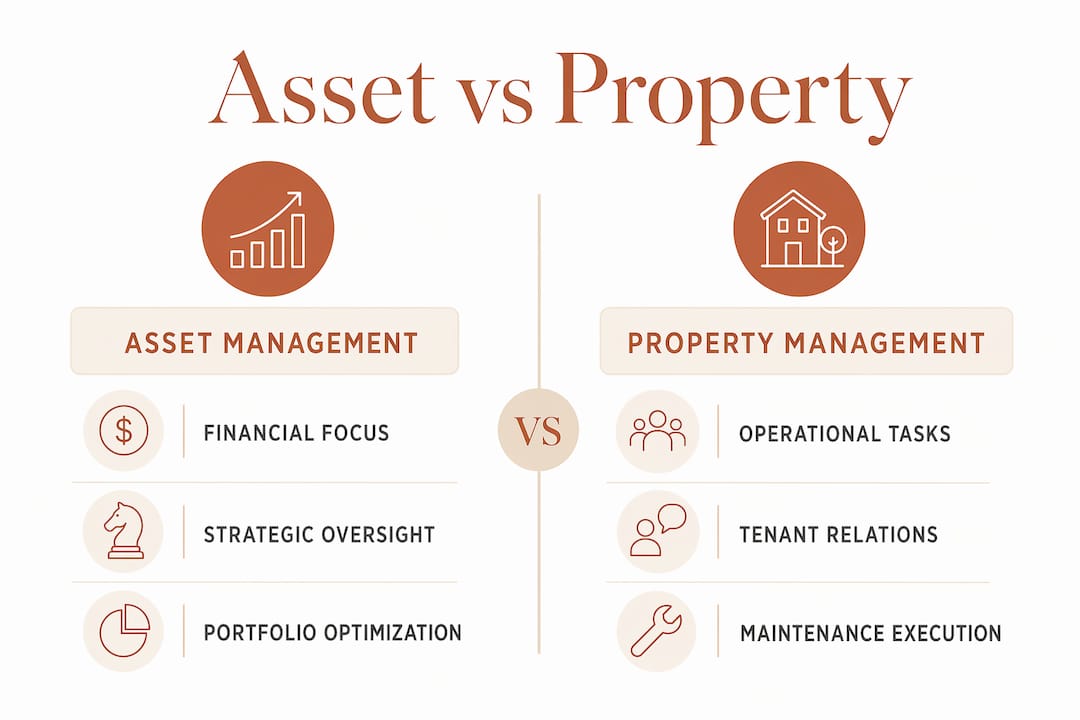
Asset managers focus on financial and strategic decisions while property managers handle daily operational tasks. The confusion between these two roles costs investors real money. When an asset manager is expected to handle tenant complaints, or a property manager is asked to approve capital expenditure, neither job gets done well.
The table below shows where each role begins and ends.
| Function | Asset Management | Property Management |
|---|---|---|
| Primary focus | Financial returns and portfolio strategy | Day-to-day building operations |
| Leasing decisions | Sets leasing direction and rent targets | Executes leasing and tenant relations |
| Capital expenditure | Approves projects based on ROI analysis | Manages vendor coordination and execution |
| Reporting | Portfolio-level financial performance | Operational metrics and maintenance logs |
| Tenant relations | Indirect, through strategic lease terms | Direct, ongoing communication |
| Time horizon | Long-term investment cycle | Monthly and annual operational cycles |
Property management fees typically range from 5% to 10% of rent. That fee covers operational execution. Asset management fees are structured separately and reflect the financial complexity of the strategic role.
The two functions are most effective when they work together. Property teams deliver operational data inputs that asset managers convert into investment decisions. A property manager who reports that three tenants are not renewing gives the asset manager the signal to reassess lease rollover strategy and potentially accelerate a capital improvement plan. You can read more about how property management maximizes returns in practice.
Clarity between these two roles avoids costly confusion and increases the effectiveness of each discipline’s contribution to investment outcomes. The best portfolios treat this as a deliberate organizational design, not an afterthought.
What strategies and tools do asset managers use?
Effective asset management in real estate relies on a combination of financial metrics, market timing, and increasingly, standardized data systems. The days of managing a portfolio on spreadsheets and gut instinct are over for anyone operating at a professional level.
Key strategies and tools include:
- NOI and cap rate analysis. Net operating income is the primary measure of a property’s financial health. Cap rates contextualize that income against market pricing. Asset managers use both to benchmark performance and identify mispricing.
- Leasing analytics. Vacancy rates, lease expiration schedules, and tenant credit quality all feed into leasing strategy. An asset manager who sees 40% of leases expiring in the same year will start renewal conversations 18 months out, not 6.
- Automated reporting systems. Standardized, machine-readable data submissions improve transparency and portfolio comparability. Asset managers who have not yet adopted automated reporting are operating with a structural disadvantage in 2026.
- Exit timing models. Managing the path to exit rather than relying on static snapshot metrics is what separates institutional-grade asset management from amateur portfolio oversight. Levered returns vary significantly based on when you sell relative to the interest rate and valuation cycle.
- Portfolio diversification frameworks. Asset managers balance risk across property types, geographies, and tenant profiles. A Singapore-based investor holding only retail assets in Orchard Road carries concentrated risk that a mixed commercial and industrial allocation would reduce.
Tools like DealAnalyzerAI’s cash flow and ROI calculator give individual investors access to the kind of financial modeling that institutional asset managers have used for decades. That accessibility has raised the baseline expectation for what informed property ownership looks like.
How can investors apply asset management principles to their portfolios?
The benefits of asset management in real estate are not reserved for institutional funds. Individual investors and property professionals can apply the same principles at any portfolio size. The key is shifting from reactive ownership to deliberate financial oversight.
Here is a practical framework to get started:
- Audit your current portfolio performance. Pull the actual NOI for each property and compare it to your original underwriting. If you did not underwrite it, calculate it now. Income minus operating expenses equals NOI. This is your baseline.
- Identify underperforming assets. A property with flat or declining NOI in a rising market is a signal. Determine whether the cause is operational (poor management, deferred maintenance) or structural (wrong tenant mix, location deterioration). The response differs significantly.
- Set a hold/sell threshold for each asset. Decide in advance at what valuation or NOI multiple you would sell. This removes emotion from exit decisions and forces you to think like an asset manager rather than a property owner.
- Align your property manager’s incentives with your financial goals. Share your NOI targets and occupancy benchmarks with your property manager. When they understand the financial strategy, their operational decisions support it. Review the property management role to understand what to expect from that relationship.
- Adopt standardized reporting. Even a simple monthly report covering income, expenses, vacancy, and capital spend gives you the data to make strategic decisions. For investors selecting new assets, understanding how to select investment property for maximum returns is the logical next step before applying asset management discipline.
- Review your portfolio allocation annually. Asset management is not a one-time exercise. Market conditions, interest rates, and tenant demand shift. An annual portfolio review against your original investment thesis keeps your strategy current.
Active strategic oversight reduces ownership risk and maximizes property value, cash flow, and ROI. That is the core promise of applying asset management principles, regardless of portfolio size.
Key takeaways
Real estate asset management is the strategic financial discipline that separates wealth-building property ownership from passive landlording, requiring deliberate oversight of NOI, exit timing, capital allocation, and portfolio structure.
| Point | Details |
|---|---|
| Core definition | Asset management focuses on financial strategy and returns, not daily property operations. |
| Role distinction | Asset managers set direction; property managers execute it. Confusing the two costs money. |
| Exit timing matters | Managing when you sell, relative to valuation and rate cycles, drives long-term levered returns. |
| Reporting is now mandatory | 2026 NCREIF/PREA standards require machine-readable, asset-level data for institutional comparability. |
| Any investor can apply it | Auditing NOI, setting hold/sell thresholds, and aligning property managers are accessible starting points. |
The misconception that costs investors the most
Most investors I work with through Aesthetic Havens come in thinking they are doing asset management when they are actually doing property management. They are tracking maintenance requests, approving lease renewals reactively, and measuring success by whether the rent came in on time. That is operations. It is necessary, but it is not strategy.
The single most valuable shift I have seen in investor behavior is when someone starts asking “what is this asset worth today versus what I need it to be worth at exit, and what has to happen between now and then?” That question reframes every decision. A renovation stops being a cost and becomes a return calculation. A tenant renewal stops being a relief and becomes a lease structure negotiation.
The other misconception I encounter constantly is that asset management is only for large institutional portfolios. That is wrong. The principles scale down perfectly. A Singapore investor with three commercial units can apply NOI tracking, hold/sell thresholds, and capital improvement ROI analysis just as rigorously as a REIT. The math is the same. The discipline is the same. The results follow the same logic.
What I find genuinely exciting about 2026 is that the technology gap is closing. Automated reporting tools, accessible financial modeling platforms, and standardized data frameworks mean that individual investors now have the infrastructure that was previously only available to institutional players. The investors who adopt these tools now will have a structural advantage over those who do not for the next decade.
My advice: treat every property you own as a line item in a portfolio, not as a standalone asset. The moment you do that, you start making asset management decisions automatically.
— Aman
Work with a real estate advisor who thinks like an asset manager

At Aesthetic Havens, the advisory approach goes beyond matching buyers to listings. Aman Aboobucker and the ERA Realtors team work with investors to assess portfolio performance, identify underperforming assets, and build acquisition strategies grounded in financial return rather than market sentiment. Whether you are evaluating a commercial leasing opportunity in Singapore or expanding into international markets, the guidance you receive is structured around your investment thesis, not just the transaction. If you are ready to manage your real estate assets with the discipline and clarity that institutional investors use, the conversation starts here.
FAQ
What is the real estate management definition in simple terms?
Real estate asset management is the strategic oversight of investment properties to maximize financial returns and minimize risk. It focuses on capital allocation, leasing direction, and exit timing rather than daily operations.
How does asset management in real estate differ from property management?
Asset managers make financial and strategic decisions about a portfolio, while property managers handle operational tasks like maintenance and tenant relations. Capital expenditure decisions overlap, but asset managers evaluate return impact before approving funding.
What metrics do real estate asset managers track?
Asset managers track net operating income (NOI), capitalization rates, vacancy rates, lease expiration schedules, and cash-on-cash returns. These metrics inform hold/sell decisions, capital improvement planning, and portfolio rebalancing.
Can individual investors benefit from asset management principles?
Yes. Auditing NOI, setting hold/sell thresholds, and aligning property managers with financial goals are practices any investor can apply. The benefits of asset management in real estate scale to portfolios of any size.
What are the 2026 reporting standards for real estate asset managers?
The NCREIF/PREA 2026 standards require consistent, machine-readable data capture on income, expenses, capital activity, and valuations at the property level. Automated reporting is now a baseline requirement for institutional-grade asset management.


