

Harrison Food Building Singapore: Expert Market Analysis
The Strategic Shift in Food Manufacturing
The industrial real estate market in Singapore is transforming. Strata-titled food factories lead this monumental market shift.1
These highly specialized assets command immense premium valuations today. Investors clearly recognize their long-term capital preservation potential. Furthermore, these unique properties offer robust rental yield generation.
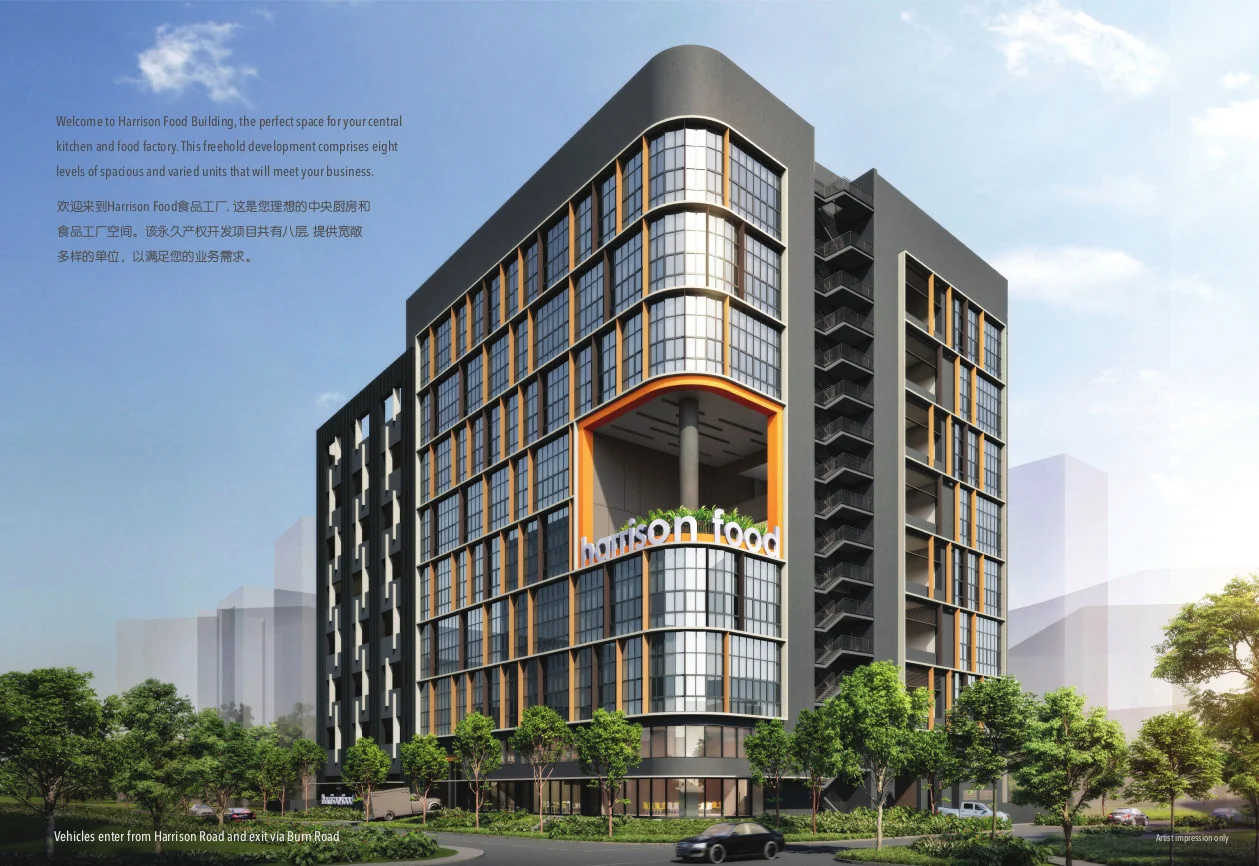
Harrison Food Building Singapore emerges as a premier asset.2 It is a rare freehold development in central Singapore.2
This project addresses the acute shortage of modern food spaces.3 Singapore currently imports over 90 percent of its food.4
This high import reliance creates severe national vulnerabilities.5 Global supply chain disruptions frequently impact the nation.
Climate change further exacerbates these critical food supply risks.6 Consequently, the government launched the ambitious 30 by 30 initiative.4
This policy aims to produce 30 percent of food locally.7 This mandate fundamentally alters the industrial real estate landscape.1 It drives unprecedented demand for high-specification food processing facilities.8
Technological disruption also redefines the local food production sector.1 Automation and smart manufacturing require specialized physical infrastructure.9
Older industrial units cannot support these advanced technological requirements. Modern food factories provide the necessary power and configurations.10
Therefore, purpose-built facilities are absolutely essential for future growth. They bridge the gap between policy and operational reality.
Macro Drivers of Local Food Production
Several macroeconomic factors propel the local food manufacturing sector. Population growth steadily increases overall baseline food consumption.8
Urbanization rapidly accelerates the demand for modern convenience foods.7 Ready-to-eat (RTE) meals are seeing rapid local market expansion.11 The RTE food market will grow substantially by 2030.11
It will expand by USD 128.2 million from 2026.11 This represents a steady 2.5 percent annual growth rate.11
Central kitchens are essential to support this expanding sub-sector.8 Moreover, shifting dietary preferences drive rapid F&B sector growth.8
Singapore currently hosts over 40,200 food establishments.8 Rising operational costs force these businesses to optimize workflows. Centralized food preparation offers massive operational cost efficiencies.3
Consequently, restaurants increasingly outsource prep work to central kitchens.
Enterprise Singapore actively encourages this food centralization trend.3 The FoodX Programme matches companies with expert contract manufacturers.3
This boosts the utilization of dedicated food factory spaces.3 High demand ensures these industrial assets remain highly profitable.
The Rapid Evolution of Cloud Kitchens
Cloud kitchens represent another massive real estate demand driver. This delivery-focused segment is growing at an incredible pace.12
Revenue will grow at a 20.05 percent CAGR through 2031.12 Traditional retail spaces are often unsuitable for cloud kitchens. They lack the necessary heavy exhaust and grease infrastructure.
Industrial food factories perfectly accommodate these intensive daily operations.2 Harrison Food Building Singapore is explicitly designed for this. Its B2 zoning allows for heavy cooking and processing.13
Consequently, operators can maximize their delivery output effortlessly. The building’s ramp-up design further aids rapid food dispatch.2 Delivery drivers can reach units quickly without delay.10
Strata-Titled Food Factories: Market Dynamics
The strata-titled food factory market exhibits uniquely strong fundamentals. Supply remains structurally constrained across the entire island.3 JLL research from Q4 2025 provides crucial market data.3
There are only about 1,200 completed strata food units.3 Freehold units comprise only one-third of this total stock.3 This makes freehold assets exceptionally rare and highly coveted.
Future supply projections reinforce this strict scarcity narrative. The market will add only 500 new units by 2028.3 The islandwide stock will barely exceed 1,700 units total.3
Most upcoming developments are relatively small in physical scale.3 Harrison Food Building contributes just 42 units here.14 Food Point at Tai Seng adds only 47 units.3 This limited supply ensures high occupancy and rental resilience.
Investment Appeal and Tax Advantages
Strata food factories offer compelling advantages for property investors. Residential property investments face punitive tax structures in Singapore. The Additional Buyer’s Stamp Duty deters many residential investors.15
Conversely, commercial and industrial properties carry zero ABSD.15 This exemption applies to citizens, residents, and foreign entities.15
Furthermore, industrial properties avoid the strict Mortgage Servicing Ratio.15 Buyers only need to meet the Total Debt Servicing Ratio.15
This looser financing framework greatly enhances total purchasing power. Foreign investors face no restrictions when buying industrial properties.16 Harrison Food Building actively targets this lucrative global demographic.2
Capital Appreciation and High Rental Yields
Industrial real estate provides highly stable recurring income streams. Typical gross rental yields range between 2.5 and 4.0 percent.15
Food factories often secure long-term leases from established operators. Moving a specialized central kitchen involves massive capital expenditure. Therefore, tenant retention rates are exceptionally high in this sector.
Capital appreciation prospects are equally promising for freehold assets. Freehold tenure ensures total protection against costly lease decay.2 It guarantees long-term value retention across generational holding periods.2
Historical transaction data confirms this strong upward pricing trajectory. Recent industrial market data shows highly resilient capital value growth.17 Warehouse and factory rents recorded 20 consecutive quarters of growth.17
B1 Versus B2 Industrial Zoning
Understanding Singapore’s complex urban zoning laws is absolutely critical. The Urban Redevelopment Authority strictly regulates all industrial land.18
Industrial properties fall into Business 1 or Business 2 categories.19 The distinction dictates the permissible operational scope for tenants.19
Regulatory Parameters of B1 Zones
B1 zones accommodate light and clean industrial commercial activities.20 These businesses must always have minimal environmental impact.21
Typical uses include software development, light assembly, and warehousing.22 B1 food factories are restricted to light packaging.13 They cannot support heavy cooking or massive manufacturing operations.13
The National Environment Agency enforces a strict nuisance buffer.23 A 50-meter buffer separates B1 zones from residential areas.22
Because of their low impact, B1 buildings sit near towns.23 Consequently, their operational flexibility is somewhat permanently limited.
Operational Superiority of B2 Zones
B2 zones permit general and significantly heavier industrial operations.20 They accommodate activities that generate moderate to high impacts.19
Heavy manufacturing, metalwork, and intensive food production require B2.19 B2 food factories perfectly support massive central kitchens.13 They feature specialized infrastructure like high-capacity exhaust systems.13
The NEA mandates a larger 100-meter nuisance buffer here.23 Consequently, B2 properties sit in dedicated heavy industrial estates.23
Harrison Food Building Singapore benefits immensely from its B2 classification.24 It allows tenants to run unrestricted, high-volume central kitchens.24 This broadens the potential tenant pool significantly for landlords.13
Both zones follow the strict URA 60:40 usage rule.23 At least 60 percent of space serves core industrial uses.23
A maximum of 40 percent can support ancillary uses.23 Ancillary uses include offices, showrooms, and industrial canteens.23 Harrison Food Building strictly complies with these regulatory ratios.25
B1 and B2 Zoning Specifications Comparison
| Feature | B1 Industrial Space | B2 Space (Harrison Food) |
| Allowed Activities | Light, clean industries, packaging | Heavy processing, kitchens |
| Environmental Impact | Low emissions, minimal noise | Moderate to high impact |
| Location Profile | Near residential/commercial | Designated heavy industrial |
| NEA Nuisance Buffer | 50 meters | 100 meters |
| URA Usage Rule | 60% Core / 40% Ancillary | 60% Core / 40% Ancillary |
| Required Infrastructure | Basic electrical, ventilation | Heavy power, dedicated exhaust |
The Tai Seng Precinct: An Elite Hub
Location is paramount in successful industrial real estate investment. Harrison Food Building sits at 7 and 9 Harrison Road.26
This is within the highly coveted District 13 Tai Seng enclave.26 Tai Seng possesses a rich industrial history in Singapore.27 It evolved rapidly after the Paya Lebar Airport opened.27 Today, it is an elite hub for multinational corporations.27
Logistics and Supply Chain Connectivity
Tai Seng offers unparalleled logistical advantages for food manufacturers. The entire area connects seamlessly to major national expressways.28
The Pan-Island Expressway and Kallang-Paya Lebar Expressway are adjacent.29 The Central Expressway is also easily and quickly accessible.28 This network enables rapid islandwide distribution of perishable products.30
Speed to market is a critical metric for food delivery.31 Tai Seng’s central location drastically cuts last-mile delivery times.32
Operators can swiftly service nearby mature housing estates easily.31 They can also seamlessly reach the dense central business district.
Public transportation connectivity is equally impressive for staff access. Harrison Food Building is near Tai Seng MRT station.2 The Circle Line provides excellent access for the industrial workforce.28
Recruiting and retaining staff is notoriously difficult in F&B. Proximity to an MRT station gives employers a competitive advantage.28
Agglomeration Economies and Peer Synergy
Tai Seng forms a natural agglomeration of major brands. BreadTalk IHQ is a prominent, well-known landmark here.33
Jumbo Group and Sakae Holdings maintain significant operational footprints.34 This incredible clustering effect generates immense value for new entrants.32 It readily attracts specialized logistics providers to the immediate area.
Furthermore, it fosters a robust ecosystem of B2B services. Harrison Food Building tenants will instantly integrate into this network.
They can easily source raw materials from neighboring suppliers. This proximity reduces transportation costs and carbon emissions significantly. Industrial synergy is a tangible financial asset in Tai Seng.
The Paya Lebar Airbase Redevelopment Catalyst
The future trajectory of Tai Seng is incredibly promising. The impending relocation of Paya Lebar Airbase is massive.35 This represents Singapore’s most significant modern urban transformation project.35
The military airbase will move to Changi in the 2030s.36 This monumental shift frees up 800 hectares of prime land.37 To provide context, this equals five Toa Payoh towns.35
Rejuvenation and Infrastructure Enhancements
The government plans to build 150,000 new homes here.37 This influx of residents creates a massive captive consumer market.31
Tai Seng food businesses will benefit directly from localized demand. Furthermore, the redevelopment integrates commercial and premium lifestyle amenities.38 It will fully transform the eastern corridor into a metropolis.35
Urban Redevelopment Authority strategies guide this massive PLAB redevelopment.39 The core strategies involve creating, stitching, and leveraging spaces.39
They aim to build self-sustaining, future-ready, community-centric neighborhoods.39 Transport, green, and blue networks will effectively stitch communities together.39 Heritage elements, like old runways, will be cleverly preserved.39
Crucially, the relocation entirely eliminates strict aviation height restrictions.36 Current buildings in Tai Seng are limited in vertical expansion.37 The removal of these limits will unlock massive land value.36
Masterplan plot ratios will likely face significant upward revisions.40 Existing property owners will see immense capital appreciation soon.40 Freehold assets like Harrison Food Building capture maximum developmental upside.
PLQ and Bidadari Transformation Synergy
The nearby Bidadari estate transformation provides another immediate vector.31 Bidadari is rapidly developing into a lush, modern community hub.31
It features beautiful new public and private housing developments.31 This incredible transformation enhances the overall liveability of the district.31
Additionally, Paya Lebar Quarter (PLQ) adds immense commercial value.41 Lendlease developed this heavily integrated mixed-use commercial and retail precinct.41 It connects directly to the Paya Lebar MRT interchange station.41
The presence of PLQ elevates the entire sub-regional commercial hub. It solidifies Tai Seng’s position as a premium city-fringe location.
Technical Specifications of Harrison Food Building
Harrison Food Building sets a new benchmark for factory design. The esteemed developer brings immense technical expertise to this project.26 Powermatic Data Systems Ltd boasts a truly exceptional track record.24
The development replaces the older Harrison Industrial Building entirely.30 It leverages a very rare freehold land plot effectively.26
Architectural Design and Unit Configuration
The building is an eight-storey, fully ramp-up industrial facility.14 It comprises exactly 42 highly optimized strata factory units.26
It also includes one ancillary industrial canteen on the ground.14 Ramp-up access is a highly game-changing architectural feature here.2 It allows delivery trucks to drive directly to unit entrances.42
This brilliantly eliminates reliance on slow communal goods lifts. Consequently, it completely prevents bottlenecks during peak daily operational hours.10
This direct loading and unloading capability maximizes vital logistical efficiency.2 Time saved on logistics translates directly to higher operational margins.
The expansive floor plates range from 1,709 to 2,490 sqft.30 These spacious layouts offer incredible flexibility for food operators.2
Businesses can customize zones for hot kitchens and cold storage.16 The modular wall design allows for easy unit amalgamation.43 Investors can combine adjacent units to create massive floor plates.43
Unit Distribution by Floor Level
| Floor Level | Unit Size Range (sqft) | Total Units per Floor |
| 1st Floor | 1,709 – 2,490 | 3 Units |
| 2nd & 3rd Floor | 1,709 – 2,490 | 6 Units per Floor |
| 4th & 5th Floor | 1,709 – 2,490 | 5 Units per Floor |
| 6th to 8th Floor | 1,709 – 2,490 | 6 Units per Floor |
Engineering and Heavy Infrastructure Capacities
Modern food production completely relies on robust engineering infrastructure. Harrison Food Building excels in this highly critical operational dimension. The ceiling heights provided are exceptionally generous and functional.14
The first and eighth floors boast towering 6.65-meter ceilings.30 The second through seventh floors feature impressive 5.07-meter ceilings.30
These heights easily accommodate massive racking systems and machinery.30 They also beautifully allow for the installation of mezzanine offices.2
Electrical supply is equally critical for heavy commercial kitchen equipment. The first floor provides massive 125 Amp, 3-phase power.30 The upper floors deliver consistent 100 Amp, 3-phase power.30
This robust electrical supply powers commercial blast chillers and ovens. Floor loading capacity is uniformly engineered at 12.5 kN/m2.30
This safely supports the immense weight of food processing machinery. It also handles dense, heavy raw material storage extremely safely.30
The internal floor units cleverly feature a 100mm sunken design.44 This specific, thoughtful feature prevents water runoff into common corridors.44
Daily washdowns are standard practice in food manufacturing facilities. Thus, this design drastically reduces accidental workplace slip hazards.
Specialized Food Industry Provisions
The developer smartly integrated essential food industry features directly. Every single unit includes a dedicated kitchen exhaust duct system.44
This shaft vents directly and safely to the building’s roof.44 This prevents dangerous odor accumulation within the facility entirely. It complies strictly with all stringent NEA environmental air regulations.
Furthermore, the building provides pre-installed sampling sumps and traps.2 Proper grease waste management is strictly mandatory for commercial kitchens.2
Town gas piping is seamlessly integrated into the facility infrastructure.2 This provides efficient, high-heat cooking energy for heavy production requirements.
The building features three dedicated lifts for optimized vertical traffic.30 They intelligently separate regular passenger traffic from heavy service traffic.30
Developer Profile: Powermatic Data Systems Ltd
The pedigree of the developer strongly influences industrial property quality. Powermatic Data Systems Ltd is an SGX mainboard-listed company.24
They possess over 30 years of deep technological manufacturing experience.24 Interestingly, their primary historical expertise lies in wireless connectivity devices.45 They are an officially appointed Qualcomm Authorized Design Centre.45
Despite their technology focus, they possess substantial real estate acumen. Their wireless business drives the vast majority of their profits.46
In 2023, wireless net profits reached S$9.44 million.46 This represented 99.5 percent of total consolidated group net profits.46 However, their property business consistently provides stable supplementary income streams.46
The developer holds a strong, established shareholder dividend track record.47 They regularly pay a final DPS of S$0.05 to shareholders.47 They own the two-adjoining six-storey semi-detached buildings at Harrison Road.48
This site is now the foundation for Harrison Food Building.48 Their robust financial health ensures the development will complete successfully. Buyers face minimal completion risks when purchasing from Powermatic Data.
Regulatory Compliance for Singapore Food Factories
Operating a central kitchen in Singapore requires incredibly strict compliance. The Singapore Food Agency (SFA) enforces rigorous, uncompromising licensing standards.49
Designing a compliant facility is inherently complex and capital-intensive. Harrison Food Building’s structural design drastically simplifies this licensing process.
Facility Design and Workflow Optimization Rules
SFA firmly mandates highly precise factory layout and workflow configurations.50 Food workflow must proceed linearly with absolutely minimal criss-crossing.50
This straight-line flow prevents dangerous cross-contamination between raw ingredients.50 The spacious, modular units at Harrison easily accommodate these rules.10
Kitchen surfaces must be easily sanitized, smooth, and highly durable.50 Construction materials cannot ever transmit undesirable substances to the food.50
Adequate physical separation is legally required between conflicting manufacturing operations.50 The high ceilings permit advanced vertical partition and storage installations.10
Specialized Vending and Mobile Food Regulations
SFA regulations also govern off-site food distribution and mobile sales. Mobile Food Wagons require a licensed backup central kitchen facility.51
This is needed for daily wastewater disposal and water top-ups.51 Harrison Food Building units are perfect as these backup kitchens.
Additionally, vending machine food must originate from licensed central kitchens.51 The sale of food from unlicensed premises is strictly prohibited.51
As automated vending expands, demand for licensed prep kitchens rises. Harrison’s central location makes it ideal for servicing vending networks.
Cold Chain and Storage Safety Requirements
Temperature control is absolutely paramount for maintaining public food safety. SFA regulations strictly and aggressively monitor cold chain logistics networks.52
Chilled and frozen foods must never break designated temperature thresholds.53 Frozen food must be carefully thawed in chillers under 4°C.52
Harrison’s heavy electrical loads easily support massive commercial cold rooms.33 The ramp-up access ensures refrigerated trucks minimize ambient exposure times.2
Ingredients remain perfectly safe during rapid loading and unloading procedures.
Environmental Health: Waste and Pest Control
Proper waste management is a deeply critical SFA licensing condition. Refuse disposal systems must be completely isolated from production areas.50
Wastes must be removed promptly in sealed, tight-fitting industrial receptacles.50 The facility must legally employ highly proactive pest control mechanisms.50 Building openings must be properly screened to prevent vermin entry.50
Furthermore, the NEA dictates strict trade waste and effluent rules.54 Wastewater cannot flow freely into natural watercourses or public drains.54 Developers must avoid architectural features that cause stagnant water pooling.54
Stagnant water breeds mosquitoes, violating basic environmental health safety laws.54 Harrison Food Building’s intelligent sunken floor design mitigates these risks.44
Sustainability and Green Building Standards
Environmental sustainability is no longer optional in modern industrial real estate. The Building and Construction Authority leads Singapore’s vital green transition.55
The Green Mark Certification Scheme rigorously evaluates a building’s performance.55 Singapore ambitiously aims to green 80 percent of its buildings.56
Energy Efficiency and Masterplan Integration
Industrial properties historically consume massive amounts of raw energy.56 Harrison Food Building incorporates passive and active energy-efficient modern designs. Natural lighting streams generously through expansive curtain-wall glass facades.24
This brilliantly reduces reliance on artificial lighting during daytime operations.24 Energy-efficient ventilation systems actively minimize total facility electricity consumption.24
Efficient chiller and exhaust systems are critical for green certification.57 The building’s design facilitates the installation of highly efficient equipment.57
Singapore’s Zero Waste Masterplan introduces even broader national environmental goals.58 The government aims to reduce landfill waste by 30 percent.58
This masterplan builds climate resilience, resource resilience, and economic resilience.58 Food manufacturers are heavily encouraged to adopt waste valorization technologies.59
Modern facilities easily support the installation of advanced commercial bio-digesters. The robust infrastructure at Harrison allows companies to deploy these effectively.
Corporate Well-being and Lifestyle Amenities
Modern industrial spaces must actively support overall human well-being. Harrison Food Building thoughtfully integrates highly valuable corporate lifestyle features.24
A dedicated ground-floor canteen provides immediate dining convenience for staff.42 Employees absolutely do not need to leave the premises daily.42 This saves immense time and boosts overall daily workplace productivity.
Additionally, the brilliant development features an idyllic, lush sky terrace.42 This provides a beautiful, tranquil space for staff relaxation activities.24
It serves as an absolutely excellent venue for informal meetings.42 These incredible corporate lifestyle amenities elevate Harrison Food Building significantly.42 It stands far above traditional, sterile, and boring industrial factories.
Comprehensive Competitor Analysis
Evaluating Harrison Food Building requires benchmarking against key peer developments. The strata food factory market currently features several high-profile projects. Key competitors include Food Point, CT FoodNex, and Smart Food.15
Comparative Pricing Dynamics and Valuation
Harrison Food Building offers a highly competitive and attractive price. Units start from approximately $2.8 million for upper floors.30
Per square foot (PSF) pricing begins around a reasonable $1,7xx.43 First-floor units naturally command a premium, starting from $4.8 million.43 This translates to roughly $2,9xx PSF for prime ground access.43
Historically, central food factories exhibit incredibly strong price appreciation trends. Older 30-year leasehold properties in Tuas sold for $366 PSF.60
Better-located Sembawang leasehold assets reached a notable $648 PSF.60 Freehold properties in central locations naturally command vast pricing premiums.12
Gourmet Xchange in Kallang recently launched from $2.3 million.12 However, Gourmet Xchange is merely a leasehold B2 strata facility.12
The site was purchased by CapitaLand for $368.9 million.12 Given its rare freehold status, Harrison Food Building presents exceptional value.
JTC Food Hub at Senoko Comparison
Government-backed facilities like JTC Food Hub @ Senoko offer alternatives.61 The Senoko hub features massive, flexible modular units of 1,100 sqm.61
Rent is priced competitively at approximately $24.09 per square meter.61 However, these JTC units are strictly for leasing, not ownership.61
Furthermore, JTC imposes incredibly strict tenant eligibility and usage criteria.25 Tenants face complex sub-letting rules and assignment prohibition periods.34
Purchasing a strata-titled unit like Harrison grants total operational freedom. Owners can freely lease, sell, or modify their private property.
Competitor Benchmarking Matrix
| Development Name | Location District | Tenure | Total Units | Ramp-Up Access |
| Harrison Food Building | D13 (Tai Seng) | Freehold | 42 | Yes (Up to Level 8) |
| Food Point @ Tai Seng | D13 (Tai Seng) | Freehold | 47 | Limited/None |
| CT FoodNex | D25 (Mandai) | Freehold | 109 | Yes |
| Smart Food @ Mandai | D25 (Mandai) | Freehold | 84 | Yes |
| Gourmet Xchange | D14 (Kallang) | Leasehold | 263 | Variable |
| JTC Food Hub | D27 (Senoko) | Lease Only | Variable | Yes |
Harrison Food Building clearly stands out for its city-fringe location. The Mandai developments are located far north of the city.31
They fundamentally serve a different logistical demographic and supply chain. Food Point @ Tai Seng is a direct, local freehold competitor.28 However, Harrison Food Building’s comprehensive ramp-up design provides superior throughput.31
Broader Market Trends and Digital Transformation
The local food manufacturing industry is actively expanding its global reach. Enterprise Singapore strongly supports local brands targeting massive overseas markets.62
China represents the world’s largest food and beverage consumer market.62 Singapore’s stellar reputation for strict food safety aids this expansion.62
Expansion into China and Indonesia
Chinese consumers increasingly demand premium, healthy food from reputable sources.62 Fresh food e-commerce in China is booming at unprecedented rates.62
Trade volume increased to an incredible 140 billion yuan recently.62 Local Singaporean factories export high volumes to meet this demand.
Similarly, Indonesia presents a massive, geographically proximate export market opportunity.62 Indonesia boasts a massive population exceeding 283.5 million people.62
Rising affluence fuels rapid consumption of modern, packaged convenience foods.62 Modern food factories in Singapore function as critical regional export hubs. Harrison Food Building provides the perfect base for such international ambitions.
Industry Digital Plan (IDP) Integration
Digital transformation is currently sweeping the Singaporean food manufacturing sector. Enterprise Singapore and IMDA launched the Food Manufacturing Industry Digital Plan.9
This initiative guides over 1,500 food manufacturers on digital transformation.9 Today, over 90 percent of businesses have adopted digital solutions.9
The IDP focuses heavily on digitalizing highly tedious administrative processes.9 It champions the adoption of Integrated Enterprise Resource Planning systems.9 It also promotes advanced artificial intelligence for optimizing complex manufacturing.9
Modern factories must support the IT infrastructure required for these systems. Harrison Food Building’s modern design easily integrates these advanced digital networks.
Investment Viability and Yield Projections
The macroeconomic outlook for Singapore’s food factory market is exceptional. Investors in Harrison Food Building definitively secure a highly defensive asset.
Food consumption logically remains resilient regardless of broader economic volatility. Consequently, demand for central kitchens provides incredible, reliable revenue consistency.
Favorable Supply-Demand Imbalances
The islandwide supply of strata food factories remains severely limited.3 Meanwhile, the government’s 30 by 30 initiative continuously fuels demand.4 This fundamental supply-demand imbalance guarantees incredibly strong pricing power.17
Rental reversions are fully expected to remain positive for years.17 Furthermore, the lack of new freehold land releases ensures absolute scarcity.2
Strategic Capital Deployment
Zero ABSD makes strata food factories a superior investment vehicle.15 Foreign investors and local family offices increasingly target this specific sector.15
They aggressively seek hard assets in politically stable jurisdictions like Singapore.15 The expected TOP in March 2027 provides a very clear timeline.26
Rental yields of 2.5 to 4.0 percent easily outpace residential averages.15 The versatile B2 zoning expands the potential tenant base significantly.13
A landlord can rapidly pivot between catering, manufacturing, or logistics tenants. This incredible versatility dramatically lowers long-term portfolio vacancy risks.
Strategic Outlook and Concluding Perspectives
Singapore’s industrial property landscape is experiencing a massive definitive paradigm shift. The integration of technology, food security, and redevelopment drives this.
Harrison Food Building sits perfectly at the intersection of these megatrends.
The relocation of Paya Lebar Airbase acts as a growth engine.35 The subsequent removal of height restrictions will unlock immense value.36
Tai Seng will quickly transform into a globally recognized commercial hub.63 Properties secured today will benefit immensely from decades of localized gentrification.
Harrison Food Building’s freehold status ensures perpetual, unmatched value preservation.2 Its fully ramp-up design, B2 zoning, and electrical capacity are flawless.14
For sophisticated investors and operators, it represents an unmissable strategic acquisition. It is a cornerstone asset in Singapore’s rapidly evolving food infrastructure. The property promises sustained operational excellence and superior capital appreciation.
Works cited
- Feeding the Future: Growth, Resilience, and Innovation in Singapore’s Food Factory Sector, accessed April 8, 2026, https://www.savills.co.nz/blog/article/225659/singapore-articles/feeding-the-future–growth–resilience–and-innovation-in-singapore-s-food-factory-sector.aspx
- Food Factory @ Harrison Road: Freehold, Near Tai Seng MRT – MySgProp, accessed April 8, 2026, https://www.mysgprop.com/harrison-food-factory/
- Singapore’s strata food factory prospects remain sound – JLL, accessed April 8, 2026, https://www.jll.com/en-au/insights/singapore-strata-food-factory-prospects-remain-sound
- Food for Thought | A sustainable food system for Singapore and beyond, accessed April 8, 2026, https://www.sfa.gov.sg/food-for-thought/article/detail/a-sustainable-food-system-for-singapore-and-beyond
- Safeguarding sustenance: Singapore’s strategic commitment to enhancing food security through advancing food research and innovation – PMC, accessed April 8, 2026, https://pmc.ncbi.nlm.nih.gov/articles/PMC12444370/
- WHAT SINGAPORE’S ’30 BY 30′ FOOD SECURITY GOAL MEANS FOR BUSINESSES – Ecosperity, accessed April 8, 2026, https://www.ecosperity.sg/content/dam/ecosperity-aem/en/reports/What-Singapore%27s-30-by-30-food-security-goal-means-for-businesses_Jan2020.pdf
- Singapore Food Processing Market Size and Industry Outlook 2026-2034 | Get Sample Report – Market Research – Global Risk Community, accessed April 8, 2026, https://globalriskcommunity.com/market_research/singapore-food-processing-market-size-and-industry-outlook-2026-2
- Food Factories in Singapore: Discovering Where Your Next Meal Could Come From, accessed April 8, 2026, https://www.era.com.sg/blogs/food-factory-why-invest
- Refreshed Industry Digital Plan to support food manufacturers | IMDA, accessed April 8, 2026, https://www.imda.gov.sg/resources/press-releases-factsheets-and-speeches/factsheets/2026/refreshed-idp-support-food-manufacturers-accelerating-technology-adoption
- Food Central Food Factory Official 2026 | By Capitaland, accessed April 8, 2026, https://www.food-central.net/
- Singapore Ready-to-eat (RTE) Food Market Analysis, Size, and Forecast 2026-2030, accessed April 8, 2026, https://www.technavio.com/report/singapore-ready-to-eat-food-market-analysis
- A Rare Freehold Food Factory Is On Sale For $38M — What Else Is Selling In Kallang?, accessed April 8, 2026, https://stackedhomes.com/freehold-food-factory-genting-road-38-million/
- B1 Versus B2 Food Factory Singapore – Smart Food @ Mandai, accessed April 8, 2026, https://www.smartfoodmandai.net/b1-versus-b2-food-factory-singapore/
- Harrison Food Building Food Factory 2026 | By Powermatics, accessed April 8, 2026, https://www.harrisonfoodbuilding.com/
- Food Factories 101: Singapore’s Sustainable Investment Alternative | PropertyNet.SG, accessed April 8, 2026, https://propertynet.sg/food-factories-101-singapores-sustainable-future/
- Food Point @ Tai Seng | FREEHOLD 12-Storey B1 Ramp Up Food Factory | 50 Playfair Road | Straits Industrialists, accessed April 8, 2026, https://www.straitsindustrialists.sg/food-point
- JTC Q3 2025 Commentary | SG – Cushman & Wakefield, accessed April 8, 2026, https://www.cushmanwakefield.com/en/singapore/insights/jtc-q3-2025-commentary
- Industrial Property Classes and What They Mean For Investors – DBS, accessed April 8, 2026, https://www.dbs.com.sg/personal/articles/nav/my-home/industrial-property-classes
- Different type of industrial space namely B1 and B2, but what’s the different between both of them in Singapore? – EDDY WONG, accessed April 8, 2026, https://www.wongeddy.com/post/different-type-of-industrial-space-namely-b1-and-b2-but-what-s-the-different-between-both-of-them-i
- How Master Plan 2025 is reshaping SG’s industrial landscape – JLL, accessed April 8, 2026, https://www.jll.com/en-au/insights/how-master-plan-2025-is-reshaping-sgs-industrial-landscape
- B1 Industrial Property Classification Singapore, Trades Allowable, accessed April 8, 2026, https://cosysingapore.com/b1-industrial-classification/
- A Primer in Understanding B1 and B2 Industrial Properties in Singapore, accessed April 8, 2026, https://www.officefactoryfinder.com/2024/05/15/a-primer-in-understanding-b1-and-b2-industrial-properties-in-singapore/
- B1 vs B2 Industrial Zones Difference per URA Guidelines, accessed April 8, 2026, https://spacelookup.com.sg/ura-b1-vs-b2-zones-difference/
- Harrison Food Building: Own a freehold, new generation food factory in central Singapore, accessed April 8, 2026, https://www.edgeprop.sg/property-news/harrison-food-building-own-freehold-new-generation-food-factory-central-singapore
- Tai Seng Avenue Terrace Workshops – Singapore – JTC, accessed April 8, 2026, https://www.jtc.gov.sg/find-space/tai-seng-avenue-terrace-workshops
- Fact Sheet – Harrison Food Building, accessed April 8, 2026, https://harrisonfoodfactory.singaporenewlaunches.sg/fact-sheet
- Once Upon A Tai Seng Village – NUS, accessed April 8, 2026, https://nus.edu.sg/nuslibraries/whats-on-listing/news/2021/03/08/once-upon-a-tai-seng-village
- Why Commercial Kitchens Are the Next Big Asset Class in Singapore: Food Point @ Tai Seng – PropertyGuru, accessed April 8, 2026, https://www.propertyguru.com.sg/property-guides/food-point-tai-seng-freehold-best-food-factory-singapore-97485
- 18 Tai Seng – Singapore – Mapletree Industrial Trust, accessed April 8, 2026, https://www.mapletreeindustrialtrust.com/property/18-tai-seng/
- Harrison Food Building Official 2026 | Tai Seng Food Factory, accessed April 8, 2026, https://www.harrison-food.com/
- Harrison Food Factory set to launch 2nd Half 2024, accessed April 8, 2026, https://www.harrison-food.com/harrison-food-factory-set-to-launch-2nd-half-2024/
- Old Buildings, New Concept: Reimagining Food Production at the Heart of Singapore, accessed April 8, 2026, https://www.era.com.sg/blogs/old-buildings-new-concept-reimagining-food-production-at-the-heart-of-singapore
- Developers find hope in strata-titled food factories as investor appetite grows – Singapore Property News – EdgeProp, accessed April 8, 2026, https://www.edgeprop.sg/property-news/developers-find-hope-strata-titled-food-factories-investor-appetite-grows
- Jumbo Group to potentially acquire 30% leasehold interest in Tai Seng Street property from Boustead Industrial Fund – Singapore Property News – EdgeProp, accessed April 8, 2026, https://www.edgeprop.sg/property-news/jumbo-group-boustead-industrial-fund-form-jv-potential-purchase-tai-seng-street-industrial-property
- Civil & Structural Opportunities in Paya Lebar, Singapore, accessed April 8, 2026, https://structures.com.sg/civil-structural-opportunities-singapore-next-metropolis/
- Boustead Fund Acquires Singapore Industrial Building For $75M – Mingtiandi, accessed April 8, 2026, https://www.mingtiandi.com/real-estate/finance/boustead-fund-acquires-singapore-industrial-building-for-75m/
- Relocation of Paya Lebar Airbase: Impact on Lorong Chuan – Joyce Tai Property, accessed April 8, 2026, https://www.joycetaiproperty.sg/lorong-chuan/relocation-of-paya-lebar-airbase-lorong-chuan/
- How will the Paya Lebar Air Base be redeveloped | Singapore Business Review, accessed April 8, 2026, https://sbr.com.sg/commercial-property/news/how-will-paya-lebar-air-base-be-redeveloped
- Paya Lebar Air Base – URA Master Plan, accessed April 8, 2026, https://www.uradraftmasterplan.gov.sg/regional-plans/east/paya-lebar-air-base/
- Redevelopment plans for Paya Lebar Air Base met with enthusiasm – The Business Times, accessed April 8, 2026, https://www.businesstimes.com.sg/property/redevelopment-plans-paya-lebar-air-base-met-enthusiasm
- Paya Lebar Quarter, Singapore – Lendlease, accessed April 8, 2026, https://www.lendlease.com/sg/projects/paya-lebar-quarter/
- Harrison Food Site Plan and Facilities, accessed April 8, 2026, https://harrisonfood.sg/facilities
- Harrison Food Building Price | Claim Your VVIP Disscount, accessed April 8, 2026, https://www.harrisonfoodbuilding.com/price/
- 7 Harrison Rd 050824.ai – Harrison Food Building, accessed April 8, 2026, https://www.harrison-food.com/wp-content/uploads/2024/08/Harrison-Food-Building-Brochure.pdf
- Powermatic Data Systems Ltd – Powermatic Corporate website, accessed April 8, 2026, https://www.powermatic.com.sg/
- POWERMATIC DATA SYSTEMS LIMITED – Singapore Exchange, accessed April 8, 2026, https://links.sgx.com/1.0.0/corporate-announcements/WFEA8YG2IWSO0OND/782091_PMD-Circular_Proposed_Redevelopment.pdf
- Powermatic Data Systems Limited – Amazon S3, accessed April 8, 2026, https://s3-ap-southeast-1.amazonaws.com/investingnote-production-webbucket/attachments/8748465bbc2bac891c13baffef681e8a2d72ba02.pdf?1520309063
- ANNUAL REPORT 2025 – Singapore – Powermatic Data Systems Ltd, accessed April 8, 2026, https://www.powermatic.com.sg/wp-content/uploads/2025/07/Powermatic-Data-System-Ltd_Annual-Report-2025.pdf
- Ultimate Guide to Obtaining an SFA Licensed Kitchen in Singapore, accessed April 8, 2026, https://www.smartcitykitchens.com/blog/ultimate-guide-to-an-sfa-licensed-kitchen/
- CONDITIONS OF LICENSING FOR FOOD ESTABLISHMENTS, accessed April 8, 2026, https://www.sfa.gov.sg/docs/default-source/food-manufacturing-and-storage/sfa-conditions-of-licensing_food-establishments.pdf
- Requirements for Licence / Permit for Food Retail – Singapore Food Agency, accessed April 8, 2026, https://www.sfa.gov.sg/food-retail/licence-permit/requirements-for-licence-permit-for-food-retail
- 06 Dec 2024 To: Food Business Operators ADOPTING GOOD FOOD SAFETY AND PERSONAL HYGIENE PRACTICES The Singapore Food Agency (SFA), accessed April 8, 2026, https://www.sfa.gov.sg/docs/default-source/circulars/others/2024/advisory-on-food-safety-practices-for-food-establishments_dec-24.pdf
- Food Safety Tips – Singapore Food Agency, accessed April 8, 2026, https://www.sfa.gov.sg/food-safety-tips/safe-food-practices/food-safety-tips
- An Industry Guide – Singapore Food Agency, accessed April 8, 2026, https://www.sfa.gov.sg/docs/default-source/food-farming/sfa-farming-guide_fa-spread-high-res.pdf
- Green Mark Certification Scheme | Building and Construction Authority, accessed April 8, 2026, https://www1.bca.gov.sg/sustainability/greenmark/
- Green Building Developments and Opportunities: Singapore | HKTDC Research, accessed April 8, 2026, https://research.hktdc.com/en/article/NDI2MDUyMjk4
- Singapore Greens Existing Buildings through Green Mark Certification, Audit and Benchmarking Legislation Package – C40 Cities, accessed April 8, 2026, https://www.c40.org/case-studies/singapore-greens-existing-buildings-through-green-mark-certification-audit-and-benchmarking-legislation-package/
- Zero Waste Masterplan, accessed April 8, 2026, https://isomer-user-content.by.gov.sg/23/85029cae-9ba1-4144-8a52-26c7f86c04ba/zero-waste-masterplan.pdf
- Food Waste Valorization: Leveraging Singapore’s Zero Waste Master Plan and 30-by-30 Goal – MDPI, accessed April 8, 2026, https://www.mdpi.com/2071-1050/16/17/7321
- List food factory projects in Singapore with profitable transactions in the past 10 years., accessed April 8, 2026, https://buddy.edgeprop.sg/discover/list-food-factory-projects-in-singapore-with-profitable-transactions-in-the-past-10-years-8934654f-d4b6-428e-84c5-7b7aed383aea
- JTC Food Hub @ Senoko – Singapore, accessed April 8, 2026, https://www.jtc.gov.sg/find-space/jtc-food-hub–senoko
- Key Markets | Food Manufacturing – Enterprise Singapore, accessed April 8, 2026, https://www.enterprisesg.gov.sg/industries/food-manufacturing/key-markets
The next chapter in Paya Lebar’s development – Singapore Property News – EdgeProp, accessed April 8, 2026, https://www.edgeprop.sg/property-news/next-chapter-paya-lebar%E2%80%99s-development

